






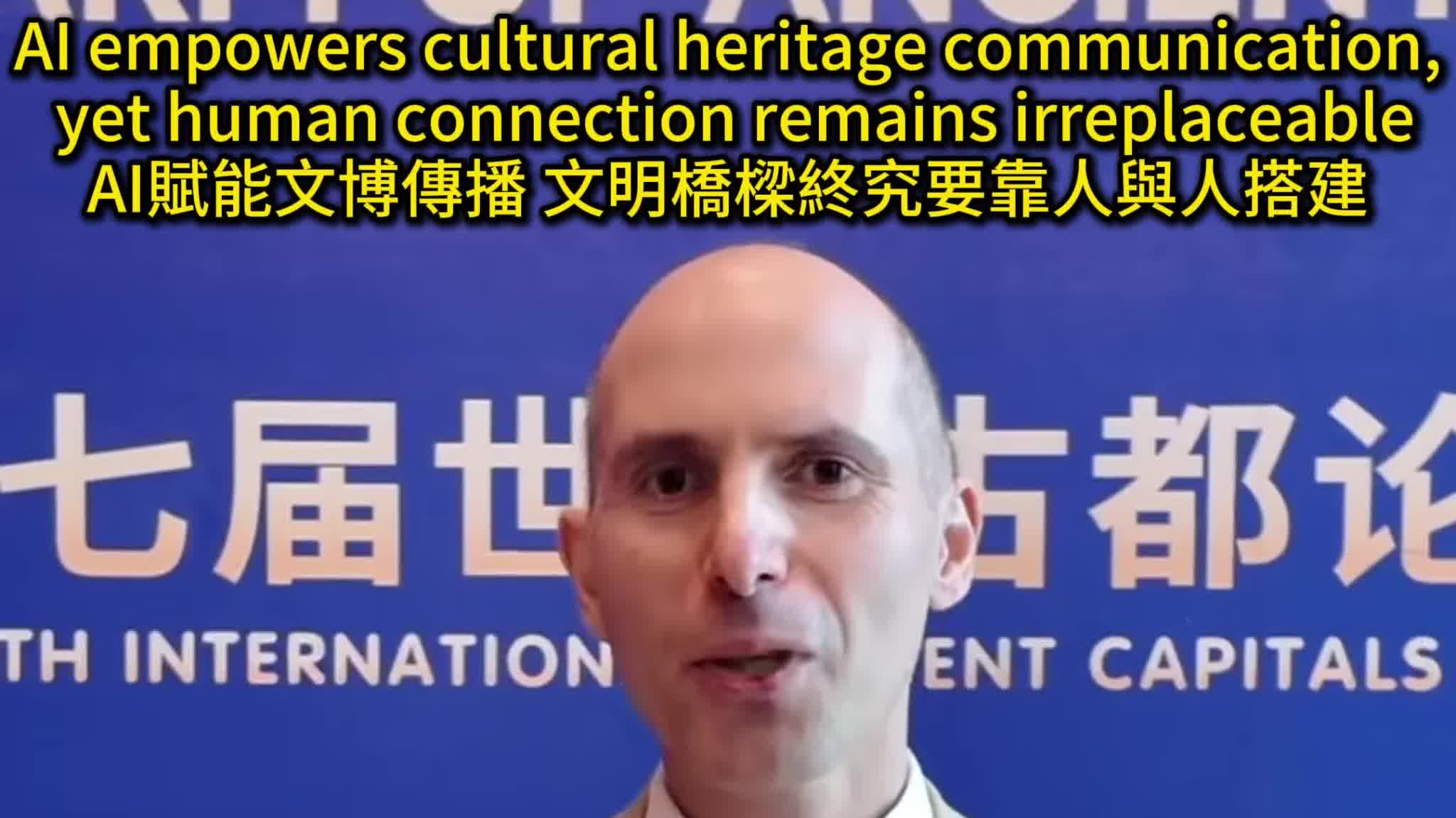
On the sidelines of the 7th World Ancient Capitals Forum, Balázs Barsi, Representative of the Hungarian National Museum in China, sat down for an exclusive interview. Based in Shanghai and a familiar face at major cultural heritage events across China, Barsi shared his insights: while artificial intelligence breaks language barriers and facilitates cultural contextualisation, emotional bonds forged between civilisations cannot be created by technology. Cross-cultural dialogue, at its core, hinges on face-to-face human interaction.
"I have lived in China for 20 years, during a period of extremely rapid development for the country," Barsi began. His work bridges Europe and China. He brings European cultural relic, history and art exhibitions to China, while introducing Chinese history and culture to European audiences to help them gain a deeper understanding of China. What strikes him most is the evolving perspective among Chinese visitors.
"In recent years, I have found Chinese audiences understand Europe much better. Many have travelled to Europe, including my hometown Budapest in Hungary. They have visited and explored the city and built up considerable knowledge of it," Barsi said. Today, cultural demands have moved beyond superficial sightseeing. Art enthusiasts no longer focus merely on individual artists, but seek fuller, more detailed insights into entire eras and art movements. "Therefore, I believe Chinese audiences now have a deeper and broader understanding of Europe, and we can further strengthen cultural exchanges between China and the West."
With years of experience in digital cultural heritage projects in China, Barsi and his team developed the Magic Wall interactive screen system, which has been deployed in museums nationwide to deliver immersive visitor experiences. The advent of the AI era unlocks new opportunities for the sector.
"AI boasts a powerful capability to explain history, art and other knowledge to diverse audiences in tailored ways, with exceptional information summarisation capacity," Barsi explained. Museums are increasingly leveraging AI for interpretation and content synthesis. Beyond simple multilingual translation, AI can facilitate cultural contextual transformation and explain background information of different cultures and civilisations, offering tremendous support for museum digitalisation.
Yet opportunities come with risks. "AI also has limitations. After all, it is not human, and its knowledge can be relatively superficial," he warned. Industry practitioners must guard against over-simplifying rich cultural narratives for the sake of automated AI summaries.
"In cross-cultural exchanges, communication happens between people. This cannot be handed over to AI or technological robots. Our goal is to build bridges and emotional connections between nations and civilisations, and that can only be achieved through human-to-human interaction," Barsi stressed.
Barsi has visited Luoyang many times and says he enjoys every trip. A joint antiquities exhibition co-hosted by the Sui-Tang Grand Canal Museum and the Budapest History Museum has just concluded successfully, marking a remarkable cultural dialogue between the two ancient Eurasian cities.
"My hometown Budapest and Luoyang have just wrapped up this highly successful exhibition exchange. I hope more friends from Luoyang will come to Budapest to visit and explore in person," Barsi said. Speaking of Luoyang, he used a popular local Henan compliment: "Luoyang zhen zhong" (Luoyang is awesome).
Over the past two decades, Barsi has travelled tirelessly between China and Europe, using exhibitions and digital technologies to foster two-way engagement between the two ancient civilisations. In his view, AI serves as a powerful tool to expand the reach of cultural heritage communication. Still, for mutual learning between civilisations, technology can only play a supporting role. Empathy and emotional resonance can never be replicated by algorithms.
(Source: Liu Rui)
Related News:
Watch This | Foreign mayors immerse themselves in the 'prosperous Tang' Luoyang
Watch This | Cultural heritage bridges people, says Greek official inspired by dynamic Luoyang





















Comment