






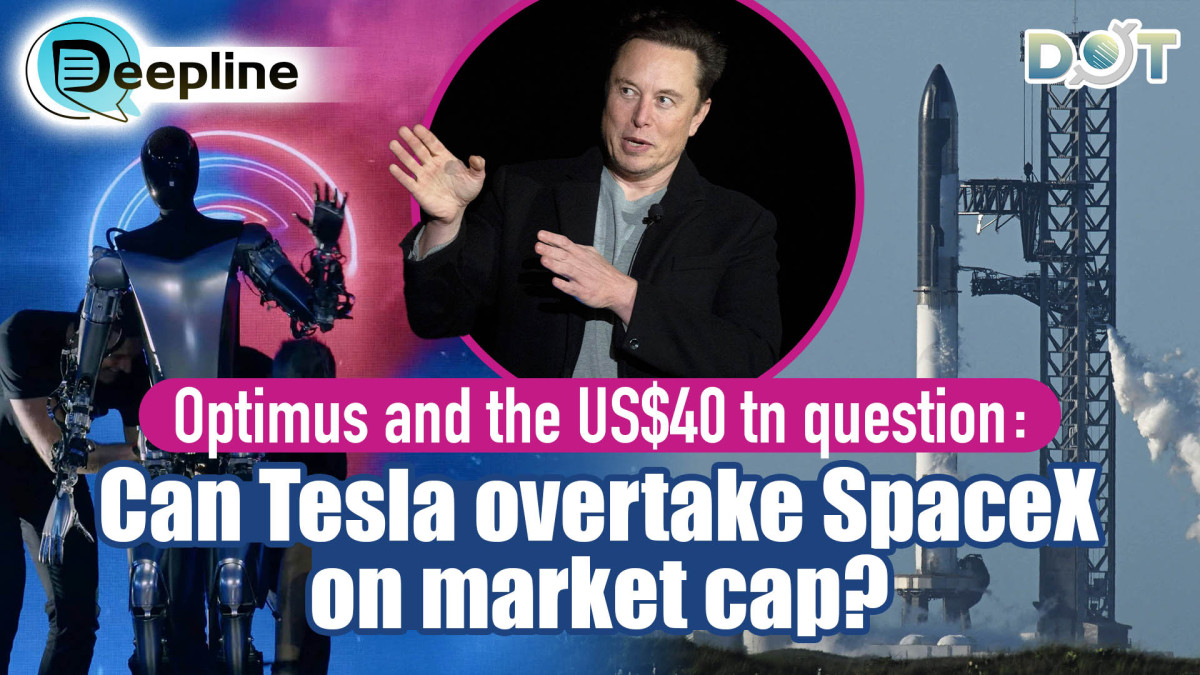
Tonight, the global capital markets are about to face the largest tsunami in their history.
SpaceX is set to officially list on Nasdaq at a share price of US$135. This unprecedented mega-IPO aims to raise as much as US$75 billion, with its post-IPO market capitalization directly anchored to a staggering range of US$1.75 trillion to US$2 trillion.
At nearly the same time, NVIDIA CEO Jensen Huang reiterated an assertion he has been making frequently in a recent investment podcast: Physical AI represents the next major computing platform, and humanoid robots represent a US$40 trillion market.
He also noted that Tesla's Optimus could rival SpaceX in terms of value.
US$40 trillion. In the past fifteen years, Huang has never assigned such a massive figure to any single end market.
As SpaceX outlines a US$28.5 trillion space economy across the vast cosmos, investors in public markets are suddenly thrust into a highly compelling thought experiment.
If Huang's US$40 trillion thesis is correct, will the ultimate market capitalization of Elon Musk's Tesla, a company currently being scrutinized by traditional analysts for slowing electric vehicle growth, surpass that of today's soaring SpaceX sooner than expected?
To understand the possibility of Tesla's market cap surpassing SpaceX's, one must first examine the underlying growth logic and the timing differences in commercial realization between the two.
SpaceX's achievement is undeniable. With its technological monopoly in reusable rockets, the Starlink network that accounts for over 61% of its revenue, and the AI infrastructure vision integrated with xAI, it attracted oversubscription interest of over four times before even going public. However, even a powerhouse like SpaceX generated only US$18.7 billion in revenue for 2025. Moreover, due to massive AI infrastructure development and Starship R&D, it still posted a net loss of US$4.28 billion in the first quarter alone.
The space economy is a quintessential "long-cycle, asset-heavy, trunk-infrastructure" business. Its grand US$28.5 trillion narrative is highly dependent on the pace of human expansion beyond Earth, the saturation of global satellite connectivity, and expensive launch services. Its monetization curve is destined to be a long one.
In contrast, Tesla's humanoid robot, Optimus, enters a world of Physical AI characterized by "short-cycle drive, immediate substitution, and a multi-trillion-dollar essential need." As a recent Wall Street research report urgently proclaims: Tesla's future lies not in cars, but in robots.
The total addressable market for global automobiles is approximately US$3.3 trillion, whereas the annual economic value of the global labor market runs into the tens of trillions of dollars. Humanoid robots don't need to wait for interstellar immigration spaceships to be built. From their very first day of production, they can seamlessly embed themselves into existing industrial, logistics, and even home environments.
Huang refers to humanoid robots as digital AI granted a body. The economic logic of this immediate applicability is straightforward: A factory pays a human worker an annual salary of tens of thousands of dollars. For a humanoid robot that works 24/7, has no emotions, and never tires, the marginal cost will plummet dramatically with mass production. This direct capture of the labor market will deliver revenue with an explosive force and penetration speed far exceeding that of capital-intensive, early-stage space infrastructure.
Within the Physical AI ecosystem, a clear duopoly has emerged: NVIDIA sells the "picks and shovels" to the gold rushers, while Tesla is currently the only publicly traded, pure-play humanoid robotics company with mass production capacity.
Why can't most robotics startups and traditional automotive giants replicate Tesla's path? Because Tesla possesses a unique, irreplicable advantage.
Autonomous driving is the highest form of physical AI. Those Tesla cars driving on the roads are autonomous robots. Currently, the number of active Tesla Full Self-Driving (FSD) subscriptions has reached 1.28 million, up 51% year-over-year. The perception, planning, and control data collected by millions of vehicles in real-world environments constitute the largest training set for end-to-end foundation models.
This fine-tuning data, born from real-world collisions, driving, and sensing, cannot be generated by any lab-bound simulator. Furthermore, most tech companies have top software but are at a loss when it comes to assembling millions of precision joints and achieving low-cost mass production.
Tesla is not just a software company; it is also a humongous, massive manufacturing factory. Tesla has already begun constructing a production line in its Fremont Factory designed for an annual capacity of 1 million robots, and is planning a staggering 10-million-unit annual capacity for its Gigafactory in Texas.
In Tesla's mindset, the electric vehicle's motor, battery, and thermal management system, custom-designed AI chips, and vision perception algorithms share over 70% homology with the actuators, power batteries, brain chips, and FSD neural network architecture required for humanoid robots. This interchangeability of industrial chains means that from its very inception, Optimus inherited the supply chain dividends from hundreds of billions of dollars of automotive business.
In the secondary market today, Tesla's valuation often leaves traditional value investors bewildered. Its forward P/E ratio persistently hovers between 350x and 380x. In contrast, even NVIDIA's forward P/E is only around 24x.
Behind this valuation dislocation lies a fundamental consensus among Wall Street institutions: Tesla is no longer an electric vehicle manufacturer. It is an AI platform building the hardware, software, AI models, and manufacturing infrastructure necessary for a robotic future.
"When a multi-trillion-dollar company wants something to happen, it will most likely happen."
The first-quarter portfolio adjustments of top-tier Wall Street firms like Coatue revealed this trend. Investors are willing to pay a hefty premium for Tesla, betting on the commercial viability of Optimus as a labor platform.
While current predictions estimate the probability of Tesla shipping Optimus in significant volumes by the end of 2026 is only around 14%, and Musk acknowledged on the Q1 earnings call that the unveiling of the third-generation Optimus has been pushed to late July or August to prevent "a frame-by-frame analysis and copy everything we're doing."
Consider a simple calculation: If the humanoid robot market reaches US$5 trillion by 2050, and Tesla secures a 20% global market share thanks to its cost control and manufacturing scale, that translates to hundreds of billions of dollars in annual revenue. Given the high-margin characteristics of software platforms and robotic services, the valuation upside for Tesla from its robotics business alone would easily surpass US$2 trillion.
From the day SpaceX goes public, the two super-powered vehicles under Musk's command will have finally converged in the public markets. SpaceX uses its Starship to push open the door to an interstellar civilization, carrying humanity's grandest ultimate dreams. Tesla, on the other hand, is grounding Optimus in Earth's factories and homes, liberating humanity's most fundamental labor.
However, viewed through the lens of capital's profit-seeking nature and liquidity efficiency, the singularity of Physical AI will arrive sooner. NVIDIA, by collecting rent from the entire industry through its chip platform, has validated the prosperity of the physical AI ecosystem. Meanwhile, Tesla, by using its automotive business to provide a continuous cash flow for scaling up production for its robot empire, is making its final thrilling leap.
Once the third-generation Optimus, unveiled this summer, demonstrates a true ability to replace humans in performing complex assembly tasks within Tesla's own Gigafactory, Wall Street's valuation models will undergo a complete reconstruction: a paradigm shift driven by Physical AI labor, away from automotive sales volume.
At that point, Tesla will no longer need to compare vehicle delivery numbers with Ford or GM. When tens of millions of silicon-based workers begin rolling off the assembly lines of the Texas Gigafactory, Tesla's market capitalization will likely break free from the constraints of traditional valuation overnight.
And then, Huang's prophecy may well come true.
(Source: 36kr)
Related News:
Deepline | Familiar land, unfamiliar race: Tesla's China story shows evolution of local automakers
Deepline | Building rockets on code: How does AI unicorn Cursor catch Musk's attention?




Comment