





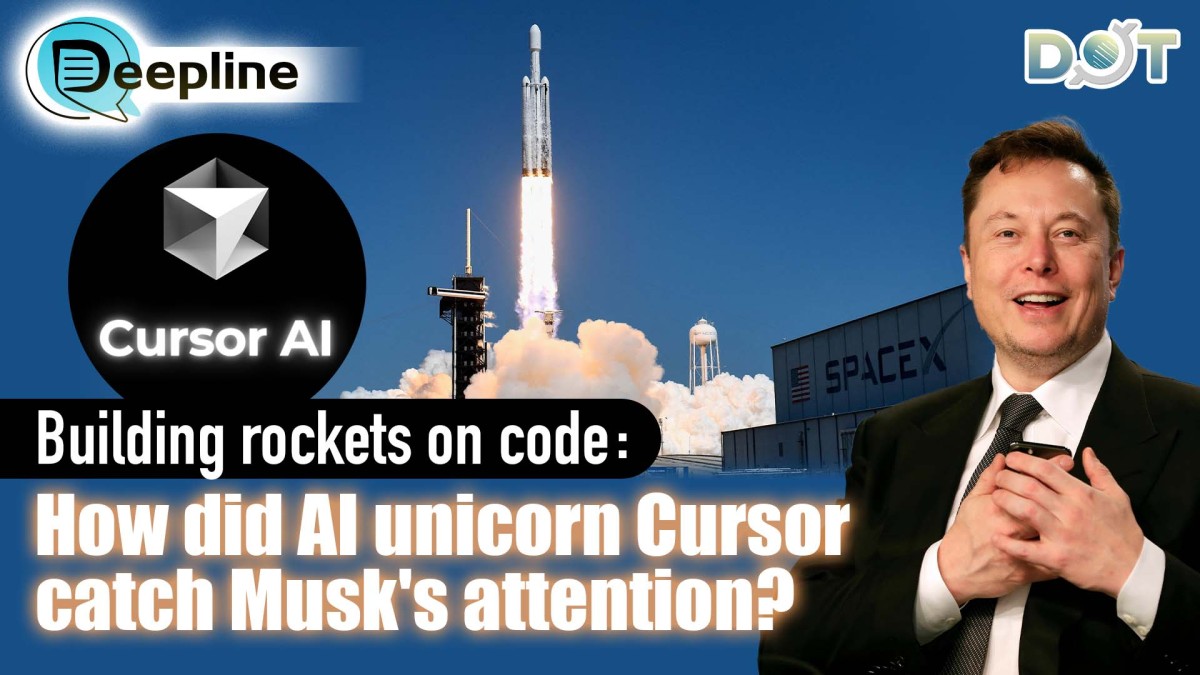
Elon Musk has struck again.
Recently, SpaceX announced on social media that its subsidiary, SpaceXAI, has partnered with AI coding startup Cursor. At the same time, SpaceX has secured the right to acquire Cursor later this year at a transaction price of US$60 billion.
Founded in 2022, Cursor is a red-hot sensation in Silicon Valley and a giant in AI coding. Under the leadership of its four founders, all born after 2000, the company has achieved an annualized revenue of US$2 billion in just four years, earning the title of "the fastest-growing B2B software company in history."
The timing of this deal is intriguing. In early April, SpaceX was reportedly secretly preparing an IPO filing with a target valuation of up to US$1.75 trillion, aiming to break the record for the world's largest IPO. At this critical juncture, making such a heavyweight acquisition, what exactly is Musk plotting?
Notably, just before SpaceX's announcement, the media reported that Cursor was quietly advancing a new Series E funding round of approximately US$2 billion, with a valuation exceeding US$50 billion. Potential investors included Nvidia, a16z, and Thrive Capital. A feast originally meant for VCs was about to begin, only for Musk and SpaceX to swoop in, not only beating all investors to the table but also completely rewriting Cursor's capital narrative.
In fact, signs of collaboration between the two sides were not without precedent. In March of this year, two of Cursor's core engineering executives left to join xAI, reporting directly to Musk. Interestingly, rather than driving the two companies apart, this "poaching" instead led to xAI leasing computing power from its Colossus supercomputer to Cursor for training its proprietary AI coding model, Composer.
In retrospect, this series of moves resembles a carefully laid preemptive gambit.
The details of the collaboration are twofold:
First, deep operational cooperation. SpaceX said that it would combine Cursor's product and its distribution capabilities, targeting professional software engineers with SpaceX's Colossus supercomputer, equipped with the equivalent of a million H100 chips, to build "the world's most useful models."
Second, an acquisition deal with an option. According to disclosures, SpaceX has not obtained a direct acquisition agreement but an option: if SpaceX decides to acquire, Cursor will be formally incorporated into Musk's business empire at a US$60 billion valuation; if SpaceX chooses to forgo the acquisition, it must pay Cursor US$10 billion as a fee to deepen their collaboration.
Regardless of the outcome, Cursor is in an invincible position. The mere US$10 billion "cooperation-deepening fee" alone exceeds most single funding rounds in the AI industry. Moreover, the US$60 billion acquisition price pushes Cursor's valuation even higher within six months. During its Series D round in November 2025, its valuation was approximately US$29.3 billion, meaning it had more than doubled in less than half a year. Even compared to the previously discussed US$50 billion Series E valuation, this represents a 20% premium.
Beyond money, this collaboration with Musk also serves as a powerful endorsement of Cursor's technological strength and market value.
Looking back at Cursor's entrepreneurial story, it reads like a real-life underdog success script.
The company's founder, 25-year-old Michael Truell, is a stereotypical "prodigy." At 14, he developed a popular programming game; in high school, he won medals at the International Olympiad in Informatics; at 18, he was admitted to MIT to pursue a double major in computer science and mathematics; and during his freshman year, he landed an internship at Google.
However, what truly changed Truell's fate was a 2019 meeting with Silicon Valley investor Ali Partovi. Partovi, an early backer of star companies like Facebook and Airbnb, was recruiting for an elite talent program called Neo Scholars, aimed at identifying future tech leaders while they were still in college.
A detail from that meeting, recorded by Forbes China, says that after a lively discussion about AI research and startup life, Partovi handed Truell a handwritten coding test, which Truell solved at a record-breaking speed. After the meeting, Partovi drew a circle on Truell's file and placed a star inside it, indicating that Truell had made a deep impression and that Partovi would be willing to invest in any future project of his.
That unique encounter would later lay the groundwork for Truell's entrepreneurial journey.
Meanwhile, during his time at MIT, Truell met three like-minded classmates: Sualeh Asif, Arvid Lunnemark, and Aman Sanger. The four often discussed the future of AI and programming, gradually forming a bold conclusion: AI should not merely be a coding aid but should fundamentally change how developers interact with code.
In 2022, the four post-2000s founders made a risky decision: drop out of MIT and start a company full-time. They founded Anysphere, Cursor's parent company, with Partovi fulfilling his promise as an early investor.
Cursor focuses on AI-driven code-editing tools, quickly gaining traction with efficient code generation, completion, and debugging features, achieving phenomenal growth. According to Cursor's website, in January 2025, the company's annualized revenue surpassed US$100 million; by June, it reached US$500 million; by November, it exceeded US$1 billion; and by February 2026, the figure stood at US$2 billion, with over half of the Fortune 500 companies as its users.
Correspondingly, there are striking efficiency numbers: Cursor has about 150 employees, meaning each generates approximately US$13.3 million in annual revenue.
This explosive growth naturally ignited enthusiasm in capital markets. Since its founding, Cursor has demonstrated impressive fundraising ability, with valuations rising accordingly:
- April 2022: US$400,000 Pre-Seed round from Alameda Research
- October 2023: US$8 million Seed round at a US$56.5 million valuation
- August 2024: Series A round at a US$400 million valuation
- January 2025: Series B round at a US$2.6 billion valuation
- May 2025: Series C round at a US$9 billion valuation
- November 2025: Series D round at a US$29.3 billion valuation, led by Accel and Coatue, with follow-on from existing investors including Thrive Capital and DST Global, and participation from Google and Nvidia
According to estimates by Forbes and other institutions based on fundraising documents, each of Cursor's four founders holds roughly 4.5% of the company. This means that if SpaceX ultimately acquires Cursor for US$60 billion, this paper wealth would be realized in cash, netting each founder nearly US$2.7 billion. From writing games at 14 to becoming billionaires at 25, Truell and his partners have completed a meteoric rise from MIT dropouts to Silicon Valley elites in just four years.
Cursor's story is indeed compelling, but US$60 billion is no small sum. Why is SpaceX willing to place such a heavy bet?
The answer may lie within Musk's business empire.
Cursor's technology is a hard requirement for SpaceX. Back in February 2026, Musk announced the merger of his AI startup xAI with SpaceX. After the deal closed, xAI became SpaceX's AI division. Meanwhile, Musk reorganized the business into four major segments, with AI coding being one of them. However, the reality is that xAI's Grok model excels at general conversation but lags noticeably behind competitors in coding ability. Even Musk has publicly admitted that Grok's coding skills are inferior to Anthropic's Claude. Successfully acquiring Cursor or forming deep cooperation with it would quickly fill this gap in SpaceX's AI capabilities.
Second, the most widely held market interpretation is that this move paves the way for SpaceX's epic IPO. In early April, news broke that SpaceX had secretly filed for a US IPO with a target valuation of US$1.75 trillion, potentially setting a global record for the largest IPO ever. Combined with the xAI merger two months earlier, it is clear that SpaceX is attempting to craft a grand narrative of "commercial aerospace + AI" to fuel capital market imagination.
This playbook has precedent. Back in 2021, as Tesla's market cap approached US$1 trillion, the company successfully redefined itself from an "EV manufacturer" into an AI and robotics company by showcasing events like AI Day, the Tesla Dojo supercomputers, and the Optimus (Tesla Bot), thereby rewriting its valuation logic. Now, SpaceX is replicating this path: first proving its foundational large model capabilities with xAI, then bolstering its AI product matrix by incorporating a high-growth AI asset like Cursor, thereby raising its valuation ceiling.
On the eve of an IPO, redefining the company's valuation logic through a highly talked-about acquisition is indeed classic Musk.
(Source: 36kr)
Related News:
Deepline | 'AGI brotherhood' of Zhichun Road: DeepSeek and Kimi's shared pursuit
Musk's xAI faces another executive shake-up as co-founder Kroiss departs




Comment