





By Liu Yu
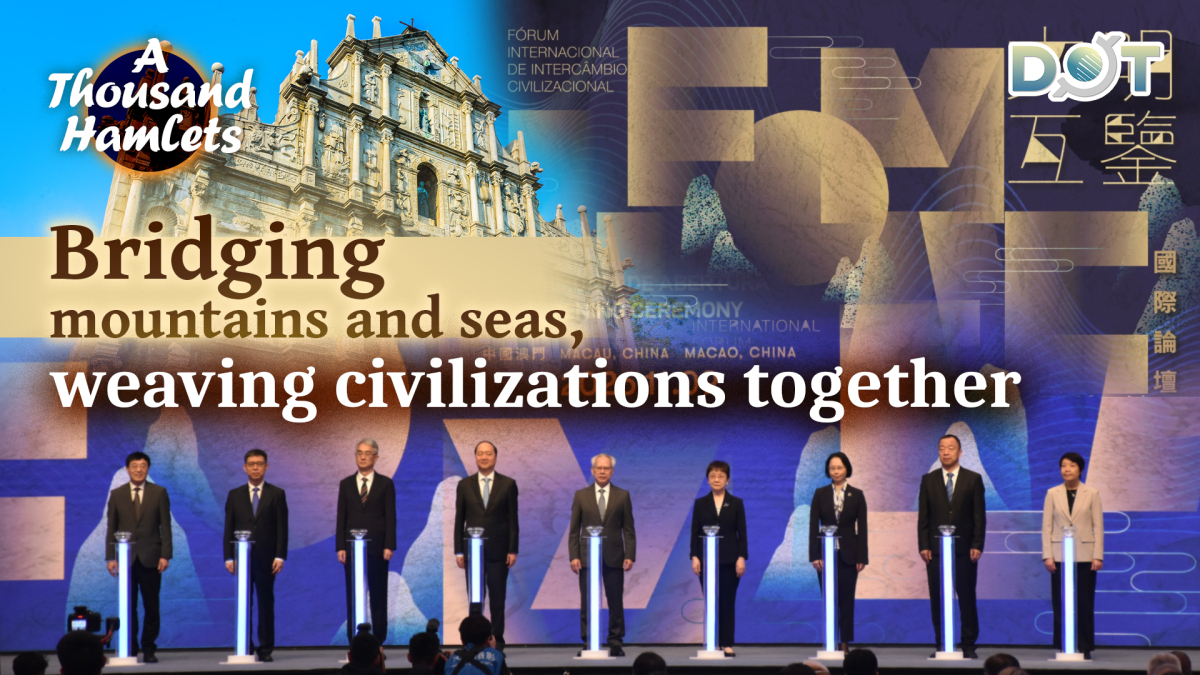
The "International Forum on Mutual Learning Among Civilizations 2026" recently opened in Macao. It gathered over 300 government representatives, international organization representatives, experts, and scholars from more than 20 countries and regions. Participants agreed that Hong Kong and Macao, with "one country, two systems" and coexisting diverse civilizations, have unique advantages and are well-positioned to become important platforms for civilizational exchange. The forum is more than an academic event; it represents a civilizational practice using Macao as a method and dialogue as a pathway.
Macao is not just a backdrop for dialogue among civilizations, but a living, breathing entity.
Discussions on mutual learning among civilizations easily fall into two categories of vagueness: one is merely paying lip service to "diversity" without clearly explaining how different civilizations can coexist; the other is turning "dialogue" into a conference without sustainable daily practice. Macao's value lies precisely in providing a living example that has remained uninterrupted for over four centuries. The diverse ethnic groups here have interwoven a tapestry of life, making it not only a silent open-air museum but also a living experience of multicultural coexistence. From the sails of the Maritime Silk Road to the side-by-side coexistence of Chinese and Western architecture in its streets and alleys, Macao has consistently played the role of "translator" and "connector" in the dialogue and exchange of civilizations.
Li Guoqiang, a member of the Academic Divisions of the Chinese Academy of Social Sciences, notes that over four centuries, Macao has been a model of East–West mutual respect and learning, where different civilizations met, understood, and integrated. Since its return, "one country, two systems" has brought economic prosperity, social stability, and better livelihoods while safeguarding cultural diversity. Macao best embodies equality, mutual learning, dialogue, inclusiveness, and the ideal of "appreciating each other's beauty and sharing beauty together." The core lesson is that mutual learning does not erase differences but builds shared rules and affections for coexistence; Macao serves as a "translator" and "connector" because it treats cultures as resources for coexistence and learning, not as objects to conquer or assimilate.
At the opening, Macao SAR Chief Executive Sam Hou-fai said that although civilizational barriers and cognitive gaps remain, President Xi's Global Civilization Initiative—advocating respect for world civilizational diversity and common human values—offers Chinese wisdom for today's global challenges. Civilizations are enriched by diversity, and mutual learning is a key driver of human progress. Sam added that Macao will further uphold the "one country, two systems" values of peace, inclusiveness, openness, and sharing; strengthen its role as a base for exchange and cooperation with Chinese culture as the mainstream and diverse cultures coexisting; provide a platform for mutual understanding among civilizations; and, as a "precise connector" between China and Portuguese-speaking countries, continue promoting two-way cultural dialogue as an active builder of contemporary civilizational dialogue. This shows Macao's civilizational exchange experience is not merely a historical narrative but is being turned into real capacity for platform building, cultural dissemination, and international exchange.
"One Country, Two Systems" as an Institutional Bridge for Mutual Learning Among Civilizations
If Macao's historical experience provides the "grammar of daily life" for coexisting civilizations, then "One Country, Two Systems" provides the "grammar of institutions" for mutual learning among civilizations.
In his keynote speech, "One Country, Two Systems and Mutual Learning Among Civilizations," Qiang Shigong, president of Minzu University of China, pointed out that "One Country, Two Systems" enables the coexistence of different social systems, and behind these systems lie cultures and civilizations, thus achieving the coexistence of different cultures and civilizations. From this perspective, the "One Country, Two Systems" implemented in Hong Kong and Macao is a bridge built between the Chinese nation as a community, the surrounding communities of shared future, and the community of shared future for mankind. This judgment is insightful: dialogue among civilizations cannot rely solely on goodwill and rhetoric; it also requires institutional inclusiveness and rule-based guarantees. Different social systems and cultural traditions can coexist peacefully and complement each other. The key lies in whether there are sufficiently inclusive institutional arrangements to prevent differences from escalating into confrontation.
Macao's "One Country, Two Systems" practice demonstrates that the role of institutional bridges is not to erase differences, but to allow them to find space for expression within the framework of a community. Therefore, Macao is well-positioned to become an important window for promoting the "Global Civilization Initiative" and has the capacity to transform the concept of "respecting the diversity of world civilizations and promoting the common values of all humanity" into tangible and accessible exchange scenarios. In his important speech at the celebration of the 25th anniversary of Macao's return to the motherland and the inauguration ceremony of the sixth government of the Macao Special Administrative Region, President Xi Jinping emphasized his hope that Macao will make good use of its cultural advantages of blending Chinese and Western cultures to promote international cultural exchanges, tell the stories of Macao and China, and build an important window for mutual learning and exchange between Chinese and Western civilizations. This requirement is highly consistent with the theme of the forum. For Macao to build this "window" effectively, it needs to showcase the openness and inclusiveness of Chinese culture, present the true fabric of different civilizations coexisting in Macao, tell the stories of China well, and listen to the stories of others. Only through two-way exchange can we truly learn from each other.
The Digital Age Requires a Stronger Safeguard of Humanistic Anchors
The forum directly addressed technology-age civilizational challenges. AI and related innovations are reshaping space and cognition at unprecedented speed, raising a key question: will technology deepen civilizational divides or help bridge them? At this turning point, humanity needs humanistic anchors more than ever. Sam Hou-fai urged that technology serve human progress, uphold humanistic values, and promote civilizational integration rather than confrontation. Macao is already using digital tools to protect and transmit cultural heritage, bringing history to the public through digital displays and technological innovation. The point is that technology is not inherently open; only when guided by humanistic values can digital technology become a bridge between civilizations rather than a new cognitive wall.
AI can copy, translate, and spread culture, but it cannot generate empathy or replace mutual understanding. Digitizing civilizational exchange must therefore go beyond putting heritage online and establish digital rules and ethics that respect difference, encourage dialogue, and protect diversity. If Macao can link heritage digitization, cultural exchange with Portuguese-speaking countries, and international people-to-people platforms, it could offer a practical model of "technology serving humanity."
From the Greater Bay Area to a Global Network: Macao's Platform Role
Macao's practice of cultural exchange and mutual learning is not an isolated urban story, but rather part of the Guangdong-Hong Kong-Macao Greater Bay Area and the nation's overall opening-up strategy. Zheng Yongnian, Dean of the School of Public Policy at the Chinese University of Hong Kong, Shenzhen, stated that the Guangdong-Hong Kong-Macao Greater Bay Area has the potential to become an important platform for cultural exchange and mutual learning, possessing several prominent advantages. These include the efficient division of labor between the central and local governments under the "One Country, Two Systems" framework, the full utilization of grassroots resources, the coexistence and integration of multiple civilizations in Hong Kong and Macao, and the upholding and manifestation of the core identity of Chinese civilization in multicultural exchanges. This analysis illustrates that Macao's platform role is supported by both institutional mechanisms and regional collaboration and grassroots vitality. Cultural exchange and mutual learning cannot rely solely on intergovernmental dialogue; it also requires the participation of academic institutions, cultural institutions, enterprises, and social organizations, necessitating the formation of a multi-level, regular exchange network.
Li Cheng, the Director of the Centre on Contemporary China and the World at the University of Hong Kong, observed that the world is currently "generally unstable" and that the imbalanced global governance system urgently needs reform. In this context, Eastern civilization's emphasis on "harmony without uniformity" should be better articulated as a harmonizing force. He also noted that people-centered development is central to Chinese civilization's self-reliance and represents an Eastern contribution to modernization. The Greater Bay Area, with its traditional wisdom and practical foundations, should focus on investing in people, things, and community development. This extends civilizational dialogue from culture to development: genuine dialogue must become concrete through human development, public goods, and community-building. For Hong Kong and Macao, investing in people can boost the economy and livelihoods, share China's experience in industrial upgrading, problem-oriented reform, and efficient governance through international advantages, and—through humanistic "going global" efforts—strengthen corporate social responsibility and support inclusive growth in the Asia-Pacific.
Evandro Menezes de Carvalho, a visiting professor at the Macao Polytechnic University, reminded us from the perspective of cross-cultural learning that cultural differences are also a form of learning; the concept of harmonious coexistence and shared human values demonstrates that cultural integration is not a catalyst for conflict; the key is empathy and understanding. He cited Fei Hsiao-tung's ideas on learning from different cultures and new concepts, pointing to "harmony in diversity." This perspective is crucial. Mutual learning among civilizations is not about proving "my civilization is superior," but about expanding the possibilities for shared human life through mutual learning. Without empathy, dialogue becomes a matter of each side talking past each other; without mutual learning, mutual exchange degenerates into mere formalities.
Transforming Forum Consensus into Daily Practice
Civilizations are enriched by diversity and develop through mutual learning. The value of the Macao Forum lies in its ability to connect historical heritage, institutional advantages, digital technology, and international networks, forming a global arena for dialogue among civilizations. Jointly promoting global civilization initiatives requires precisely this kind of practice: not creating confrontation through differences, but building consensus through dialogue; not letting technology divide people, but letting innovation serve humanity; not only telling our own stories, but also listening to the stories of others. Of course, the forum is just a starting point. To truly implement the "Macao solution," continued efforts are needed in institutionalization and routine implementation: extending dialogue among civilizations to specific areas such as education, culture, youth exchanges, digitalization of cultural heritage, and cooperation with Portuguese-speaking countries; ensuring that "investing in people" and "investing in community development" mutually reinforce each other; and upgrading Macao's role as a "translator" and "connector" from historical experience to institutional capacity.
With Macao as a bridge, transcending mountains and seas, mutual learning among civilizations can ultimately become a solid bond for building a community with a shared future for mankind. Inspiring wisdom through mutual learning and illuminating the era with innovation—this is both the forum's expectation and Macao's answer to the world in this era.
Liu Yu is the lead editor of the cultural commentary "A Thousand Hamlets." Liu holds a BA in English Literature from HKBU and an MA in History from HKU.
The views do not necessarily reflect those of DotDotNews.
Related Readings:
A Thousand Hamlets | Farewell to Cambridge: Decline of the Dons




Comment