






By Jason Harding
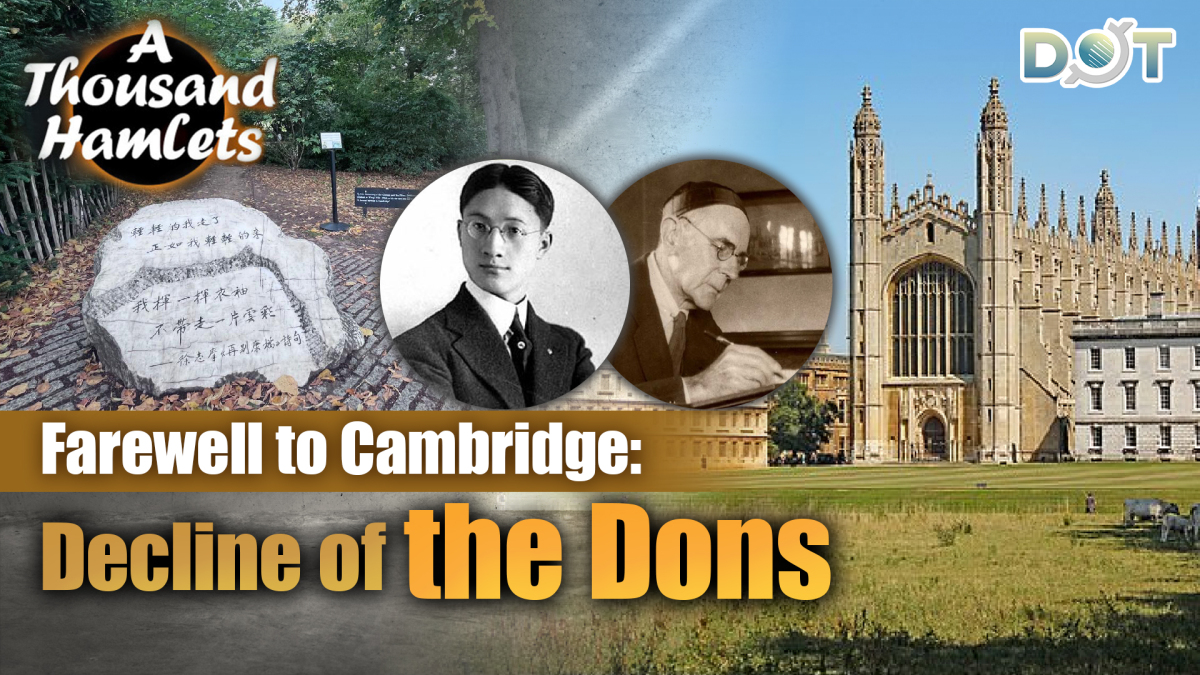
Xu Zhimo's celebrated poem "Saying Goodbye to Cambridge Again" opens delicately: "Softly I take my leave, As softly as I came." After five more stanzas, sketching willow trees along the Backs and punts skimming the River Cam, Xu returns to his parting gesture: "I gently wave my sleeve, Nor wisp of cloud claim."
These lines, beloved by generations of Chinese schoolchildren, are carved onto Beijing marble in the Xu Zhimo Memorial Garden at King's College, Cambridge. Xu was at King's during the academic year 1921-22, discovering a love for English romantic poetry, above all, the nature poetry of William Wordsworth. By the time Xu wrote "Saying Goodbye to Cambridge Again", following a brief return to King's in 1928, he had matured as a man and poet. Xu confided his marital difficulties to Cambridge intellectual Bertrand Russell. He formed a lasting friendship with his mentor at King's, Goldsworthy Lowes Dickinson. Both men were public advocates for China at a time of turbulent Sino-British relations.
In 1932, a year after Xu's death in an airplane accident in northern China, I. A. Richards, founding member of the Cambridge English faculty, later a visiting professor at Tsinghua University, credited Xu with conjuring in China an image of Cambridge as "a place where you lay on the grass in the 'Backs' while wise men came to talk to you and insensibly you became a poet". If Richards is to be believed, Cambridge possessed an "almost magical standing with many Chinese students."
The period when Xu studied English literature and philosophy at Cambridge, attending meetings of the radical Heretics Club, has acquired a legendary afterglow. In 1921, the publication of the Tractatus by Ludwig Wittgenstein, Russell's protégé, revolutionized philosophy. Of greater real-world consequence, Sir Ernest Rutherford's experiments were redefining atomic physics. This paradigm-shift was taking place in the Cavendish Laboratory in busy central Cambridge, while Xu lay meditating on the Backs writing his romantic poetry. In the 1920s, 70% of Cambridge students studied in the arts faculties.
C.P. Snow's novel The Masters, set in 1937, depicts a power struggle between scientists and humanists in a Cambridge college. The importance of science and technology to Britain's wartime effort – Alan Turing relocated from King's to become a codebreaker at Bletchley Park – ensured the triumph of scientific research by "the new men" (as Snow called them). In 1993, the big battalions of Cambridge research were established with the launch of the School of Technology, dominated by the huge Engineering Department and by expanding Computer and Management Studies.
Cambridge's deepest impact on Britain is not to be found in research publications but in (to quote Snow again) "corridors of power". In 1955, Noel Annan, later Provost of King's, traced the network of intermarried families (Darwins, Trevelyans, Keyneses) who formed an "intellectual aristocracy" at Oxford and Cambridge. They educated a ruling class who took top jobs in government and the civil service, in banking and business, extending to colonial elites, such as Hong Kong taipans at Jardine Matheson.
Annan believed the "golden age of the don" was the decades following World War Two, when dons enjoyed freedom and job security, public esteem from appearances in the media, and were recruited as government advisers. Annan notes: "Between 1958 and 1968 salaries rose by over 28%, vastly in excess of inflation."
Colin Kidd's Twilight of the Dons (2026) examines the gradual loosening of Oxbridge's institutional grip on national power. By the late 1960s, student protests and a decline in deference, linked to British geopolitical and economic decline, weakened the status of dons. In the 1980s, Mrs. Thatcher's Conservative governments stopped appointing dons to Royal Commissions shaping government policy and reduced state funding. A crisis of confidence was reflected in the 1992 edition of Anthony Sampson's Anatomy of Britain: "Whatever their apparent privilege, all the dons feel themselves much less confident and autonomous than ten years ago … most dons are beset by money-worries: writing proposals for grants, fund-raising for their college, or adding to their incomes."
In the late 1990s, Stefan Collini, Cambridge Professor of Intellectual History, wrote an essay satirizing "CamU PLC" as a critique of the marketisation of UK higher education.
In this brave new world, selling degrees in global markets with an exponential growth in international students, who pay trebled student fees, became a key part of Cambridge University's strategy. Chinese students make up the largest group of overseas nationals studying at Cambridge: there are currently around 3,000 students from the mainland and Hong Kong. Opened in 2018, the Xu Zhimo Memorial Garden is the culmination of cultural charm offensives (I curated an exhibition on "Cambridge English and China" at King's College Archive Centre in 2011) designed to appeal to Chinese sensibilities.
The marketisation of "CamU PLC" did not bring riches to the dons. The average salary of a Junior Research Fellow at Cambridge is around £33,000 pa, similar to tuition fees for international students. This salary is offset by the privilege granted to Fellows of walking over grass college courts wearing a gown. In A Room of One's Own (1929), Virginia Woolf imagined a male porter ordering her off the college grass.
Sociologist A. H. Halsey documented "a final demotion of the rank-and-file of academic teachers and researchers [at Oxbridge] to a proletarian role as non-tenured, peripheral, contract staff." In 2024, a freedom of information request revealed that 88% of research staff at Oxford are employed on insecure contracts.
If Oxbridge dons are no longer drawn exclusively from gentlemanly classes, this has not prevented heated debates about entrenched gender and racial injustice.
Cambridge University recently suffered significant reputational damage for its handling of the tragic case of Jason Arday. His meteoric rise from self-proclaimed illiteracy up to adulthood, to becoming at 37 the youngest Black Professor in the University's history, attracted increasing scrutiny after plagiarism analysis of his PhD from Liverpool John Moores University uncovered 188 identical or near-identical passages, most taken from an earlier Brunel University PhD.
When a Times Higher Education journalist wrote to offer Arday a right of reply to doubts expressed about the academic rigor of this PhD and data in articles, Arday reported him to the police, starting a four-month investigation. A letter from a notoriously aggressive law firm Carter-Ruck was enough to intimidate THE into spiking their article. Students who complained about Arday's teaching were cautioned against racial harassment, the same defense made by Cambridge professors who signed a solidarity open letter calling out "fake accusations" (some later silently deleted their names after further revelations about outlandish, provably dishonest claims emerged). Cambridge University suddenly switched from PR denouncing a "vile campaign" to smear Arday, to launching a formal investigation into academic integrity and honorary appointments he did not in fact hold.
After Arday's resignation, ex-colleagues, most vocally Priyamvada Gopal, a professor of postcolonial studies, demanded an enquiry into his appointment to a Cambridge chair.
Arday's public humiliation and suicide turned the spotlight on DEI (diversity, equity and inclusion) recruitment at Cambridge with anger mostly directed at the University. Black and ethnic minorities (BAME) made up 35% of the 2024 undergraduate intake, twice the BAME percentage of the UK population, nearly three times the admission rate of Whites. Contextual adjustments for Cambridge entry offers, counteracting any "white privilege", are standard practice, as I witnessed for myself as a college admissions interviewer.
Cambridge University has never been truly meritocratic throughout its 800-year history. I. A. Richards's Practical Criticism (1929) catalogued the poor reading comprehension of Cambridge students and dissected their superficial "stock responses". Judgements of UK academic peers and performance metrics do not indicate Cambridge is in a class apart. The latest government research assessment exercise ranked Cambridge's History department 29thby grade point average in the UK.
Cambridge University is still revered throughout Asia as the gold standard of scholarly excellence. In 2025, City University of Hong Kong announced that it was paying for 18 post-doctoral researchers at Cambridge. None were reserved solely for City University graduates. Large pictures of Cambridge colleges posted on the Kowloon Tong campus showcased cultural capital derived from this tribute of millions of pounds.
Xu Zhimo's romantic farewell to Cambridge lingers for Chinese readers. By contrast, William Empson, Richards's best student who followed him to Beijing, wrote a poetic goodbye to Cambridge, a year after Xu, casting off "that strange cackling little town".
The decline of the social status of Cambridge dons, examined in Colin Kidd's Twilight of the Dons, is highlighted by public debate sparked by Jason Arday. It is arguable whether the value of a Cambridge education lies more in its entrée to privileged social networks than in claims of unique intellectual distinction in a global academic market.
Reflecting upon an official history of Cambridge University, insider Stefan Collini stated that these colleges "create networks of sentiment and loyalty among the political class that help secure more favourable treatment than ever the faculties' primary intellectual activities could do." Which, translated, means Cambridge is an ideal place for guanxi.
Jason Harding is the Head and Professor of the Department of English at Lingnan University. He holds a PhD from King's College, Cambridge.
The views do not necessarily reflect those of DotDotNews.
Related Readings:
A Thousand Hamlets | Jeep girls and everyday encounters in postwar China
A Thousand Hamlets | Tragedy at the Hong Kong International Shakespeare Festival




Comment