






By Liu Yu
Editor's Note: Cao Yu's Thunderstorm is a tragedy of a bourgeois family with a strong feudal colour in modern China. It is also a reflection on the status of Chinese women under the May Fourth wave. Over the next two months, I will analyze several portrayals of female characters in this play.
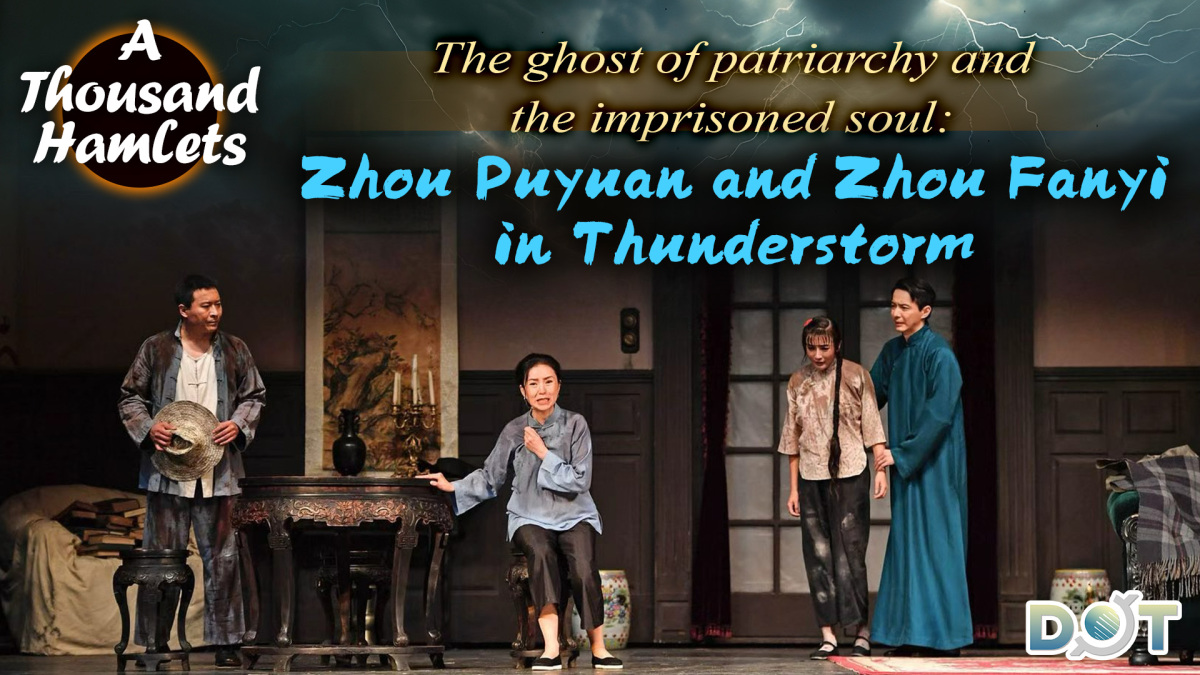
This article focuses on two central figures: Zhou Puyuan, the male authority who dominates the family, and Zhou Fanyi, the upper-class woman imprisoned within it. Together they reveal how spiritual oppression operates across class and gender in the feudal-bourgeois household.
Zhou Puyuan: Authority Without Presence
Zhou Puyuan is undoubtedly a representative of the Chinese feudal patriarchal system, and his character is closely tied to the feudal bourgeoisie. Cao Yu does not place him in direct conflict with the female characters. Instead, he paints him as an irresistible subconscious authority. When Lu Dahai breaks into the Zhou house and criticises Zhou Puyuan for deliberately letting the dam burst and drowning workers to suppress opposition, Zhou Puyuan's indifference to human life and his defence of his own interests become clear. The author gives him a class character, a deliberate choice in the revolutionary historical period.
The most prominent feature of Puyuan's authority is his attachment to family order and hierarchy. The whole family sits in a sultry study room in the heat of summer, yet because of Puyuan's words, no one dares open the windows for ventilation. The irony is that Puyuan is not even in the study at the time; his potential prestige alone intimidates others into making no decisions without permission. In another scene, when Lu Dahai represents the workers fighting for rights in the Zhou house, Puyuan's son Zhou Chong tries to negotiate with the workers and argues with his father from the workers' perspective. Yet under his father's sharp eyes, Zhou Chong lowers his head. Other family members, such as Fanyi and Si Feng, can only persuade Zhou Chong not to be reckless and not to comment on Zhou Puyuan.
Puyuan's role as a feudal "father" shows that his instructions to his sons cannot be resisted. He is arrogant and unreasonable. He will not allow his sons to have independent opinions or free thoughts other than his own words. This educational model will profoundly influence the family: the sons will imitate him in educating the next generation. The old ideas that dominate and hold absolute control will inevitably despise the new ideas that have not yet gained a firm foothold.
When we examine the relationship between Zhou Puyuan and Lu Shiping, it becomes clear that when the feudal system forced him to choose between his own emotions and practical interests, he obeyed the latter. Like all young men in large feudal families, Puyuan was manipulated by his parents. Subject to their orders, he had no right to know or decide; he could only accept the decision to drive Lu Shiping, a servant, out of the house. Yet he is also a perpetrator who accepts the concept of hierarchical marriage. Cao Yu used the word "play" when discussing their relationship in 1962, and "spoil" when discussing it with Wang Chaowen in 1978. In Puyuan's eyes, true love has prerequisites: the core of self and family interests. His character traits are defined by Cao Yu as "reactionary" and "hypocritical." His immoral behaviour is attributed to social systems and cultural concepts—the result of a social environment forcing people to alienate themselves. The label "father" in front of the family is not only a feudal parent in the general sense but also a gender symbol superior to women, placing heavy mental pressure on them.
Zhou Fanyi: A Soul Imprisoned by Feudal Chains
Zhou Fanyi is a stepmother with a kind heart. Her desperation for love makes her willing to break social norms. In the preface to Thunderstorm, Cao Yu describes Fanyi as a "very close friend." He respects her bravery as a woman under feudal society who sticks to her heart, and he feels that society treats women like her unfairly.
Fanyi is always a rebellious female image in the story. She refuses to drink bitter Chinese medicine. It is difficult to judge whether Fanyi is truly sick. We can infer that her condition is caused by mental torture; it is more like paranoia than physical illness. Puyuan demands that Si Feng and Zhou Ping force Fanyi to drink the medicine. Fanyi never openly breaks with Zhou Puyuan or resolutely runs away from home during the long hardships. However, her inner conflict is still visible. She chooses to fight alone in the family cage. This is due to the potential influence of her identity and upbringing: she has both the ideological factors of a "new bourgeois woman" and an "old woman." As a "new bourgeois woman," she is not willing to be pinned down by feudal values. She wants to be herself: a woman who dares to love and hate. As an "old woman," she obeys the values of feudal society as a mother, which makes her suffer from mental disorder.
Zhou Puyuan always emphasises the so-called "mother image," forcing Fanyi to act as a role model and show absolute obedience in front of her children. This is a kind of moral kidnapping, which makes Fanyi accept discrimination against her by her female identity. Under the traditional concept of acquiescence, an absolute class concept is formed. Puyuan's words to Fanyi are always compulsive: "Do as you are told." Fanyi once makes a helpless evaluation of Zhou Puyuan: "Doing the most atrocious in private, yet put the blame on others and wore a mask of morality, philanthropist and respectable figures." We can infer that Fanyi knows Puyuan's personality in her heart. When she complains to Zhou Ping, she says: "Your father is the hypocrite of all." She knows she cannot subvert Zhou Puyuan's control, which will slowly corrode her. She hopes Zhou Ping will realise his father's sin and stop imitating him. She not only screams for help from Zhou Ping but also shows a kind heart to the girl. She can discriminate morally between right and wrong and dares to speak it out in front of her stepson, regardless of feudal society's values of a "wife" or a "mother."
Fanyi shouts to Zhou Ping: "Suddenly you came along and make me half stepmother half mistress. It's you who seduced me." Although trapped in the ethical issue, Fanyi is still willing to continue this kind of life if Zhou Ping treats her well as he used to. Zhou Ping, like his father, has deceived Fanyi through rhetoric; now Zhou Ping is closer to Si Feng. The relationship between Zhou Ping and Fanyi compensates for the emptiness of love left by Zhou Puyuan. However, she ties her life to a coward who dares not act and dares not take responsibility, which also determines that her love choice is predestined to be wrong, and the short-lived love eventually turns into a tragedy. The scene compares the two characters' attitudes towards love in the feudal bourgeois family environment, showing the weakness of Zhou Ping and the strengths of Fanyi.
"I can't stand two generations of bullying." Such incest is male-dominated, which dramatically degrades the status of women and makes women appear on the screen as male accessories. When Fanyi meets with Lu Shiping, the servant Lu Gui asks Fanyi to meet with the doctor: "Master's order, please now go." Although Lu Gui is Fanyi's servant, he says this request in a commanding tone. Fanyi looks shocked, but accepts his proposition. Male domination still exists even across class differences.
The image of Fanyi portrays the struggle of young educated women at that time. As Cao Yu wrote in the preface to Thunderstorm: "I can't count how many Fanyi I have seen with my own eyes (of course they are not Fanyi, most of them are not as brave as her). They all live in the gutter, but their hearts are too high. Enthusiasm was an unquenchable fire, but God punished them to grow dry on the sand."
Zhou Puyuan and Zhou Fanyi, one oppressing and one rebelling, are both trapped in the feudal-bourgeois family. Puyuan is an absent yet omnipresent patriarchal ghost; Fanyi is an imprisoned soul. She dares to love and hate, yet she cannot truly escape. This essay has focused on patriarchy and the tragedy of an upper-class woman. The next article turns to the lower-class mother Lu Shiping and her daughter Si Feng, examining how class and gender produce another kind of generational cycle.
Liu Yu is the lead editor of the cultural commentary "A Thousand Hamlets." Liu holds a BA in English Literature from HKBU and an MA in History from HKU.
The views do not necessarily reflect those of DotDotNews.
Related Readings:
A Thousand Hamlets | Why remember the Long March?
A Thousand Hamlets | Western food in Hong Kong: The 'Cha Chaan Teng' story




Comment