






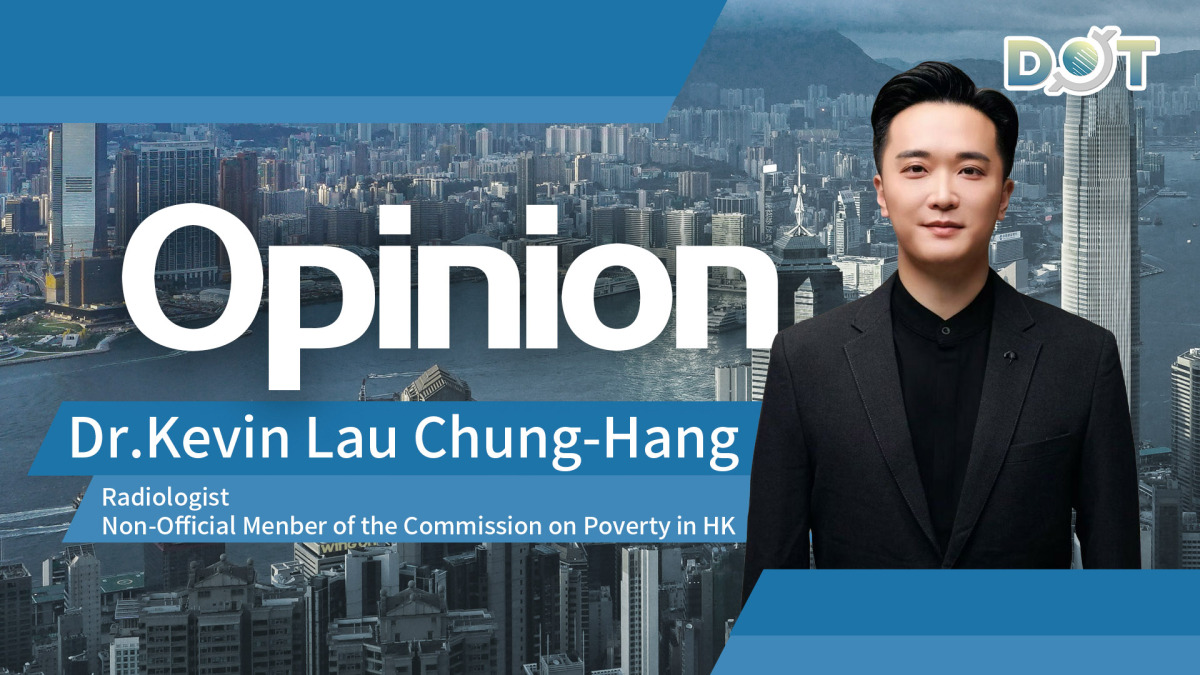
By Dr. Kevin Lau
On 16 September this year, the HKSAR Government officially released the first Five-Year Plan for the Economic and Social Development of the Hong Kong Special Administrative Region (2026–2030). This is Hong Kong's first local five-year plan since its return to the motherland, unveiled in the inaugural year of the nation's 15th Five-Year Plan—an occasion of both symbolic and substantive significance. The Plan is not only Hong Kong's proactive effort to align with national development strategies; it is also an institutional arrangement that stabilizes public expectations and enhances governance effectiveness through a medium- to long-term vision. It marks a shift in Hong Kong's development model away from short-term, reactive measures towards more forward-looking, proactive "planning-led" governance.
The foremost highlight of the plan lies in its comprehensive alignment with the nation's 15th Five-Year Plan and its reinforcement of the "four centres, one highland" framework. Over the next five years, Hong Kong will consolidate and enhance its status as an international financial centre, an international shipping centre and international aviation hub, and an international trade centre, while accelerating the development of an international innovation and technology (I&T) centre and establishing a highland for international talent. In finance, Hong Kong will strengthen its functions as the global offshore renminbi business hub, an international asset and wealth management centre, and an international risk management centre. In shipping, it will promote the transformation of its port from a "tonnage port" into a "value port". All of these measures are positioned around "what the nation requires, what Hong Kong excels at", enabling Hong Kong to consolidate its unique advantages while serving the broader national development agenda.
Secondly, the plan takes the Northern Metropolis as its spatial anchor to promote the integration of industry, academia and research—the top priority among all priorities. Covering some 30,000 hectares of land, the Northern Metropolis accounts for one-third of Hong Kong's total area and future population. Divided into nine new development areas, it can provide 3,000 hectares of new development land, with targets of 500,000 new housing units and 500,000 new jobs. The Government has proposed building three university towns—in San Tin, Hung Shui Kiu and Ta Kwu Ling—under the "one city, five elements" concept, each comprising a campus zone, a technology zone, an industrial zone and a living community, organically linking education, technology, talent and industry chains. Coupled with the target of raising gross expenditure on research and development from the current 1.13 per cent to 2.7 percent of GDP, Hong Kong can genuinely overcome its structural weakness of "emphasizing commerce over scientific research", allowing I&T to become a new engine of new-quality productive forces.
At the same time, the Hetao Shenzhen-Hong Kong Science and Technology Innovation Co-operation Zone, with its unique "one zone, two parks" advantage, will be developed into an international I&T hub. The Hong Kong Park focuses on scientific research and pilot-scale commercialisation, while the Shenzhen Park possesses strong industrial chains and advanced manufacturing capacity; together they form a complete I&T value chain from research to industrialisation. The HKSAR Government is studying innovative facilitation measures covering flows of people, goods, capital and data, and will seek policy support from the central authorities. This complements the plan's deployment to deepen the development of the Guangdong–Hong Kong–Macao Greater Bay Area—through "hard connectivity" in infrastructure, "soft connectivity" in rules and regulations, and "heart connectivity" in people's livelihoods—facilitating the convenient movement of people, data, capital and goods, so that Hong Kong can better share in the fruits of national development and international opportunities.
Of course, the ultimate purpose of development is to benefit people's livelihoods. The plan sets a total of 105 indicators and establishes a mechanism of "five-year planning at the helm, annual policy implementation, budgetary support, and annual reporting", with regular monitoring and evaluation of implementation. The livelihood chapter covers education, healthcare, housing and elderly care, requiring the integration of economic development with the improvement of people's livelihoods to form a dynamic cycle. At the end of the day, the fruits of financial and economic development must genuinely benefit the wider public before they can resonate with the community; and only with stable livelihoods can the economy remain resilient.
The plan carries Hong Kong's aspiration to move from stability to prosperity. The blueprint has been drawn; the key now lies in implementation. As long as all sectors of society work together with one heart, Hong Kong will surely ride the mighty momentum of the nation's 15th Five-Year Plan and build itself into a more open, inclusive, free, prosperous and safe international metropolis.
The author is the Founding Convenor of the Hong Kong Global Youth Professional Advocacy Action, a specialist in radiology, Master of Public Administration, Master of Public Health of the University of Hong Kong, and an adviser of the Our Hong Kong Foundation.
The views do not necessarily reflect those of DotDotNews.
Read more articles by Kevin Lau:




Comment