






By Liu Yu
In 1840, after the Opium War, Hong Kong was forced to become a British colony. From then on, British culture began to flow into Hong Kong, where Chinese and Western cultures met and clashed.
Food is a big part of that cultural exchange. This article looks at how Chinese and Western food cultures mixed in Hong Kong, and what the cha chaan teng 茶餐廳 means as a cultural symbol. There were three stages in this cultural learning process: contact, imitation, and adaptation. Cultural learning is always moving and changing when different cultures meet. The cha chaan teng grew out of Western food becoming more common, and it stands for the mixing of Chinese and Western cultures. Knowledge, society, and personal identity are all changing and tied to context. As Chinese and Western food cultures mixed more in Hong Kong, Western food became popular in three stages. First, Western restaurants were few, aimed at a small group, and expensive. Second, local people opened restaurants using cheaper ingredients. Finally, cheap ice rooms and cha chaan tengs appeared. The main reason for these changes was that Hong Kong people were accepting Western food culture more deeply.
The meeting of Chinese and Western food in Hong Kong began because the British colonists wanted food from home. The early form of the Hong Kong cha chaan teng was Western-style dining rooms that served the British who came to live there. At that time, Western restaurants were very few and usually only inside high-end hotels. They were one of the special services those hotels offered. Because they were so expensive, ordinary people rarely came across them in daily life. Western food and local Hong Kong people were kept apart, so Western food did not become popular in Hong Kong before the 20th century.
In the early 20th century, some Western restaurants in Hong Kong began cutting costs so that Western food could reach more people. The Stag Hotel 鹿角酒店 is an important example. Lowering prices was the biggest problem. If we compare the hotel's menu before and after its changes, we can see that it removed milk, which cost more, from the drinks list. For main dishes, it used chicken and frozen pork instead of beef. Meat in soups became pig and cow innards. By the early 20th century, Western restaurants were showing up in busy shopping areas. In short, without changing Western dining manners or style, making ingredients cheaper was a key step toward the birth of the cha chaan teng.
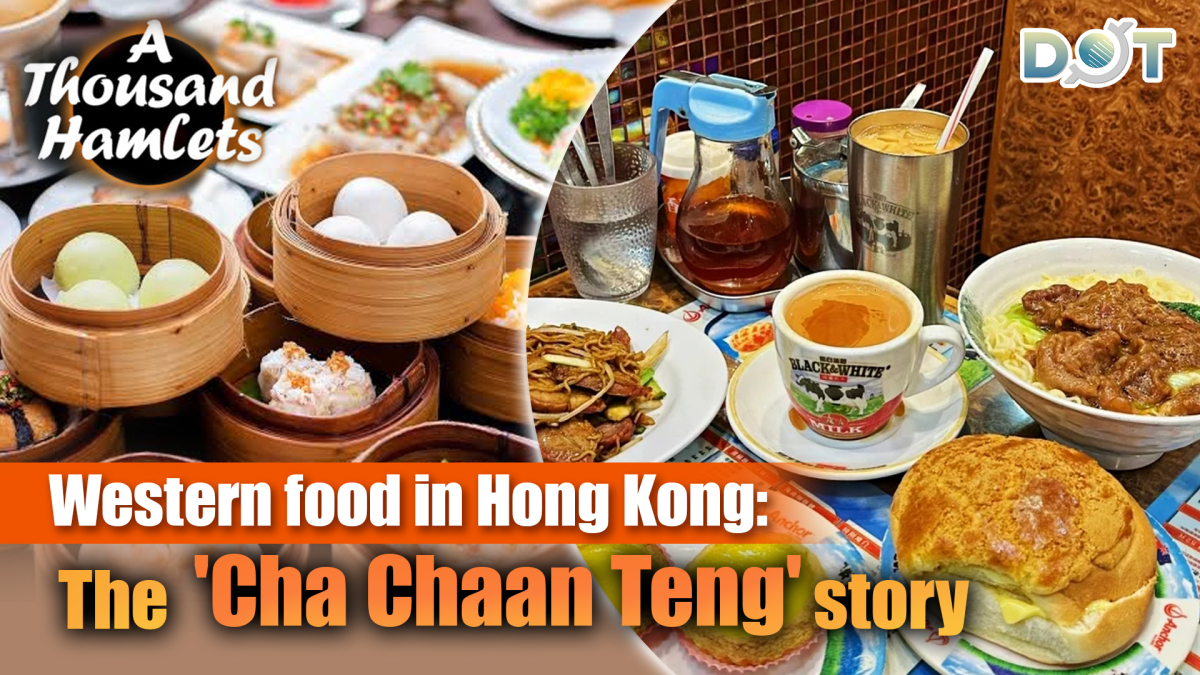
This stage came after World War II, and its clearest sign was the rise of the "bing sutt 冰室", or ice room. The bing sutt was influenced by British afternoon tea. It mainly sold coffee, milk tea, soft drinks, ice cream, and other light items, not full dinners. Its dishes were fairly cheap, and its customers were office workers and working-class people. After World War II, more people moved to Hong Kong. Most of these newcomers were ordinary working people. More demand for food pushed the bing sutt to grow and change. The earliest cha chaan tengs appeared at this point. But unlike the bing sutt, the cha chaan teng did not stop at drinks and desserts. It also served cheaper local street food and Western dishes. Today, Chinese and Western food sit side by side on the cha chaan teng menu, which shows how much Hong Kong people contributed to mixing Chinese and Western food cultures. In one of the world's most expensive cities, restaurants are one of the few things that stay affordable even for the poorest people. This deep cultural mixing shows local people's amazing creativity. "Yuenyeung 鴛鴦", for example, mixes tea and coffee. It is one of the most direct examples of Chinese and Western food cultures coming together.
The cha chaan teng is now a window into how Chinese and Western cultures have mixed over time. As a cultural symbol, it carries both cultures at the same time and in the same space in Hong Kong. Knowledge, society, and personal identity are all moving and tied to context. Western food was introduced, then local Hong Kong people imitated it, and in the end the cha chaan teng became a symbol of Hong Kong's own food culture. Western food kept its "home culture" while also joining actively with the "host culture".
I, too, have repaired many a time to establishments of the Macao and Hong Kong fashion, and there partaken of numerous occidental viands transmuted after local whim. Perchance the kitchen, to contend with the sultry, humid clime, lends them the ardour of chili; or, to gratify the native palate, bends them toward sweetness. These locally begotten creations I would fain designate "Hong Kong or Macao dishes," seeing that they belong neither to traditional Chinese cookery nor to that of the West.
The views do not necessarily reflect those of DotDotNews.
Related Readings:
A Thousand Hamlets | Seeking another Kawabata in Izu's summer chill
A Thousand Hamlets | Jeep girls and everyday encounters in postwar China




Comment