






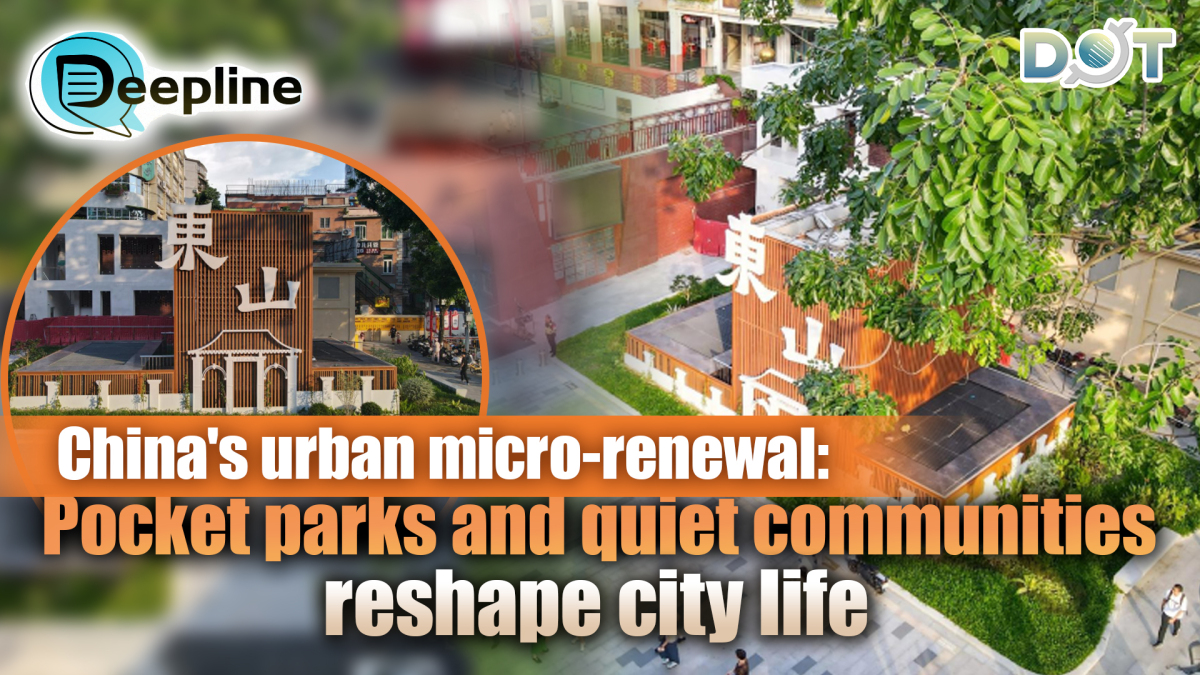
In the heart of Guangzhou's historic Dongshan district, a tiny corner pocket park has become an unexpected window for the international community to observe China's approach to urban renewal. In July 2026, Xinhua News Agency published an English feature titled "Pocket parks drive urban renewal, eco‑improvement efforts in China," highlighting the achievements of the country's pocket‑park programme. Among the selected case studies was the Dongshan Pocket Park in Yuexiu District – a prime example of how old cities can be revitalised through micro‑upgrades.
A 'Square‑Inch Battle' on Historic Ground
The park was completed at the end of August 2025, after a 30‑day intensive construction sprint led by the Yuexiu District Forestry and Landscaping Bureau, with design work by the Guangzhou Landscape Architecture Planning and Design Institute (GZLI). What made this project remarkable was not its size, but the complexity of its challenges – and the ingenuity of its solutions.
The site sits at a critical junction: it is the interchange of a commercial artery and a residential lifeline, the terminus of Bus No. 1, a key drop‑off point for Shupqian Road Primary School, and a gateway connecting the metro to the historic Xinhepu conservation area. Beneath the tarmac lie over five centuries of Lingnan memory – the Yongtai Temple of 1480, the Dongshan Temple of 1561, and the Dongshan Park built by public subscription in 1924. Yet before the renovation, the site was a concrete wasteland. Subway construction had stripped away most greenery, leaving only seven old trees and a large expanse of hardened cement. Morning commuters, school‑run parents, tourists seeking rest, and residents going about their daily routines all jostled for space in a chaotic, poorly managed lot.
Designing with Memory, Not Erasure
The project team agreed from the start that this was not a blank canvas. Three core questions had to be answered: how to untangle the chaotic traffic flows; how to cater to multiple user groups; and how to bring the lost memory of the century‑old park back into everyday life.
The seven ancient trees became the "spatial protagonists." Instead of starting with any structure, the designers built everything around them. The old, constraining tree‑pools were removed, and new terrazzo seating bases – inspired by the local terrazzo craftsmanship of the nearby Dongshan Meat Market – were installed to give both trees and people more room. For two trees whose bases stood 1.2 metres above ground, stepped seating gently wrapped around them, enlarging the resting area, bringing people closer to nature, and giving the trees space to breathe. "People lean against the trees, and the trees breathe freely" – the relationship shifted from confrontation to coexistence.
History was embedded underfoot rather than displayed on boards. The team distilled archival materials into "cultural story bricks" set into the pavement. Pedestrians now walk over inscriptions that recall the 1924 donation record, the 1561 temple chronicle, and the 1480 temple foundation. The flowing paving pattern abstracts the bustling traffic of the Xinhépu historical district, visually guiding the eye to the site's focal points.
Even the metro ventilation shaft – a major headache – was turned into an asset. Its grille was redesigned as a readable urban sculpture, architecturally echoing the vanished gatehouse of the old Dongshan Park. As light filters through the grille, shifting shadows give the "gatehouse" a voice that silently narrates history.
A "passageway" gallery, aligned with the route of Bus No. 1, became the only landscape shelter on site. Its façade uses the red‑brown hue of traditional Xinhépu buildings, echoing the bus's red heritage, while the interior adopts a Republican‑era yellow – the bus's signature colour. The gallery is more than nostalgic: it houses a plant‑science exhibition, a convenience store, and seating areas, combining memory display, education, and daily services.
Every group found its own reason to stay. Commuters got shaded benches; parents got an open plaza; residents got cosy gathering spots; tourists got story bricks and historic images. The park has no "keep off the grass" zones – all green spaces overlap with usable areas. The design avoids a purely visual "park" and instead creates a functional "living room" for the community.
A 30‑Day Sprint with Lasting Impact
Construction began in the summer of 2025, with a strict deadline: the park had to open by the start of the new school term. Working through heatwaves and pandemic precautions, the team completed site enclosure, demolition, material transport, civil works, and installation in just one month. The result: when the children of Shupqian Road Primary School returned to school, the former chaotic waiting area had been transformed into a readable, restful corner park.
Today, birdsong has replaced honking horns and shouting. The park is not only a haven for residents but also a popular spot for city walkers and social‑media check‑ins. More importantly, it has pioneered a sustainable operation model. Combining public welfare with market mechanisms, the government manages public maintenance and community events, while a private operator runs convenience services and cultural retail. A partnership with Yangcheng Tong has set up a "Little Yang Space" integrated service hub, offering affordable services to the neighbourhood. Revenue from cultural products and retail helps cover maintenance and public activities – a "park‑supported‑by‑park, government‑enterprise co‑construction" model that offers a replicable blueprint for long‑term pocket‑park management across China.
Nationwide, from 2021 to 2025, over 18,000 pocket parks were built. Micro‑renewal has become a key strategy in the 15th Five‑Year Plan for urban regeneration. Dongshan Pocket Park shows that even in a high‑density old city, an abandoned corner can be reborn – not by creating new memories, but by making old ones touchable, usable, and continuous. From the Yongtai Temple of 1480 to the Dongshan Park of 1924 and the pocket park of 2025, this plot of land has changed form and function, but its mission as a public urban space remains constant. The seven trees are still watching, Bus No. 1 still arrives and departs on time – but everything feels different. People now sit under the trees and read history under their feet.
Beyond Green Spaces: The Quest for Quiet Communities
Pocket parks are one facet of China's urban renewal; another, equally vital, is the fight against noise pollution – a growing challenge as cities become denser. In Yuxi, southwest China, 72‑year‑old Shi Jikun used to dread opening his windows because of the thud of balls and whistles from a nearby indoor sports venue. After two rounds of soundproofing – with acoustic materials on walls and double‑glazed windows facing the residential area – the noise abated. "The neighbourhood is quiet now," Shi said.
Such experiences are part of a national push to build "quiet communities," launched as a pilot project in May 2023. By the end of 2025, 3,272 quiet communities had been established, benefiting over 2.4 million households, according to the Ministry of Ecology and Environment. The drive now has stronger legal backing: China's Ecological and Environmental Code, which took effect on Saturday, includes a dedicated chapter on noise prevention.
The scale of the problem is clear from the numbers: in 2025, prefecture‑level cities received about 6.83 million noise complaints, with social‑life noise accounting for 73.2 %. Neighbour disputes, equipment failures, and disturbances from square dancing – a popular group exercise often held in public spaces – topped the list.
But quiet communities are not about total silence. "Quiet communities do not mean that there should be no sound," said Lu Lu, deputy head of the noise management division at the ministry. "The goal is to create a comfortable and harmonious living environment while balancing everyday activity with residents' need for quiet."
Solutions vary. In Shenzhen, new residential communities incorporate noise control at the design stage – low‑noise pavements, vegetation buffers, separate pedestrian‑vehicle routes, and automatic noise monitors. Older neighbourhoods, like Huiyu Garden in Hangzhou's Xiaoshan District, use renovation projects to replace ageing elevators and repair drainage grates. In Weihai, Shandong, residents, property managers, and square‑dancing groups agreed to end dancing at 8:30 p.m., with the main square lights switched off as a signal to wrap up.
Property managers in Shenzhen have even developed a visual noise‑management chart to monitor renovation work in nine stages, carrying out targeted inspections and enforcing designated working hours. The key, said Jiang Chunyan, head of a community committee in Weihai, is to respond quickly to complaints and give residents and activity groups a platform to negotiate solutions.
Challenges remain – quiet communities are still concentrated in a few cities, and older neighbourhoods or regions in central and western China lag behind. Some communities also struggle to sustain noise‑control measures after initial upgrades. The Ministry of Ecology and Environment plans to integrate quiet‑community development into the national noise‑control work plan for 2026‑2030, with regular inspections and follow‑up visits to ensure lasting effectiveness.
Zheng Shanshan, an ecological official in Hangzhou's Xiangfu Subdistrict, noted that the next step is to extend noise management from individual communities to larger areas using tools like sound‑environment maps. "Quiet communities are only a starting point," Zheng said. "We hope to create more quiet spaces across the city."
A Shared Vision for Livable Cities
Whether through a tiny pocket park that resurrects five centuries of history or a quiet‑community programme that restores peace to daily life, China's urban micro‑renewal efforts share a common philosophy: put people at the centre, respect local context, and design for everyday use. The Dongshan Pocket Park and the nation's quiet communities are not isolated projects – they are parts of a larger movement to make high‑density cities more liveable, more humane, and more sustainable. And in doing so, they offer valuable lessons for cities around the world grappling with similar challenges of growth, density, and quality of life.
(Source: Xinhua, Guangzhou Government, People's Daily | Editor: Liu Yu)
Related News:




Comment