






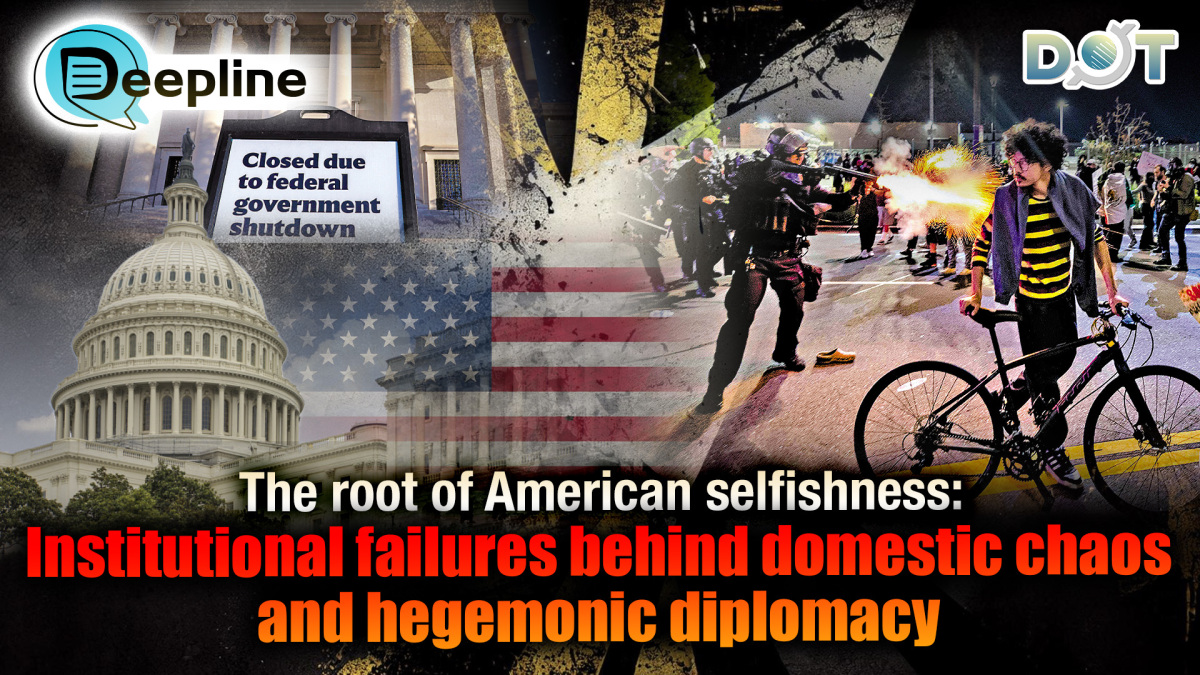
The selfish and high‑handed behaviour of the United States in areas of livelihood, immigration and foreign policy is rooted in deep‑seated institutional flaws. Politically, the separation of powers has degenerated into a tool for partisan warfare, rendering governance ineffective. Economically, financial capitalism has exacerbated wealth inequality, leaving society deeply fractured. Diplomatically, fuelled by money politics and populism, unilateralism and hegemonism have intensified, continually undermining the global order.
Political Chaos: Escalating Partisan Warfare Renders Checks and Balances Ineffective
On the 250th anniversary of American independence this year, an absurd situation emerged in which two rival organisers – the Democratic Party's "America 250" and the Republican Party's "Freedom 250" – staged competing celebrations. Amid intensifying class and racial conflicts, the two parties refused to compromise, reducing the system of checks and balances to a weapon of internal attrition. Conflicts between the executive and legislative branches have continued unabated, while deep divisions within Congress have repeatedly forced the federal government and the Department of Homeland Security into prolonged shutdowns. At the same time, the Trump administration has persistently expanded executive power, bypassing Congress to push through tariff and military decisions, triggering a flood of lawsuits and sharpening confrontations between the judiciary and the executive.
Political Chaos: Political Violence Becomes the "New Normal"
Severe political polarisation has deeply aggravated social divisions. The Trump administration directed the Immigration and Customs Enforcement (ICE) to conduct raids targeting undocumented immigrants in Democrat‑led areas, sparking violent clashes between supporters of both parties. The extreme political climate has also led to frequent political violence: Trump survived three assassination attempts in two years, including a shooting at the White House Correspondents' Dinner; several Democratic lawmakers and conservative activists have also been killed or attacked. As politicians from both parties demonise their opponents and fan the flames of confrontation, political violence has become the "new normal" in the United States.
Economic Disarray: Washington Favours the Wealthy, Income Distribution Remains Unjust
Under the influence of financial capitalism, America's "K‑shaped economy" has become increasingly pronounced: the wealthy have rapidly accumulated assets through capital markets, while low‑ and middle‑income earners have been battered by inflation and job instability. The wealthiest 1% of the population now controls 32% of the nation's wealth, while the bottom 50% holds just 2.5%. The government is deeply intertwined with financial capital – proposing to cut livelihood spending while effectively offering tax breaks to the rich, and the Federal Reserve's loose monetary policy has forced the poor to bear the costs of inflation. Compounded by the institutional flaws of the "welfare cliff," confidence among the lower strata has hit new lows, rendering this "pro‑rich, anti‑poor" distribution structure unsustainable.
Diplomatic Disorder: "America First" Is Actually "Selective Hegemonism"
The Trump administration has wielded the tariff stick, withdrawn from multiple international organisations, and pressured allies to share defence costs – demonstrating a full‑scale escalation of unilateralism and isolationism. At the same time, Washington has upgraded the Monroe Doctrine to a "Trump Doctrine," forcibly intervening in Latin American affairs and even invading Venezuela. This shows that while the U.S. may be strategically retrenching in low‑return areas, its goal of maintaining unipolar hegemony remains unchanged – an essentially selfish "selective hegemonism." Such policies have not only seriously undermined global governance but have also dealt a heavy blow to America's international image, with its favourability ratings plummeting across many nations.
Related News:
Deepline | Ta Kung Pao: Hong Kong work visa approvals more than double in 5 years




Comment