






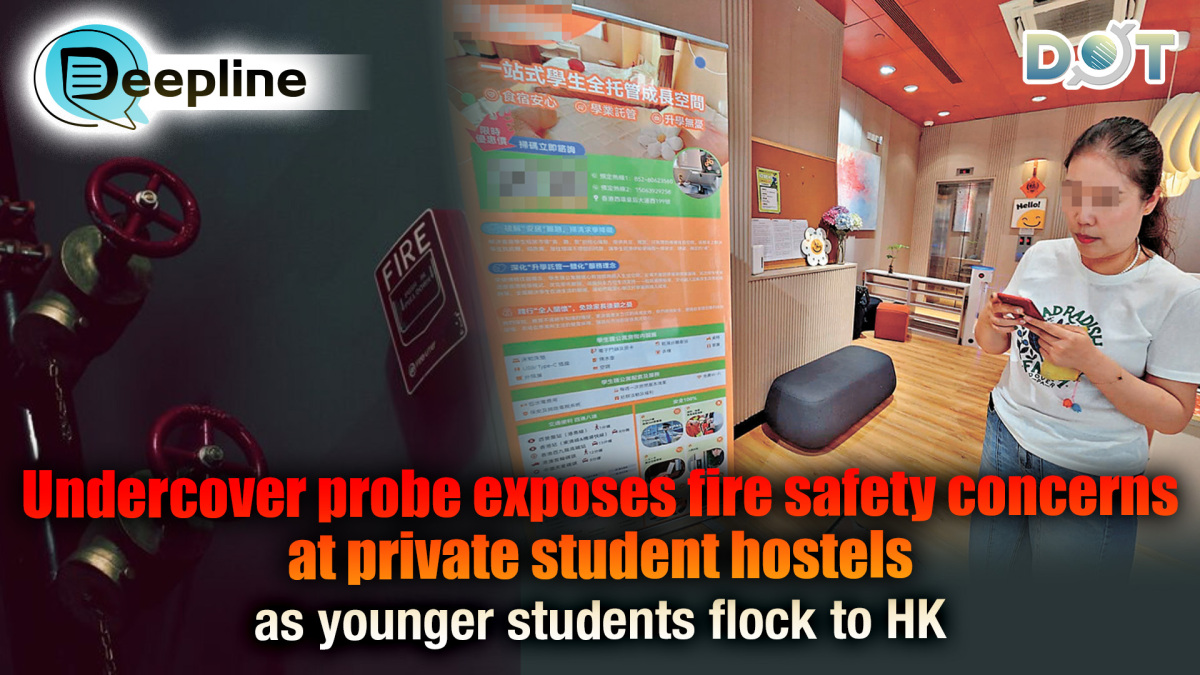
"Study in Hong Kong" has become a calling card for the city, with an increasing number of younger students coming to HK for their education in recent years. Even primary school pupils are now joining the ranks of overseas students. But while HK is increasing the number of places available to students, are other supporting facilities and arrangements ready?
Wen Wei Po conducted an in-depth investigation into student accommodation, visas and residency arrangements, guardianship and other issues.
To ensure that public funds are used appropriately, the Hong Kong Special Administrative Region government revised the eligibility requirements for subsidized university places last year. Under the revised policy, children of people admitted to HK under schemes including the Top Talent Pass Scheme must have lived in HK for at least two years before becoming eligible to apply for subsidized places at the city's eight universities and other post-secondary institutions. The policy will be fully implemented from the 2028-29 academic year.
As the implementation deadline approaches and the number of students coming to HK for education continues to rise, the Wen Wei Po investigation found that private student hostels have sprung up across the city, with some even offering accommodation to underage primary school students.
Reporters visited several student hostels and found that annual accommodation fees could approach HK$200,000. In terms of the number of occupants allowed in bedrooms and the number of students attending tutoring classes, among other arrangements, some operators appeared to have found ways to avoid the requirements of laws including the Hotel and Guesthouse Accommodation Ordinance and the Bedspace Apartments Ordinance.
The ratio of staff to students was also seriously disproportionate, with children left alone in bedrooms without adult supervision. Education and legal professionals have urged the HKSAR government to strengthen regulation to ensure that private student hostels meet fire safety and child-care requirements and safeguard HK's reputation as a destination for overseas education.
Undercover reporter visits student hostel in Sai Wan
Recently, a Wen Wei Po reporter posing as a parent visited a student hostel in Sai Wan.
According to local residents, the hostel had operated briefly for about a year several years ago before suddenly ceasing operations. It only resumed business recently.
The hostel occupies a 20-storey standalone building. The lower floors, including the fourth and fifth floors, contain a dining hall, activity rooms and other communal facilities, while the upper floors are used for bedrooms. There are two bedrooms on each floor, with each room accommodating two students.
Receptionist claiming to be a "teacher" keeps close watch and repeatedly checks reporter's identity
Security at the hostel was tight. Visitors had to verify their identities before being allowed through an electronic gate into the ground-floor lobby.
A receptionist who identified herself as a "teacher" kept a close eye on the reporter throughout the visit and repeatedly checked the identity before eventually allowing the reporter to tour the premises.
The staff member said that because it was still the summer vacation, all residents had returned to their hometowns and the floors were empty on the day of the visit.
She took the reporter to a "show unit" on an upper floor. The standard twin room contained two single beds and two desks, as did the other bedroom on the same floor.
The staff member said the hostel had been operating for a year and that its rooms were in high demand.
"Almost all the rooms have been rented out. There are only a small number of beds left. Has your child already chosen a school in HK? If you want to rent one, you should hurry," she said.
She said most of the residents were primary school pupils, with some secondary school students as well.
"They all attend ordinary government-aided schools in HK. Their parents work or run businesses on the mainland, so they leave them in our care," she said.
Accommodation costs more than HK$10,000 per month, with families required to pay more than HK$200,000 upfront for a full year. The hostel also provides school bus services, as well as breakfast and dinner from Monday to Friday.
One of the twin rooms visited by the reporter had windows and a bathroom with separate wet and dry areas, and was relatively spacious. But questions about safety arrangements revealed a series of concerns.
The staff member acknowledged that the bedrooms were normally occupied by only two students, with no adult staff members present. A security guard would occasionally patrol the floors.
Closed-circuit television cameras covered only communal areas such as staircases and corridors. There were no cameras inside the bedrooms, nor any emergency call system.
"Don't worry. There is one dormitory supervisor for every five students. Boys and girls live on separate floors, and they only come into contact with each other in the dining hall and other communal areas," the staff member said.
Staff member avoids question about overnight supervision
The reporter subsequently expressed concerns about potential inappropriate contact between male and female students.
"Although the boys' and girls' bedrooms are on different floors, students can still meet each other by using the stairs to go between floors," the reporter said.
The staff member simply responded that there was "monitoring" and that they had "never encountered" such a problem.
The reporter then asked whether dormitory supervisors stayed overnight at the hostel. The staff member was evasive.
When the reporter further requested to meet a dormitory supervisor, the request was rejected on the grounds that "the dormitory supervisor is not here."
The staff member stressed that "our dormitory supervisors are highly experienced, with more than 30 years of experience."
More importantly, when applying for accommodation, parents are required to sign a guardianship authorization form. However, the staff member explicitly stated that the institution's role as a "guardian" was limited to serving as an emergency contact.
If a student suffered an accident in HK and required surgery at a hospital, the parents would have to come to HK in person to sign consent forms and other legal documents. In day-to-day operations, the institution only communicates with parents through WeChat groups.
Hostel converted from guesthouse claims to comply with fire regulations
The hostel was reportedly converted from a guesthouse. The staff member claimed that it complied with HK's fire safety regulations and was equipped with automatic sprinkler and fire suppression systems.
She said that a curfew would be imposed after 8:30 p.m. The electronic gate on the ground floor would then be locked, allowing people to enter but not leave.
"If there is a fire, the security guard downstairs will immediately unlock the doors and the escape routes," she said.
However, even if the building complies with the fire safety regulations applicable to guesthouses, the hostel has not necessarily taken into account the fact that its residents are all minors, meaning fire safety requirements may need to be more stringent than those for ordinary guesthouse guests.
Questions also remain over whether the access controls and emergency evacuation arrangements on each floor could make it more difficult for students to escape in the event of a fire.
Nearly all 80 beds rented out as parents cite word-of-mouth referrals
"Children of people admitted under the Top Talent Pass Scheme need to live in HK for two years before becoming eligible for subsidized university places, and applications from Top Talent Pass children for accommodation have surged this year," a staff member at another student hostel group told the Wen Wei Po during an undercover visit.
During the visit, the reporter happened to meet a mainland parent who had come to pay the accommodation fees. Posing as another parent, the reporter struck up a conversation with her.
The parent said she was from northeastern China and that the child would come to HK after the summer vacation to enter secondary four. She had chosen the institution on the recommendation of a friend.
When asked whether the hostel held a business license, she simply replied: "I don't know. I only came because a friend recommended it."
The student hostel group operates on a considerable scale, with five hostels in total. Three are dedicated to secondary school students, while the other two accommodate primary school pupils.
During the undercover visit, the reporter was taken to a 23-storey hostel for primary school students.
According to the person in charge, the first to third floors are used for leisure and communal facilities, while the remaining 20 floors are residential. Each floor contains a single apartment, with each unit measuring 329 square feet and accommodating four students in one room.
The entire building has 80 beds, nearly all of which have been rented out.
The hostel offers two service models—"semi-supervised" and "fully supervised"—costing RMB 14,700 and RMB 17,500 per month respectively. Both include accommodation and meals.
The difference is that the fully supervised package additionally includes after-school academic supervision and guardianship services.
The person in charge said the hostel employs five or six dormitory management staff referred to as "teachers."
"They are mainland female teachers who came to HK and have teaching experience. Most of them have postgraduate degrees, and all of them hold first-aid certificates and certificates showing they have no criminal records," she said.
Under the guardianship arrangements, parents must sign authorization documents allowing the "teachers" to communicate with schools, handle daily affairs and receive notices on their behalf.
"The teachers will say that they are the student's aunt when attending parents' days at school," the person in charge said.
However, she stressed that major matters such as signing consent forms for surgery at hospitals must still be handled by relatives in person. The institution can only accompany the student.
Students do not have to report outings to teachers
Although the hostel has a curfew prohibiting students from going out after 9 p.m., there are no restrictions on outsiders entering the premises.
The reporter further asked: "Do students need the teachers' permission or have to report to them before going out?"
The person in charge replied: "No."
EDB urges non-local students to choose compliant accommodation carefully
Secretary for Education Choi Yuk-lin had previously reminded non-local students coming to HK to study to "carefully select compliant accommodation facilities."
She said she had noticed that some student hostels, dormitories and student apartments were being promoted through platforms frequently used by mainland people, such as Xiaohongshu and WeChat.
"Everyone must pay close attention to this. If the accommodation facility provides educational services such as tutoring or homework assistance, and the number of students on the premises reaches eight or more at any one time, or 20 or more in a day, it must be registered or provisionally registered as a school under the Education Ordinance. Otherwise, it is operating illegally," Choi said.
Ma Yan-kwok, chairman of the Hong Kong Legal Exchange Foundation and a barrister, told the Wen Wei Po that HK currently has no dedicated licensing and regulatory system specifically designed for private student hostels.
Most private hostel operators do not possess professional qualifications for caring for and supervising minors, creating potential safety risks, he said.
He suggested that the government draw on HK's existing regulatory system for subdivided units and introduce requirements for the ratio of dedicated supervisory staff to students to address gaps in safety management.
The student hostels visited by the reporter during the undercover investigation appeared to avoid regulation under all the relevant ordinances, according to the report.
Under the Hotel and Guesthouse Accommodation Ordinance, for example, any premises providing paid accommodation must obtain a license if the rental period is less than 28 consecutive days.
Student hostels generally rent rooms for at least an entire school term, which is well beyond the 28-day threshold for licensing.
The Bedspace Apartments Ordinance, meanwhile, applies only to residential units containing 12 or more bedspaces. With each bedroom in the student hostels accommodating between two and four students, the hostels again fall outside the scope of the law.
(Source: Wen Wei Po)
Related News:
Opinion | Knowledge is hard currency: Academic strength will underwrite HK's long-term prosperity




Comment