






By Zheng Yuduo
On the twenty-third of July, 2026, Keigo Higashino, master of Japanese mystery fiction, passed away from colorectal cancer at the age of sixty-eight.
When we speak of his works, what exactly are we speaking of? The grim calculus of murder? The seamless geometry of a locked room? The cold arithmetic of a prolific killer? In his novels, you will search in vain for such stock images and stock villains that crowd the common detective story. And yet, why have they endured for decades, cherished by millions?
At twenty-seven, Higashino penned his debut, After School, which at once claimed Japan's highest honour in mystery writing, the Edogawa Rampo Prize. Born of the "Orthodox School" (本格派) of mystery fiction, and famed for it, he soon grew restless within its gilded cage. He turned his gaze beyond the whodunit, beyond the final deduction and ventured into the territory where crime casts its longest shadow: the realm of Social Mystery (社会派).
The unveiling of truth is not an ending, it is a beginning. This belief marks one of the sharpest divides between Keigo Higashino and his fellow mystery writers. Once the case is closed, once the truth is laid bare, once guilt is fixed and the offender answers to the law—what then of those who remain? How do the living carry on? What ripples disturb their days, what turns bend their futures, and into what unfamiliar shapes are their lives remoulded? These are the questions that haunt the 106 works Higashino left behind, and they are also posed to the readers.
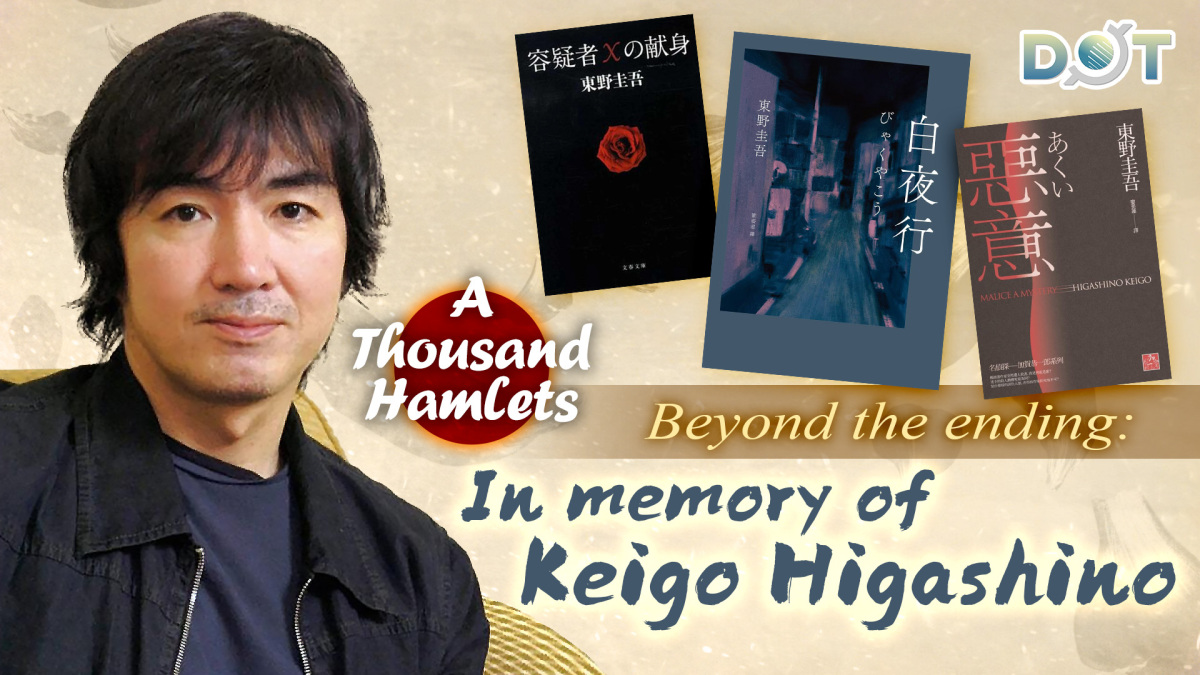
Journey Under the Midnight Sun 白夜行, stands among Keigo Higashino's most celebrated works. The narrative takes root in two protagonists' childhoods: Ryoji, who as a boy witnesses his mother's adultery, then stumbles upon his father's violation of Yukiho, and in that searing moment, drives scissors into his father's chest to shield her; and Yukiho, sold by her own mother into a cycle of sexual abuse from her earliest years. Their blighted beginnings eventually sow a harvest of ruin that claims not only themselves, but many others caught in the widening gyre. Yet this novel never lingers over murder methods or crime scenes. Instead, it dwells with unflinching intimacy on the crooked contour of their coming-of-age, and on the interior monologues of souls slowly eaten away by vengeance and shadow.
Malice: A Mystery 惡意, from my perspective, is the most penetrating work in which Higashino lays bare the darkest recesses of humanity. Osamu Nonoguchi, a struggling writer, murders Kunihiko Hidaka, the celebrated author who had helped him several times, and then deploys every artifice at his disposal: he usurps the dead man's identity, fabricates diary entries to incriminate his victim, and nearly succeeds in recasting himself as the aggrieved party. When the truth finally breaks through his web of lies, his confessed motive proves almost absurdly simple, nothing more than envy, born of the bitter realisation that Hidaka, who had once lagged behind him in childhood, had soared far beyond his reach in later life. Envy that curdled into a madness of hatred. After closing this book, I believe most readers will find themselves chilled to the bone by the abyss of darkness that dwells within the human heart.
Among all of Higashino's works, the sole recipient of the Naoki Prize (直木三十五賞), Japan's highest literary honour, is The Devotion of Suspect X 嫌疑犯X的獻身. This novel boasts neither a convoluted murder plot nor an excessive cast of characters. To shield a mother and daughter from the consequences of accidentally killing the former husband, the mathematician Ishigami murders a vagrant to serve as a decoy, and orchestrates an elaborate misdirection that sends the police chasing shadows. His sole motive springs from a single moment: he had once stood on the brink of suicide, only to be saved by that mother, Hanaoka Yasuko. From that instant, he pours forth his purest love and wields his formidable mathematical logic to construct a fortress around the pair—and he very nearly succeeds. The emotional crescendo of the book arrives at its final pages, when Yasuko, guided by her own conscience, chooses to surrender; Ishigami's masterful scheme crumbles at the last gasp, and his soul shatters in utter collapse. This ending crowns no victor, offers no redemption to anyone, only the collision of ultimate rationality and ultimate love, leaving the reader in silent awe.
Most of Higashino's novels tread this same ground. For him, the heart of storytelling lies not in the truth itself, but in the society that gives it shape, the justice that trembles in the balance, and the people who must continue living in its aftermath. When love crosses swords with justice, and goodness stands opposed to the law, those of us who share the same world will find it difficult, perhaps impossible to draw clean lines between right and wrong. Even after a case is closed, the lives it has touched continue to unfold in ways that linger and trouble the mind: the criminal goes to prison, yet his family serves a silent sentence of their own; to protect the one you cherish, you may have to weigh the cost of an innocent's life; the dead may at last have the truth laid bare, but by then their reputation has long since been scattered to the winds. Good and evil seldom wear clear-cut faces, they shift, they merge, they coexist. Right and wrong defy any single, fixed definition. In Higashino's fiction, what ultimately commands our gaze is always the ones still alive.
Higashino has now left us, but the contemplation of his work should not cease. Yet over more than forty years of writing, the questions he raised about humanity, fairness, and justice—he never offered any definitive answers. Perhaps, in the end, no such answers were ever there to give.
Zheng Yuduo is the Assistant Teaching Officer of Lingnan University. Zheng holds a BA in Global Development and Sustainability from Lingnan University and an MA in History from HKU.
The views do not necessarily reflect those of DotDotNews.
Related Readings:
A Thousand Hamlets | 1997 cinema in dreams, long reconciliation and starting over
A Thousand Hamlets | Tragedy at the Hong Kong International Shakespeare Festival




Comment