






By Liu Yu
Today is July 1. As we mark the 29th anniversary of Hong Kong's return, approaching the subject through films that played in both Hong Kong and the mainland in 1997 offers a lens full of tension. If we step away from the celebratory glare and turn back to the dim cinema halls of 1997, we find that what unfolded on screen that year was far more complex than the handover ceremony itself—it was the manifestation of several dreams, disconnected yet secretly interpenetrating, that precisely reflected the turbulence where grand historical transformation intersected with individual fate.
At midnight on July 1, 1997, the flag came down and went up at the Convention and Exhibition Centre. In the months before, another, quieter migration had been secretly taking place on celluloid, like migratory birds sensing a shift in the magnetic field before the storm.
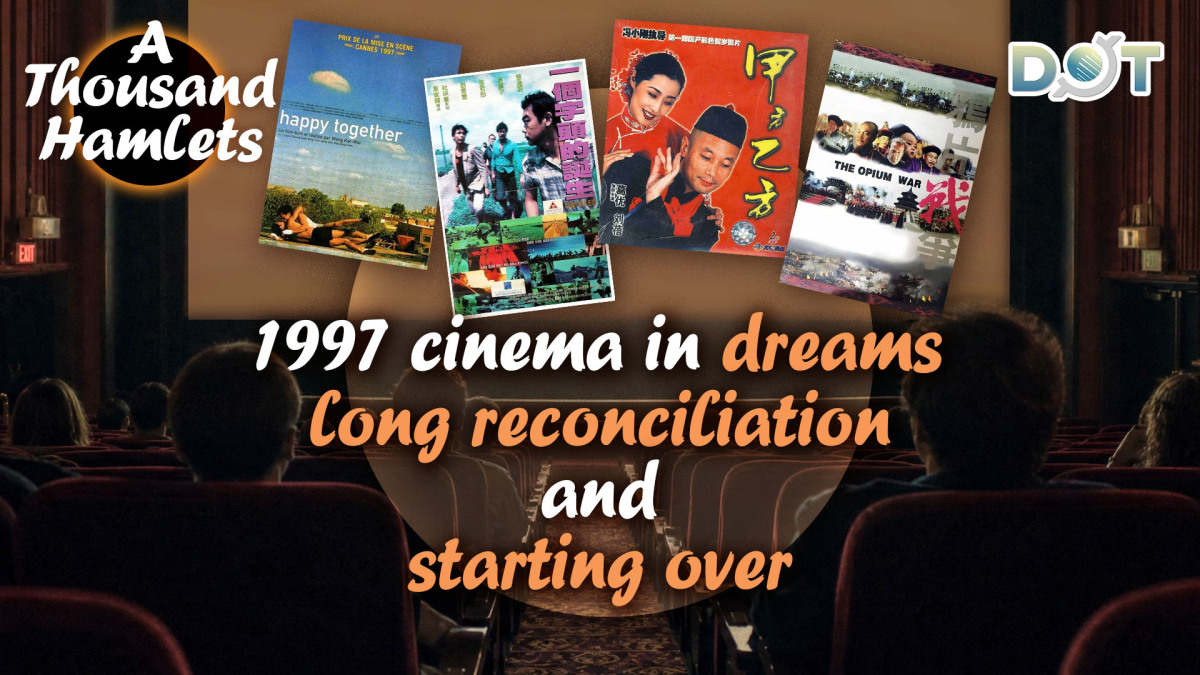
Wong Kar-wai dedicated the closing credits of Happy Together (春光乍洩) to an old man, but the Lai Yiu-fai and Ho Po-wing beneath his lens were wearing each other out at the southernmost tip of the earth, in Buenos Aires. That city felt like an enclave—reversed seasons, an unfamiliar Spanish tongue, a messy kitchen, and a revolving lantern painted with the Iguazu Falls they could never reach. Ho Po-wing kept murmuring, "Let's start over." It was not a vow, but something closer to divination, cast repeatedly in the language of love in the face of the unknown. The Hong Kongers trapped in a foreign land wanted to go back but couldn't—and this geographical displacement was the most profound psychological mirror: the return was not an arrival, but an endless suspension and desire of the very notion of "going back." When Lai Yiu-fai stood alone beneath the falls and felt that "the person standing here should have been two," there was no history in the spray of water—only the lingering echo of a dislocated era.
At the same time, Wai Ka-fai, in Too Many Ways to Be No. 1 (一個字頭的誕生), unfolded a nearly cruel deduction of fate. The small-timer Wong Ah Gau stood at a fork in life, and Milkyway Image gave him two hypotheticals: go to Zhanjiang and die in a pool of blood; go to Taichung and end up paralysed and betrayed. The gestures of the underworld intertwined with legends of a "great limit," and every choice led to a black joke. Most striking of all, the entire film is composed of a string of "what ifs" that can never be replayed; in the end, it seems that only at the razor's edge of self-destruction is there a faint chance to reclaim one's "character." This profoundly pessimistic view of time was less about fate than about Hong Kong people's most visceral imagination at the word "future" at history's turning point, which offers no answers—only a display of choices.
The most torn and unyielding scene came from Fruit Chan's Made in Hong Kong(香港製造), released shortly after the handover, marking a blooming in the "post-97" period. Chung-chau—an abandoned youth on the margins, toyed with by the triad world—cares for his intellectually disabled companion Ah Lung in a public housing estate and falls in love with the terminally ill Ah Ping. The love letters he writes to Ah Ping are stained with blood, cheap perfume, and fantasies that have sunk to the dust. Finally, on the Mid-Autumn Festival, under the autumn sun, Chung-chau runs among the graves, completing his youth's sacrifice that no one noticed. That rough DV-like footage is a noisy memorial to lives silenced by the past era.
If these works were murmurs trapped in the cracks of time, the mainland screen was calmly settling historical accounts. Xie Jin's The Opium War (鴉片戰爭) was released in June 1997, and in its sombre, serious tone, it framed the cession of Hong Kong as a national "baptism." Bao Guo'an's Lin Zexu—a gaunt silhouette in the tradition of Zhao Dan—sent smoke rising over Humen Beach, as if performing a belated exorcism. The pain of "backwardness invites beating" was recast as a collective psychological closure of "shame spurs courage." The film's Qishan lets out complex sighs, but more of its frames are trained on cannon emplacements, dragon banners, and commoners addicted to opium. The humiliation of a century and a half ago was finally narratively settled in the fireworks of the return ceremony. Yet when the epic curtain fell, what truly brought warmth to the common people was Feng Xiaogang's The Dream Factory (甲方乙方), released at year's end. In the "Good Dream One-Day Tour" company, one character after another queues up to indulge their fantasies of being a general, of suffering, of reunion—deconstructing all weight into cunning amusement within virtual dream fulfilment. At the film's end, Ge You raises his glass and says, "1997 is gone, and I miss it." The tone is neither sad nor happy, like closing a well-read old novel—light, self-contained, even with a touch of gentle perfunctoriness. This "lightness" was precisely the mainland's way of dissolving the hard kernel of history at that time: while Hong Kongers tossed and turned in nights before the handover, Beijingers had already learned to treat "life" as a customizable, refundable consumer experience.
Looking back today, this cluster of 1997 film fragments inadvertently created a double exposure of history. The Opium War explained the past; The Dream Factory settled the present; while Happy Together, Too Many Ways to Be No. 1, and Made in Hong Kong spoke of the hesitation before change. They wander in the fissures of time, speaking of farewell and rebirth in a language close to dream-talk.
Twenty-nine years have passed, and the dust is far from settled—it has only changed form. Hong Kong cinema, from its focus on small details to its exploration of the personal soul, has historically relied on strong social critique, police-gangster drama, and contemporary anxieties as its selling points, while co-productions have become mainstream and structural adjustments in the local market. The mainland film market, with commercial maturity and a thaw in creative thinking, has undergone revolutionary progress. Hong Kong-style comedies like Table for Six (飯戲攻心) can now draw laughter from mainland audiences, and Hong Kong faces appear in the cosmic expanse of The Wandering Earth (流浪地球). This feels like a new, barely perceptible coexistence. But perhaps only by returning to the shadows of those 1997 reels can we more deeply understand the true weight of that line, "Let's start over"—not an escape, not a surrender, but after fully acknowledging that "we can never go back," to still whisper in one's heart the possibility of a new beginning.
It is the courage, after recognizing that the face in the mirror belongs simultaneously to oneself and to a stranger, to still push open the door and step onto a fork in the road never before taken.
The film fragments left behind that year are the very origin of this long reconciliation.
Liu Yu is the lead editor of the cultural commentary "A Thousand Hamlets." Liu holds a BA in English Literature from HKBU and an MA in History from HKU.
The views do not necessarily reflect those of DotDotNews.
Related Readings:
A Thousand Hamlets | Tragedy at the Hong Kong International Shakespeare Festival
A Thousand Hamlets | Between tradition and the world: The everyday poetics of Ye Si




Comment