






By Xu Xi
In discussions of Hong Kong writer Ye Si (Leung Ping-kwan, 1949–2013), critics have long tended to classify his literary style under Western modernism or postmodernism. He graduated from Baptist College with a degree in English, then earned a PhD in Comparative Literature from the University of California, San Diego. From the 1970s onward, he introduced the French New Novel and Latin American literature to readers in Hong Kong and Taiwan through translations and critical essays. The modernity that flows through his poetry and fiction was indeed shaped in part by Western avant-garde cinema and literature. Yet this persistent label of "(post)modernism" has, to a considerable degree, obscured a vital strand in Ye Si's literary lineage—his deep nourishment by the Chinese literary tradition. This emblematic figure of Hong Kong literature had his roots sunk, in fact, in classical Chinese literature and the modern vernacular poetry since the May Fourth era. Around the time of the 1997 handover, Ye Si's poetic excavation of Hong Kong's everyday life was also shaped by the "aesthetics of opposition" developed by Chinese modernist poets in the 1930s and 1940s.
Hidden Roots: How Tradition Transforms in the Modern Neon Lights
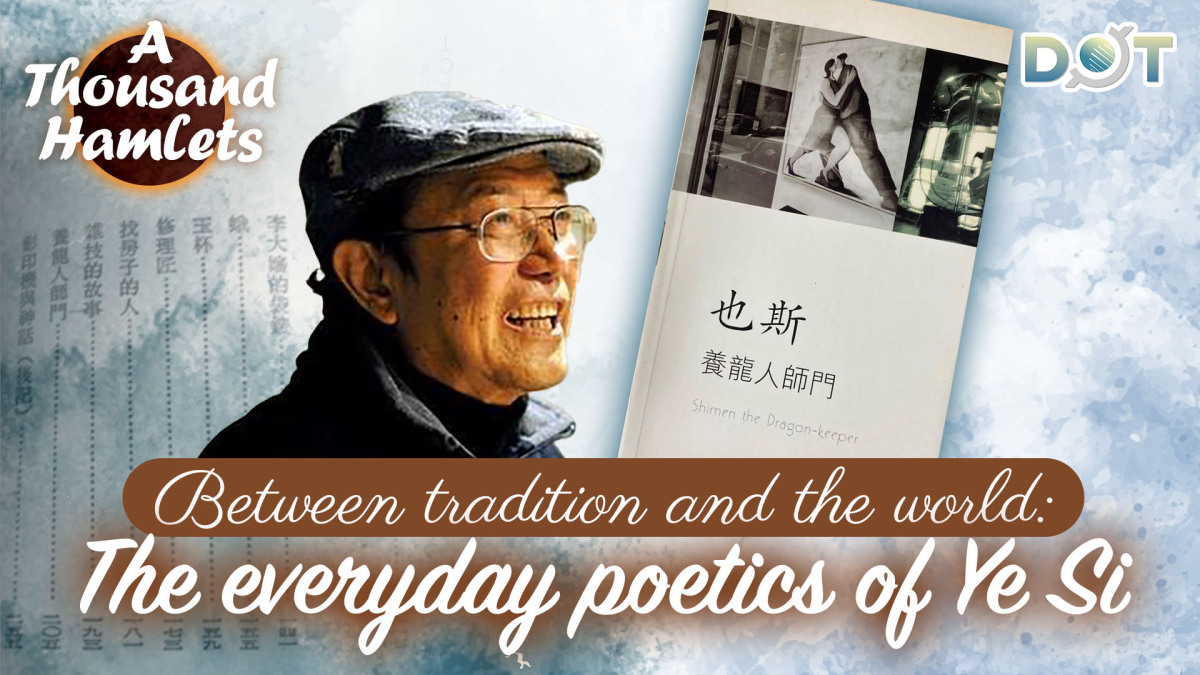
Ye Si's absorption and transformation of classical Chinese literature is already evident in his early story "Master Men, Keeper of Dragons" (1979), which draws its prototype from the Liexian Zhuan, a collection of tales about immortals and holy figures from the pre-Qin period. Then, in 1999—the early years after the handover—he composed the poetry sequence "Eleven Strange Tales" (Zhi Yi Shi Yi Shou 誌異十一首), directly borrowing the classical framework of Pu Songling's strange tales to probe urban alienation in Hong Kong through fantastic fiction, and to search for the humanistic spirit within a commercialized society. Pu Songling wrote of ghosts and foxes by a solitary lamp in the early Qing dynasty; Ye Si wrote of the city in the neon-lit years after 1997. Separated by centuries, both were engaged in the same essential act of "strange tales": within a shifting society, finding a space where the individual might settle body and mind. In Ye Si's hands, classical tradition is not a dead relic but a living, dynamic tool for reflecting on the present—a modern narrative instrument.
Ye Si drew inspiration not only from classical literature; his poetry never strayed from the broader lineage of modern Chinese vernacular verse. During the Cold War, Hong Kong played a unique role as a cultural intermediary. As Ye Si wrote in his preface to Ma Lang's poetry collection The Iconoclast Who Burned the Qin(焚琴的浪子): "It was through writers of the previous generation such as Liu Yichang and Ma Lang, that we came to engage more fully with the May Fourth tradition of new literature … To look back at how their generation continued and developed the May Fourth tradition, absorbing and transforming foreign modernism, is meaningful for us." Ye Si was not merely an inheritor of this tradition; he became its overseas "ferryman." From the 1980s onward, he translated and introduced the works of many modern Chinese poets into English. He assisted his mentor, Yip Wai-lim, in compiling and translating Lyrics from Shelters: Modern Chinese Poetry 1930–1950, which introduced the "Nine Leaves" poets to Western readers for the first time, extending the international reach of modern Chinese poetry. His doctoral dissertation, completed in 1984, Aesthetics of Opposition: A Study of the Modernist Generation of Chinese Poets, 1936–1949, was among the earliest systematic scholarly studies of Chinese poetry from the 1930s and 1940s, both in China and abroad—a work of considerable academic distinction that left a lasting mark on Chinese poetry scholarship in the international sinological field.
The Resilience of the Everyday: Local Practice of the "Aesthetics of Opposition"
It was precisely the literary nourishment in the work of Bian Zhilin, Mu Dan, and other outstanding poets of the 1930s and 1940s—writing that combined the critical spirit of May Fourth with classical poetic aesthetics—that Ye Si distilled into his doctoral concept of the "aesthetics of opposition": confronting the "past" with the "present," challenging conventional or commercial language, escaping linear expression, rejecting the commercialization of culture, and resisting both ossified tradition and capitalist civilization. He used this framework to characterize the aesthetic qualities of Mu Dan's generation of poets, and it helped him identify the most important poetic concept in his own creative work: the quality of everydayness.
Hong Kong, around the time of the 1997 handover, faced multiple pressures: the sweeping commercialization of capitalism, the consumer culture industry, the overwhelming grand narratives of political transition, and the fierce speculation filling the newspapers and television screens. Ye Si took no part in those high-pitched, slogan-driven forms of expression. Instead, through descriptions of vegetables, fruit, cha chaan tengs (Hong Kong-style cafés), and old neighborhoods, he expressed what might be called "the resilience of the everyday": using the most familiar, concrete, and intimate objects and spaces to offer a quiet comfort to Hong Kong people living through a turbulent era. In his "Ode to the Bittermelon" (給苦瓜的頌詩,1988) he wrote: "The loudest song's not necessarily passionate; the bitterness pain stays in the heart, because you've seen lots of false sunlight, too much thunder and lightning, hurt and hurting." The bittermelon was his way of taking a stance—not meeting intensity with intensity, but with a quiet tenacity, "insisting on a different flavor" in a world of "bees and butterflies, of wild grasses and flowers," "cleansing the world of its feverish heat" and "refreshing and brightening our eyes."
When grand historical discourse attempted to reformat individual memory, Ye Si retreated to the wet market and the rhythms of daily life. He gazed at a bowl of the most ordinary plain congee and saw in it "the unceasing trials of this mortal world," yet urged us to "taste quietly the many lives within a bowl of plain, unflavored congee." He passed through the alleyways of Central, witnessing "bright red cherries on a fruit stall," "a child tying a crab with a rush of salted grass"—and in those seemingly trivial everyday fragments, he found the most solid ground for poetry. He even "traveled with a bitter melon" (1998), wondering whether it "had looked around curiously on the plane, or cried from hunger," dissolving with this near-childlike tenderness the weight and anxiety hidden beneath transnational travel and shifting identities.
Through his writing, Ye Si demonstrated that the subjectivity of Hong Kong culture need not be built on grand, airy abstractions or abstruse theoretical language—it lives, in fact, within these smoky, mixed, yet resilient everyday lives. His own summary of his creative posture appears at the end of "Midday, Quarry Bay" (1974): "Sometimes I walk to the hillside to observe the stones / learning to be as hard as them / Life is unceasing blows / too many obstacles, too much shattering / But I am always an odd stone / sometimes wanting to soften / sometimes dreaming of flight." It is precisely this willingness to be "odd", this movement between hardness and softness, that gave his poetry its distinctive texture throughout—unassuming, yet possessing its own weight; never strident, yet possessed of its own tenacity.
Beyond the Insular: Toward a Cosmopolitanism
Yet Ye Si's "aesthetics of opposition" never hardened into a narrow or exclusionary parochialism. On the contrary, he opened up the boundaries of Hong Kong literature with a remarkably capacious cosmopolitan spirit.
In his creative practice, he broke through the single-medium constraints of traditional pure literature by collaborating with several artists across different disciplines. He worked with photographers Lee Ka-sing and Wong Chor-kiu on A Geography of Food(1997) and the collection Vegetables and Fruits Speak(2004), allowing poetry to enter into dialogue with images. He joined dancer Mui Cheuk-yin and musician Leung Siu-wai to adapt his lotus-leaf poetry sequence into the cross-media poetic theater piece Flowing Enchantment(2004), a work that fused the aural and the visual. These collaborations brought poetry into galleries and let literature flow through visual and spatial dimensions—much like the overlapping, fluid boundaries of Hong Kong itself.
After the return of Hong Kong, Ye Si traveled frequently to Europe and the Americas, participated in international poetry festivals, and worked actively to translate Hong Kong literary works into English, French, and German for global audiences. He pushed back against the tendency of international literary circles to confine Chinese literature to the "yellow earth narrative," and countered the Western academy's Orientalist "political exoticism" when it came to Hong Kong literature. Through creative writing and translation, he demonstrated to the world that Hong Kong literature's value depends on no external label, but resides in its inherent modernity, its experimental spirit, and its keen attunement to urban experience.
The most precious model Ye Si left to those who came after is precisely this: an open, resilient, and wise posture—rooted in the Chinese literary tradition, oriented by a Western modernist vision, and flowering, on Hong Kong soil, into something wholly its own. He showed us that true local literature is never sealed off or self-pitying. It requires deep attentiveness to the everyday in order to establish a sense of self, and the courage to go out into the world in order to complete the conversation.
Xu Xi is a literary scholar teaching at Beijing Normal-Hong Kong Baptist University, Zhuhai. Xu holds a PhD from HKU.
The views do not necessarily reflect those of DotDotNews.
Related Readings:
A Thousand Hamlets | Tranquility in the heart of bustle: Experiencing Buddha's Birthday in Hong Kong
A Thousand Hamlets | The modern life of the queen of detective fiction




Comment