






By Xu Xi
In Hong Kong, the air in May is always an interplay of saline humidity from the sea and the quietude of burning incense. Every year on the eighth day of the fourth lunar month, the city shifts its rhythm. From the morning bells of the Tian Tan Buddha on Lantau Island to the rhythmic chanting at Chi Lin Nunnery in Diamond Hill, and the thunderous gongs and drums on Cheung Chau Island, the metropolis seems to slip through the cracks of its modern financial pulse into an ancient, profound frequency. This is the Buddha's Birthday.
In Hong Kong, this day is more than a religious ritual; it is an annual performance of identity and cultural memory. It carries forward grassroots folk traditions dating back to the Qing Dynasty, blends with the warm memories of popular culture, and connects modern urbanites seeking their spiritual home.
A Snapshot of History: From Folk Tradition to Public Holiday
The Buddha's Birthday, also known as the "Buddha Bathing Festival," celebrates the birth of Siddhartha Gautama, the founder of Buddhism. In Hong Kong, the evolution of this day's status is a vivid history of social and cultural change. In earlier years, influenced by colonial culture, public holidays primarily revolved around Western religious dates or royal anniversaries. Despite the vast number of Buddhist practitioners among the local population, the Buddha's Birthday was long absent from the official calendar. Starting in the 1960s, groups led by the Hong Kong Buddhist Association began a long journey of advocacy, attempting to persuade the British colonial government to recognize the day as an official holiday. This persistence was not merely for a day off, but to establish the dignity of local traditional beliefs in the multicultural crossroads of Hong Kong.
The turning point arrived after the 1997 handover. In 1998, through the tireless efforts of Elder Sik Kwok-kwong and many devotees, the Legislative Council officially passed the motion to make the Buddha's Birthday a public holiday, which was first implemented in 1999. The establishment of this legal status marked a shift in the center of gravity of Hong Kong's socio-cultural power: it finally acknowledged Buddhism as one of the mainstream spiritual pillars of the city, allowing the "Bathing the Buddha" ritual to move from temples into public spaces, becoming a shared cultural symbol for the entire city.
Intertextual Folklore: The Cheung Chau Jiao Festival and 'McDull-style' Romance
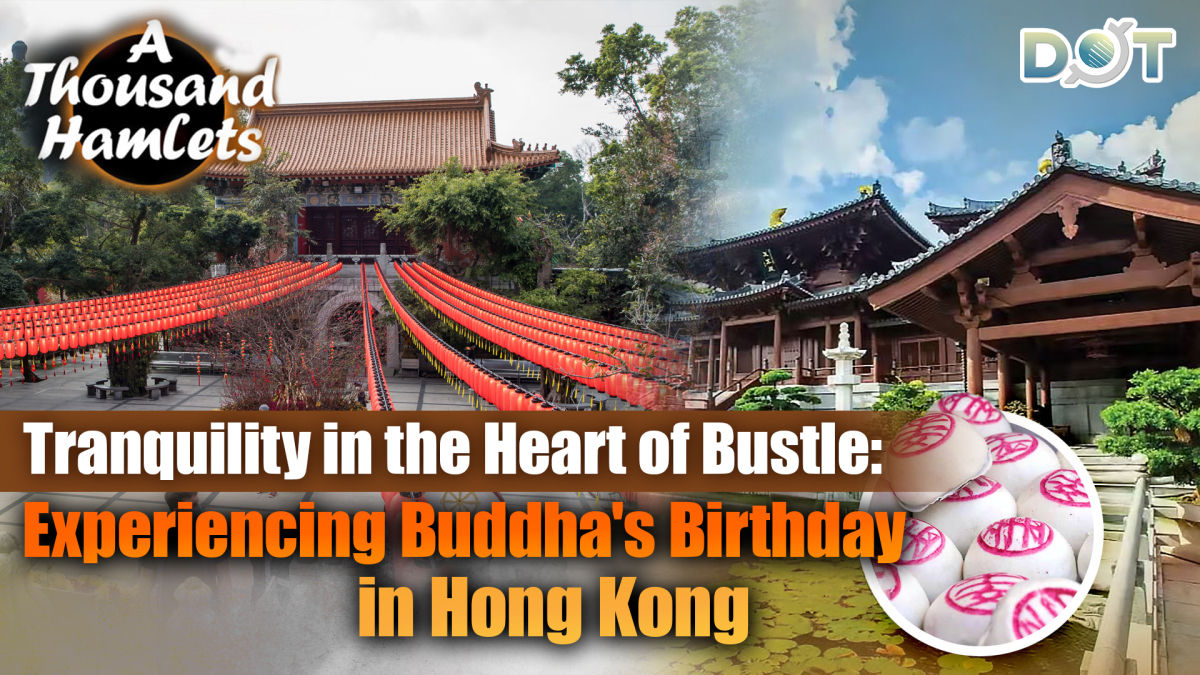
During the Buddha's Birthday, celebrations ranging from blessing rituals to cultural exhibitions take place across the city. The most vibrant of these is the world-renowned "Cheung Chau Jiao Festival" (or the Tai Ping Ching Chiu 太平清醮). Originating in the Qing Dynasty, legend has it that when a plague struck the island, residents invited monks to set up altars and paraded the statue of the deity Pak Tai through the streets to drive away evil spirits; the plague subsequently ended. Since then, residents have held the festival annually to pray for peace. In 2011, the festival was included in the National List of Intangible Cultural Heritage due to its long history and deep community cohesion. During the festivities, islanders hold "Piu Sik" (Floating Colours) parades and perform "Shenggong" (thanksgiving) operas. However, the most eye-catching spectacle is the towering "Bun Mountains" made of bamboo and buns. People believe that the more "Ping On" (Peace) buns they snatch, the more blessings they will receive.
For many Hongkongers, the image of "snatching buns" is inextricably linked to a beloved anthropomorphic pig cartoon character—McDull, created by Hong Kong cartoonists Alice Mak and Brian Tse. In MyLife as McDull(2001), the simple-hearted piglet trains hard to climb the bun mountain, only to find that it is no longer an Olympic event, nor a lucrative business. This persistence in "the use of the useless" captures the essence of Cheung Chau's folklore: it is not a commercial performance, but a simple, grassroots desire to protect one's home and pray for safety.
During the festival, the entire island of Cheung Chau observes a three-day vegetarian fast. Even international fast-food chains follow local customs by selling vegetarian burgers. This collective sense of ritual is particularly precious in a fast-paced modern society. Through the intertextuality of mass media (like comics and animation) and traditional rites, ancient heritage gains a warm interpretation in the hearts of the youth, rather than remaining a mere relic of the past.
Urban Zen: The Modern Transformation of Hong Kong Temples
Shifting focus back to the heart of the city, one finds that Hong Kong's temples are undergoing a profound modern transformation. They are no longer just incense-filled religious sites, but have evolved into "urban spiritual hinterlands" that combine aesthetic value with psychological healing functions. Chi Lin Nunnery and Tsz Shan Monastery are the typical landmarks of this transformation.
Chi Lin Nunnery in Diamond Hill is modeled after Tang Dynasty architecture. Its rigorous all-wood structure creates a powerful contrast against the surrounding skyscrapers. It uses the "sense of order" in classical architecture to counter the "sense of chaos" in urban life. Through its garden and pond layouts, it allows visitors to achieve an immediate psychological "noise reduction". Meanwhile, Tsz Shan Monastery in Tai Po goes a step further, showcasing the fusion of religious, environmental, and modern aesthetic concepts. It operates on a reservation system to limit crowds and ensure a quiet environment. It promotes eco-friendly practices, such as offering water instead of burning incense, a minimalist approach that perfectly meets the middle-class desire for "Danshari" (the art of letting go) and deep meditation. Beyond being a place for monastics, the monastery hosts psychological counseling and art exhibitions, serving as a spiritual recovery center for modern people. This transformation reveals that in high-tech Hong Kong, religion is adapting to modernity through aestheticization and the creation of public space.
Finding Inner Peace in a Noisy Era
The existence of the Buddha's Birthday serves as an annually scheduled "relief valve". From its legal recognition in 1999 to the grassroots warmth of the Cheung Chau bun mountains and the minimalist Zen flowing through modern temples, Hong Kong's Buddha's Birthday culture has constructed a three-dimensional spiritual coordinate system. It reminds us that no matter how noisy the city or how turbulent the times, deep within this steel forest, there is always a space that allows us to rest. In the clear waters of the Buddha-bathing ritual and the aroma of the Peace Buns, we find that long-lost sense of inner stability.
Xu Xi is a literary scholar teaching at Beijing Normal-Hong Kong Baptist University, Zhuhai. Xu holds a PhD from HKU.
The views do not necessarily reflect those of DotDotNews.
Related Readings:
A Thousand Hamlets | Silent Friend: A silent long march through labyrinth of introspection
A Thousand Hamlets | The modern life of the queen of detective fiction




Comment