






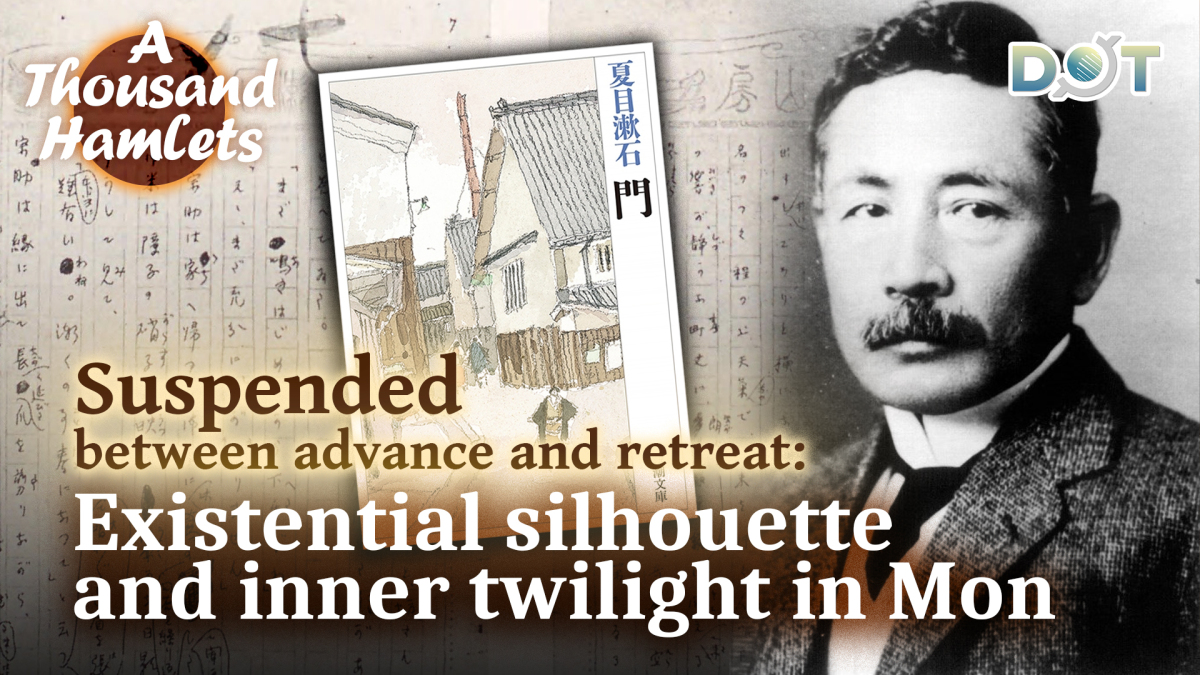
By Liu Yu
Editor's Note: Mon (The Gate) is the final installment of Natsume Sōseki's Love Trilogy. As I explored in my analysis of the previous two works, which follow a progressive trajectory, the final piece is invariably where the emotional intensity must subside. While the story may subtly allude to the illicit union depicted in the second work, I prefer to detach this novel from the continuity of its predecessors and to regard its protagonist as a fully socialized character, one who has already matured, for he no longer displays the naïve choices and impulses of the earlier figures.
The estrangement and desolation of modern people never manifest through dramatic confrontation, but rather as a pervasive, all-encompassing gloom and listlessness that seeps into every crevice of existence. The couple at the heart of Mon, Nonaka Sōsuke and his wife Oyone, are the quintessential embodiment of such spiritual plight—people who spend their entire lives standing at the boundary of light and shadow, quietly waiting for the sun to set.
The bond that binds Sōsuke and Oyone together never becomes a sanctuary against the desolation of the world; instead, it turns into a road of self-imposed exile. They huddle securely in their tiny, private universe, gazing from a distance at the fulfillment of others, yet steadfastly refuse to face the truth: the gate that cuts them off from the world, severs any possibility of reconciliation, and imprisons their very selves, has always been shut by their own hands.
With delicate and restrained brushstrokes, Sōseki renders a portrait of their nearly reclusive existence. They dwell in a cramped, gloomy rented house at the base of a cliff, struggling with dire financial straits, their daily lives barren and desolate. The commuting scene at the novel's opening already lays bare the essential nature of Sōsuke's existence: swept along in the tide of humanity, brushing past the world morning and night, yet never truly living within it.
The mechanically repetitive footsteps, the numb and hollow emotions shut out the outside world and envelop a wound at the bottom of his heart that will never heal—and this wound is the original sin of their lifelong union. Oyone was once the lover of Sōsuke's close friend and classmate, Yasui. This love, born of betrayal and transgression, is the only warmth and anchor of their remaining years, yet also the moral shackle that traps them for a lifetime, impossible to shake off.
Sōseki defines their relationship with an exquisite metaphor: they are like two drops of oil fallen into clear water, isolating themselves from all that is external, clinging to each other and forming a symbiotic, enclosed union. This intimacy, which runs counter to the world, is all they possess in their impoverished lives. Precisely for this reason, the mere mention of Yasui's long-buried name is enough to shatter their feigned calm, awakening the interrogation of conscience that they have desperately tried to bury under the day-to-day stability they have painstakingly maintained. Their happiness bears an inherent incompleteness from its very inception; beneath the surface of what seems like a perfect union lies an unremitting spiritual depression and a profound weariness of body and mind.
The "gate" is the novel's most intensely distilled spiritual image, and the ultimate symbol of the modern individual's inner predicament. Sōsuke has always been lucid and perceptive—whether dealing with secular financial entanglements or the practical difficulties of relatives and friends, he can analyze them with clarity and reason. Yet the moment he approaches the gate of the heart that leads to repentance, redemption, and self-reconciliation, his rationality collapses entirely.
In the end, he journeys to a remote mountain temple to practice Zen, painstakingly seeking a way to open the gate and break through his impasse, only to arrive at a sobering self-realization: it is not that he has no path to walk, but that he simply dares not push the gate open. Fearing the surging guilt, pain, and radical honesty that lie beyond, he willingly chooses to remain stalled. Sōsuke's tragedy has nothing to do with his abilities or his circumstances; it lies in his lack of courage to face the past and shatter his false peace. His emotions and cowardice overpower his reason, reducing his lucid contemplation to a futile exercise in self-consolation. In this moment, Sōsuke is frozen into the novel's most classic tragic silhouette: powerless to push open the gate and stride toward redemption, yet equally unable to withdraw and return to an innocent past, he is caught with no ground to advance or retreat, suspended in the void of the world. He can only stand beneath the gate, watching the light of day fade away inch by inch, quietly awaiting fate's final curtain. This cold iron gate cuts him off from the clamorous human world and also completely veils his future.
Sōseki's profundity lies in his refusal to offer the world cheap redemption. With a gaze of almost clinical detachment, he records the fragmentary routines of daily life within the couple's dim dwelling: the quivering shadows of bamboo, the cold frost peeling away, the piercing agonies of illness—countless subtle, chilly scenes that together construct a static, sealed spiritual prison where no one can offer deliverance.
This happiness, built upon betrayal, is a silence and evasion the two have actively chosen. Quietly waiting for sunset is the end they have predetermined for themselves. And this is not merely the fate of Sōsuke alone, but rather Sōseki's profound metaphor for the modern human condition: when people, out of fear and cowardice, shut tight the gate of the heart that leads to sincerity and repentance, they will spend their entire lives trapped within a dusk of their own making, gazing at the light of the world from a distance, until they finally resign themselves to becoming eternal unfortunates in the darkness.
Liu Yu is the lead editor of the cultural commentary "A Thousand Hamlets." Liu holds a BA in English Literature from HKBU and an MA in History from HKU.
The views do not necessarily reflect those of DotDotNews.
Related Readings:
A Thousand Hamlets | Youth lost in 'three worlds' — Are you also Sanshirō?
A Thousand Hamlets | And then, would you risk everything for love?




Comment