






By Liu Yu
Editor's note: Over the next three months, I will be sharing Natsume Sōseki's Love Trilogy with you all. As Professor Fan Shu-wen from the Department of Japanese Language and Literature at National Taiwan University put it: we move from the bitter youth of Sanshirō, the passionate love of And Then, to the self-discovery of The Gate. There is a single word in English for this kind of gradual, coming-of-age story: a Bildungsroman. These novels are extraordinarily delicate; readers often place themselves in any character's position and wonder: Is the next choice in human relationships really the best one? Would you choose the same way as the protagonist?
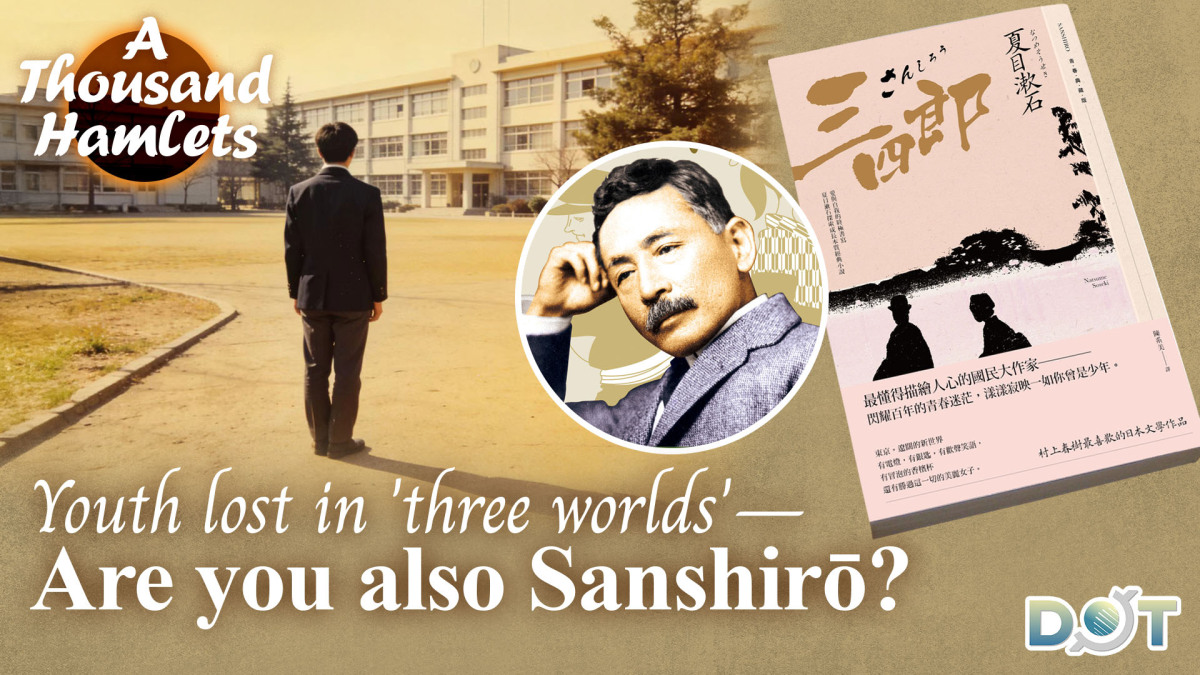
In 1908, Natsume Sōseki wrote Sanshirō. Together with And Then and The Gate, it forms his classic "Love Trilogy." It has no dramatic plot twists, no intense love-hate entanglements, yet with exquisitely subtle writing, it captures the spiritual anxiety of an ordinary young man in the Meiji era. The protagonist, Ogawa Sanshirō, leaves the countryside of Kumamoto to enter Tokyo Imperial University. Caught between the collision of old and new civilizations and pulled by three separate worlds, he undergoes a spiritual baptism of love, identity, and growth. This confusion and awakening have long transcended their time, becoming a universal fable that every young generation can relate to.
From the moment our protagonist, Sanshirō, sets foot in Tokyo, his life is split into three worlds that pull at each other yet can never merge. Indeed, you will find that many readers and scholars like to describe the book as a story of psychological conflict from "three worlds," and I agree — but I also have my own way of distinguishing them.
The first world is his distant hometown of Kumamoto. It is his root, a spiritual haven holding his mother and old memories, the only place he finds peace when lost. At the same time, hometown is also a chain engraved into him, a mark of backwardness, narrow-mindedness, and incompatibility with Tokyo's modern civilization. He desperately flees, eager to fit into Tokyo, yet can never shed the label of a country youth. Most ironically, at the end of the book, he returns home because of a trivial, unnecessary letter from his mother — only to discover, upon his arrival, that the woman he loves has already married. Hometown becomes the origin he wants to break free from yet cannot help but look back to.
The second world is the glamorous sphere of Mineko, the woman he adores. It is the most vivid face of Tokyo: a blend of modern civilization, new ideas, and urban romance — a world Sanshirō yearns for yet can never enter. He falls for Mineko at first sight, seeing her as the finest symbol of the modern city. But this devoted love cannot bridge the gap of reality, such as class difference, pulling him deeper into curiosity, longing, and inferiority.
The third world is the Tokyo of his imagination: the academic circle of Professor Hirota and Nonomiya. Far from urban vanity, it is a pure land of knowledge. Professor Hirota's clarity and wisdom, Nonomiya's obsession with physics, may carry the ideals and persistence of intellectuals — yet they are like defenders of the old society, unable to keep up with the city's progress. This world is too detached from reality, an ivory tower isolated from the world. It offers Sanshirō no support for survival, nor can it contain his longing for love and secular life; it remains only a distant spiritual enclave.
Trapped between these three worlds, Sanshirō becomes what Mineko repeatedly calls "the lost lamb." Yet this defining metaphor of the novel belongs not only to Sanshirō — it is also Mineko's own inner voice.
Sanshirō's loss is a loss of identity. Thrown from a closed countryside into a bustling metropolis, he first questions his own conservatism and backwardness from the forwardness of a strange woman he meets on the train. Tokyo's rapid transformation clashes violently with his simple worldview. He cannot fit into the aloofness of the academic circle, nor reach the splendor of the glamorous world. His mother's ordinary letters comfort and bore him; Mineko's mixed signals leave him anxious and uncertain. He cannot find his place, nor see the direction of his life.
Mineko's loss is a dilemma of the times. She is a modern woman with new education, open-minded and transcendent in spirit — extraordinary in the Meiji era, when women held low social status. Yet she cannot break free from traditional constraints: she depends on her brother and must marry before he does. She is well aware of Sanshirō's affection and holds vague feelings for Nonomiya, but neither can give her stability. Sanshirō is a country student with an uncertain future; Nonomiya is a "scholarly fanatic" absorbed in experiments, lacking warmth. Torn between love and reality, independence and dependence, she too is lost. Her ambiguity is nothing but the helpless hesitation of a new woman trapped in an old era.
When I first read Sanshirō, I thought Mineko's marriage to her brother's friend was a tragic love story caused by Sanshirō's failure to confess. Some even call her a "green tea bitch" in modern internet slang. But such choices are rarely made in an instant. Natsume Sōseki never wrote about a "missed chance" in love — he wrote about reality mocking romantic ideals, and the times disciplining the individual. Mineko's choice was never about not loving. She could pursue spiritual freedom, yet had to bow to the reality of survival. This helplessness is the inescapable fate of modern women in the Meiji period.
You might think this interpretation is boring, as if you can guess halfway through that it is all "the fault of the times." But I believe this is exactly what Natsume Sōseki intended.
Natsume Sōseki quietly wove the intense conflict between Western civilization and Japanese tradition into his characters. When Sanshirō arrives in Tokyo, Japan is at the height of blind Western worship: people revered everything Western, and vanity and empty boasting prevailed. Intellectuals like Professor Hirota and Nonomiya, who stayed true to themselves, became a rare stream of purity in the chaos.
Mineko embodies this conflict: she carries the outward appearance of a Western new woman — independent, free-spirited — yet is deeply bound by traditional values at her core, finally compromising for a secure secular life. The innocent Sanshirō once saw her as a goddess untouched by mortal affairs, but the ending forces him to accept that even the most beautiful ideals cannot defeat worldly reality.
What is fascinating is that, a hundred years later, is this pain of growth not still a required lesson for young people? For Hong Kong drifters: stay and struggle in Hong Kong, or return to hometown? Pursue pure love, or settle for a practical partnership? Ideal and reality, hometown and distant places — these are forever life's hardest dilemmas. Life cannot stay frozen in the beauty of the first sight; obsessions and fantasies must eventually be smoothed by reality.
Sanshirō is far more than a story of unrequited love. It is a story for all young people who have lost their way at life's crossroads, who have wavered between even more worlds than Sanshirō. Isn't youth exactly about understanding yourself, understanding life, and finally growing from "a lost lamb" into someone who can face life directly?
Liu Yu is the lead editor of the cultural commentary "A Thousand Hamlets." Liu holds a BA in English Literature from HKBU and an MA in History from HKU.
The views do not necessarily reflect those of DotDotNews.
Related Readings:
A Thousand Hamlets | 144 years in the making: Sagrada Família was never meant to be fast




Comment