






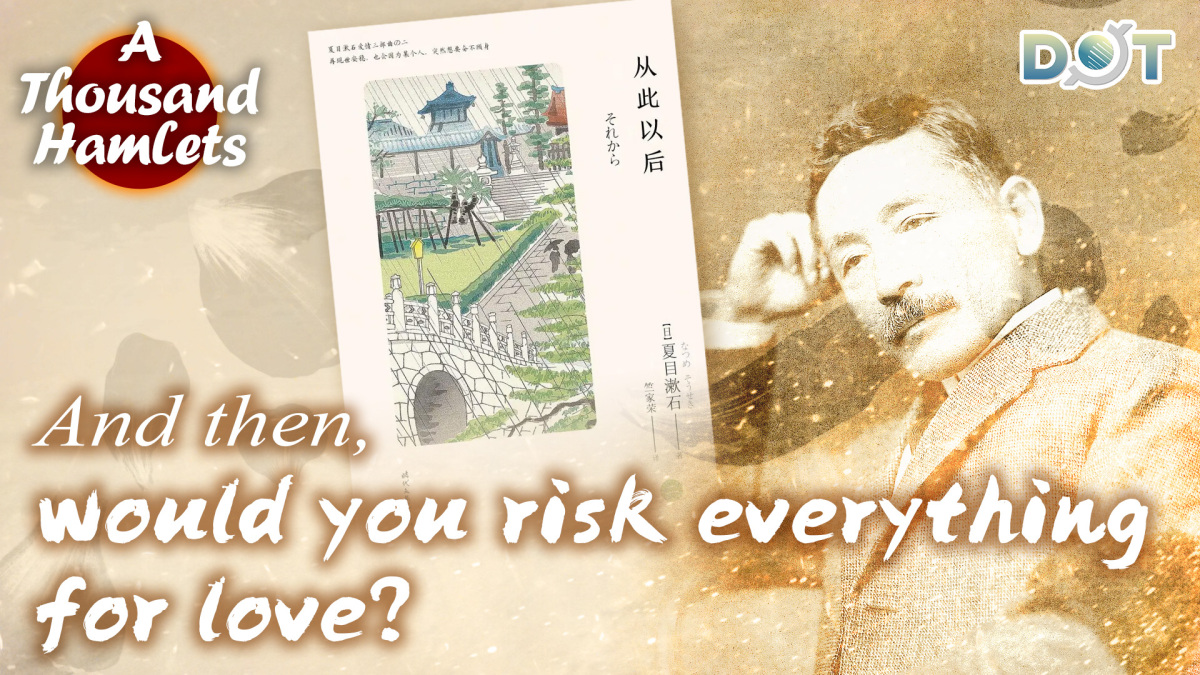
By Liu Yu
Have you ever had a moment in your life when you were willing to risk everything for love?
In today's online discourse, there's much talk of a certain "tragic beauty" — knowing full well that separation is inevitable, yet desperately hoping to live out a lifetime of love within the limited time left, only to finally exit with regret. I've always felt that Natsume Sōseki's Sorekara (And Then) depicts precisely such a headlong rush that burns through everything within the constraints of social convention.
The core of the story is not a simple love triangle, but rather a prolonged struggle between love and societal norms. In his youth, the protagonist Daisuke, for the sake of so-called "doing the honorable thing," personally pushed his beloved Michiyo into the arms of his close friend Hiraoka. He used this "act of selflessness" to cloak himself in the "white robe of morality." In the years that followed, he consistently rejected the well-matched marriages arranged by his family, harboring a deep-seated aversion to this system of worldly matrimonial rules measured by social status and personal gain. He trapped himself in a web of his own making, on one hand binding himself with morality, while on the other allowing his love to grow wildly in his heart, until it could no longer be concealed.
Yet the sharpest point of the story has never been love itself, but rather the price of choice: when you choose to deviate from public order and go against conventional morality, you are doomed to face rejection from the entire world.
As a typical intellectual of the late Meiji period, Daisuke is perpetually entangled in the paradox between tradition and modernity. Educated in Western culture, with considerable intellectual cultivation and artistic sensibility, he is able to see clearly through the decay of Japan's inherited traditions and criticize the futility of blind Westernization. In this sense, he is a truly awakened modern intellectual. Yet his life remains firmly anchored in the framework of the old era: without any means of self-reliance, entirely dependent financially on the support of his father and elder brother, his prolonged comfort has bred a deep-seated inertia, his rebellion limited to dragging words. He is a "high-class idler" who depends on the old system for survival — an inherent flaw that predestines his rebellion to offer only two choices from the start: first, to resign himself to the status quo, letting his thoughts soar in the illusion of the heights while never breaking free from the ropes of the world; second, destruction. Through Daisuke's choices in love and marriage, Sōseki explores the spiritual predicament of the intellectual: clear in consciousness yet weak in body; yearning for freedom yet resigned to the status quo; criticizing the world while harboring his own contradictions.
Daisuke is fully aware that to embrace this immoral love and win Michiyo back, he must scorn conventional morality, make choices that defy common sense, and bear the price of being abandoned by the entire world.
In that room filled with the scent of lilies, as Daisuke utters in his heart the words, "Only today have I returned to the true past," he believes he has finally broken free from the oppression of morality and returned to a "nature" free of desire, gain, and shackles. Yet this is nothing more than an illusory bubble he has constructed for himself. As this illusory beauty still lingers, the thought of the "eternal pain born of brief happiness" strikes him in an instant. His lips suddenly lose their color, the faint blood under his fingernails trembling slightly — this is the moment when Daisuke's psychological defenses completely collapse. For too many years, he has deceived himself, using "doing the honorable thing" to mask his own cowardice, using "moral duty" to suppress his love. But at this moment, his deep love for Michiyo collides with the ethical guilt he bears, shattering within him. This physical trembling... He thought that severing moral constraints would allow him to face his naked desires directly.
In the end, Daisuke makes his choice: he refuses the marriage arranged by his family and decides to win Michiyo back. But behind this resolve lies a devastating price: he is disowned by his father, cut off from all financial support, completely alienated from his close friend Hiraoka, and becomes an "outcast" of the entire secular world.
This is the collective predicament of Japanese intellectuals during the Meiji Restoration period: pursuing individual liberation only to be seen as "deviating from morality" and suppressed by their entire families and society; detesting the ugliness of the secular world and unwilling to compromise for survival — yet when they truly lose their support, they discover that their so-called "loftiness" cannot withstand the test of comfortable material conditions.
So, what do you think? Would you really risk everything for that?
Liu Yu is the lead editor of the cultural commentary "A Thousand Hamlets." Liu holds a BA in English Literature from HKBU and an MA in History from HKU.
The views do not necessarily reflect those of DotDotNews.
Related Readings:
A Thousand Hamlets | Youth lost in 'three worlds' — Are you also Sanshirō?
A Thousand Hamlets | 144 years in the making: Sagrada Família was never meant to be fast




Comment