






By Xu Xi
The Tang Dynasty was a pinnacle of Chinese history, leaving behind a cultural legacy so profound it is still felt today. Overseas Chinese enclaves are known as 'Tang People Streets' (Chinatowns); children still begin their education by reciting Tang poetry; and many calligraphers start their journey by imitating the works of Tang masters like Liu Gongquan and Yan Zhenqing.
In recent years, the popularity of novels and TV dramas like Strange Tales of Tang Dynasty, The Longest Day in Chang'an, and The Lychee Road has sparked a 'Great Tang Craze,' turning the city of Xi'an into a premier travel destination. Taking 'Tang-style' portraits has even become a must-do for young tourists. However, television and movies are often works of artistic fiction, and depictions of daily life frequently suffer from anachronisms. For instance, characters are often shown sitting in high-backed chairs, when in reality, the Tang Dynasty was a transitional period between sitting on the floor and using elevated furniture. Formal banquets still maintained the tradition of kneeling on mats or platforms. Furthermore, characters are sometimes seen eating sweet potatoes or chili peppers—crops from the Americas that wouldn't reach China until the Ming Dynasty.
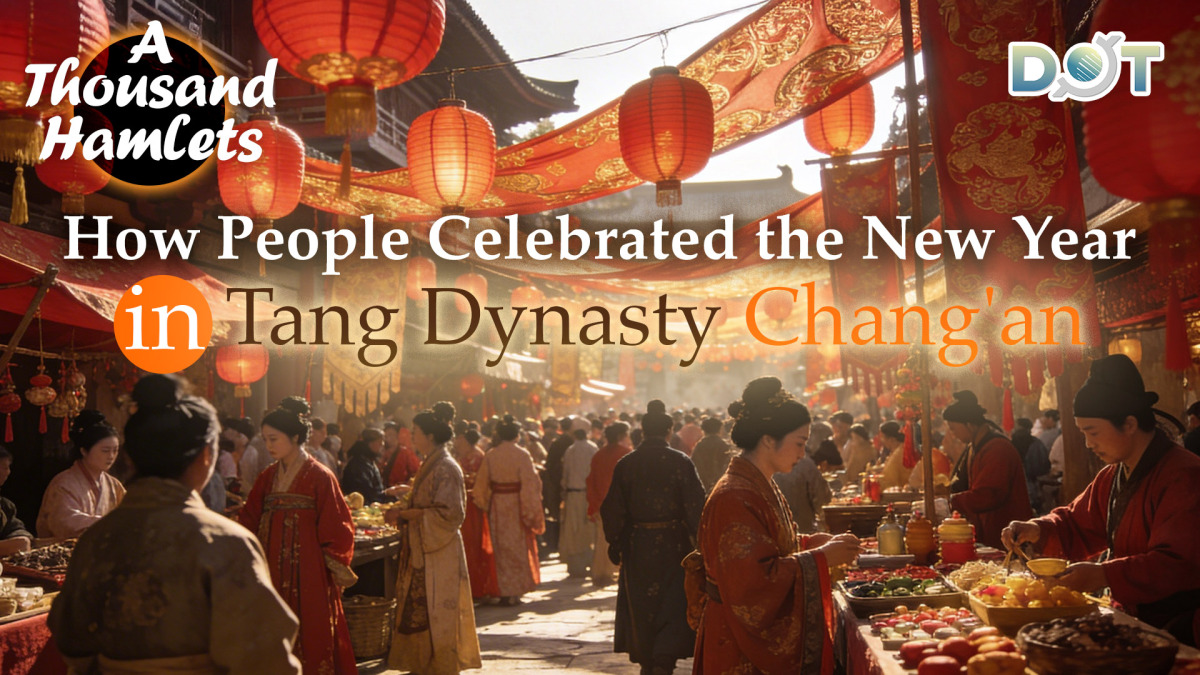
As the Spring Festival approaches, how did the people of Chang'an, then the world's largest and most populous city, actually celebrate the holiday? Did they get time off? What was on the New Year's Eve menu? Did they stay up all night, visit relatives, or give out red envelopes? Could they set off firecrackers? Reliable answers to these questions can be found in Dr. Gao Ruize's new book, Heading to Chang'an Today《今日向長安》. The book's format is unique; while it references over 1,500 historical documents, it isn't a dry academic tome or a fictional time-travel novel. Instead, it reads like a Lonely Planet guide for a backpacker. Through concise and humorous prose and over 600 illustrations, it details the food, clothing, housing, and festivals of Chang'an, allowing modern readers to embark on a dream journey back to the grand city of the 8th century.
The Prelude: Laba Festival
There is a common folk saying: 'Once Laba passes, it's the New Year.' This means that after the eighth day of the twelfth lunar month, the festive atmosphere begins to thicken. In Northern China today, people drink Laba congee and eat Laba garlic. However, in the Tang Dynasty, this day was known as La Ri (臘日 The Day of La). While it was a public holiday, the people of Chang'an did not drink congee, a custom that didn't become popular until the Song Dynasty.
The most popular custom at the time was 'Bathing the Buddha' at temples, using fragrant water brewed with medicinal herbs to cleanse Buddha statues of dust. Beyond cleaning the statues, people would also bathe themselves to wash away impurities. Bathing was considered an important form of Buddhist cultivation, leading temples to build large, well-equipped bathhouses—some even featured steam saunas! The poet Meng Haoran once recorded his experience of bathing at a temple on this day: 'With a ceremonial mat, I invited the wise; by the spring, I donned my bathing robe. I hope to receive the water of merit and cleanse myself of the world's dust.'For soap, they used 'bath beans' (powdered legumes), soap pods, and cypress leaves, which are entirely natural and eco-friendly.
New Year's Eve: The Great Exorcism
New Year's Eve was the final day of the year, known in the Tang Dynasty as Sui Chu (歲除). Including the days before and after, there was a seven-day public holiday. While commoners enjoyed their 'Seven Days of Happy New Year', government officials didn't have it so easy. Imperial regulations forbade local officials from leaving their posts, meaning they had to spend the New Year at their offices. High-ranking officials in Chang'an had to wake up early the next morning to attend the 'Grand Imperial Court' to offer New Year greetings to the Emperor.
On New Year's Eve, both the court and the common folk held grand Qu Nuo (驅儺 exorcism) ceremoniesto pray for a peaceful year ahead. On the wide Zhuque Boulevard, crowds of performers wore masks of various characters and brandished weapons, shouting slogans to drive away plague demons. The spectacle drew massive crowds, resembling a modern carnival parade. While Tang locals didn't paste red 'Spring Festival Couplets' on their doors, they believed peach wood was a 'celestial wood' capable of warding off evil. They would either tuck peach branches into their doors or hang peach wood boards carved with the images of the guardian deities Shentu and Yulei to protect their homes.
The Sound of the New Year
Childhood memories of the New Year are often accompanied by the bang of firecrackers and the glow of fireworks. While the Tang Dynasty already possessed gunpowder, the rolled-paper firecrackers we are familiar with today didn't appear until the Southern Song Dynasty. Children in Chang'an had no fireworks to watch. Instead, they played with Baozhu (exploding bamboo). They would toss bamboo stalks into a courtyard bonfire; as the air inside the bamboo tubes expanded from the heat, it would burst with a loud crack. This ancient custom can still be found in some rural areas today. In the Tang Dynasty, children in Chang'an did not receive 'lucky money' (red envelopes) as we know them today. While the imperial palace followed a tradition of gifting 'Spring Day Reward Money,' this occurred specifically during Lichun (the Start of Spring) rather than on New Year's Eve. Furthermore, these rewards were not standard currency used in the market. Instead, they were specially minted coins inscribed with auspicious phrases, serving more as protective amulets than spendable cash.
A Feast for the Senses
While they missed out on cash, they certainly didn't miss out on the food. Much like today, the people of Chang'an celebrated with grand banquets and a sumptuous New Year's Eve dinner for the whole family. Stir-frying wasn't yet the norm in the Tang Dynasty; instead, people preferred steaming, boiling, and roasting. Staples included biluo (long noodle rolls with sweet or salty fillings), steamed buns (usually stuffed with meat), hubing (similar to modern naan), wontons, and botuo(boiled noodle sheets). While ordinary families rarely ate meat during the rest of the year, they would slaughter chickens and sheep to celebrate the festival. Some even enjoyed kui, a dish of thinly sliced raw fish mixed with scallions, ginger, and fermented beans, much like modern Shunde-style sashimi. Dessert followed the meal. Since cane sugar was rare and expensive, most people ate jiaoyatang (a type of maltose). Festive spreads might also feature raisins from the Western Regions, Persian dates, and pistachios. After the feast, families would gather to chat and stay up late (shousui) to welcome the arrival of the New Year.
New Year's Day: Rituals and Revelry
The first day of the New Year was called Yuan Ri (元日). The imperial court held a solemn grand assembly where civil and military officials, along with foreign envoys, wore formal court attire to pay their respects to the Emperor. The Emperor, in turn, would host a banquet to reward his subjects and display the majesty of the royal house.
Among the ordinary people, New Year's morning began by erecting long poles hung with streamers made of silk or colored paper. Known as 'Long Banners' or 'Spring Banners,' these were symbols of prayer for favorable weather in the coming year. Two specific drinks were essential: Tusu wineand Pepper-Cypress wine. Both were medicinal brews intended to ward off evil and strengthen the body. Drinking them followed a strict etiquette: you had to start with the youngest person first. As the saying went, 'Starting from the young and moving to the old, with everyone taking a small sip, the whole family will be free from illness'.
The dining table also featured a mandatory dish: the Five Spicy Herbs Platter (Wuxin Pan), a cold dish made of five pungent vegetables. While historical records vary on the exact ingredients, scallions, garlic, and leeks were common choices. Traditional Chinese medicine held that pungent foods could clear 'turbid air' and nurture yangenergy, which was beneficial for health in the spring. Over time, people began wrapping these vegetables in thin pancakes, a practice very similar to eating Spring Pancakes today.
The people of Chang'an usually didn't stay at home on New Year's Day; they loved to socialize. They would visit relatives to offer New Year greetings or drop by a neighbor's house for a free meal (a practice known as chuanzuo). Those who loved entertainment would head to the great temples to listen to 'popular preaching' (sujiang)—a lively, collaborative performance of storytelling and singing used to explain Buddhist sutras in plain language.
The Grand Finale
Throughout the Spring Festival, Chang'an was alive with daily banquets and entertainment for all ages. The festivities reached the peak during the Shangyuan Lantern Festivalon the fifteenth day of the first lunar month. There are many more wonderful customs from this period that we cannot detail here, but curious readers can find them in the book. This winter, why not take a 'time-travel' trip back to the Tang Dynasty and experience the vibrant New Year spirit of Chang'an for yourself?
Xu Xi is a literary scholar teaching at Beijing Normal-Hong Kong Baptist University, Zhuhai. Xu holds a PhD from HKU.
The views do not necessarily reflect those of DotDotNews.
Related Readings:
A Thousand Hamlets | Mapping Hong Kong: City of impermanence




Comment