






By Jason Harding
What is the essential character of Hong Kong, or any big city? How can we comprehend the totality of geography, population, and history that constitutes the life of a city, transcending the viewpoint of an individual? Does data science provide reliable knowledge, or must it be supplemented by a humanistic understanding of city life? What might a panoramic view from ICC's Sky100 Observation Deck tell us about the teeming existence of millions of Hong Kong residents and visitors inhabiting the territory below?
Mapping seeks to close this gap between representation and reality. Maps are, at the same time, tools for cognition and assertions of power.
When the British arrived in Hong Kong in 1841, they rapidly mapped the Island, initially for defense, but enduringly to parcel lots offered to traders. By the 1960s, huge fortunes could be made by investors and industrialists on what would become the most expensive real estate on the planet. The Hong Kong government is still selling land for development. The map of the government-owned MTR is a symbol of this economic system, connecting the new towns and public housing projects built to accommodate mass immigration, providing one way to conceptualize the interconnections of Hong Kong Island, Kowloon, and the New Territories.
Maps abstract key data for specific purposes; in that sense, they are ideological as much as representational, serving the needs or interests of those who commission and use them. In fact, there is an almost limitless amount of information generated by the streets of a city as dense in buildings and people as Hong Kong. The possibilities for mapmakers who wish to navigate this city are as disorienting as they are exciting.
At recent talks at Wyndham Social in Central, architect and urban designer Dr. Peter Cookson Smith shared his thoughts on Hong Kong's past, present, and future, articulated in illustrated books; in particular, The Urban Design of Impermanence: Streets, Places and Spaces in Hong Kong. Arriving on a temporary post in the 1970s, Peter embarked instead upon a fifty-year love affair with the city, founding one of the first urban planning consultancies in East Asia, advising many revitalization projects in the Greater Bay Area, and holding several visiting appointments at Hong Kong universities. He is a past-President of the Hong Kong Institute of Urban Design, where he remains a council member, and a fellow of the Royal Society of Arts.
Cookson Smith's books delight in the vitality and pragmatism of Asia's cities. Twenty are sketched in The Urban Design of Intervention: Imposed and Adaptive Places in Asian Cities in arresting illustrations capturing intricate urban bustle. He traces the evolution of Asian cities through historical topologies, including interventions imposed by colonialism that stimulated a resilient capacity for urban adaptation and renewal. Unlike European imperial capitals—Rome, London, Paris, Berlin—defined by grand squares, monuments, and avenues, sites of ceremonial public displays of power, Asian cities displayed a resourceful organic growth that embraced a mixture of uses in the same space; for example, in three-story shophouses that combined family business and home with colonnades for informal social encounter and play.
Urban design is focused not simply on redevelopment but regeneration, and Cookson Smith laments kaleidoscopic transformations that erase communal places only to be replaced by the transnational impersonality of soaring skylines—towers of corporate capital. He reminds us that planners should facilitate pedestrianization, place-making, and overall improvement of public areas. Compared to Singapore or even Shanghai, the profit motive of Hong Kong's relentless real estate market takes a wrecking ball to sentiment, complicating any holistic public planning for urban renewal.
It is a challenge that Cookson Smith suggests is best addressed through consideration of a diverse range of stakeholders, especially communities who have the largest stake in local neighborhoods and contribute most to an increasingly fragile cultural heritage. It is the role of the urban designer to shape cities according to livable, sustainable human values.
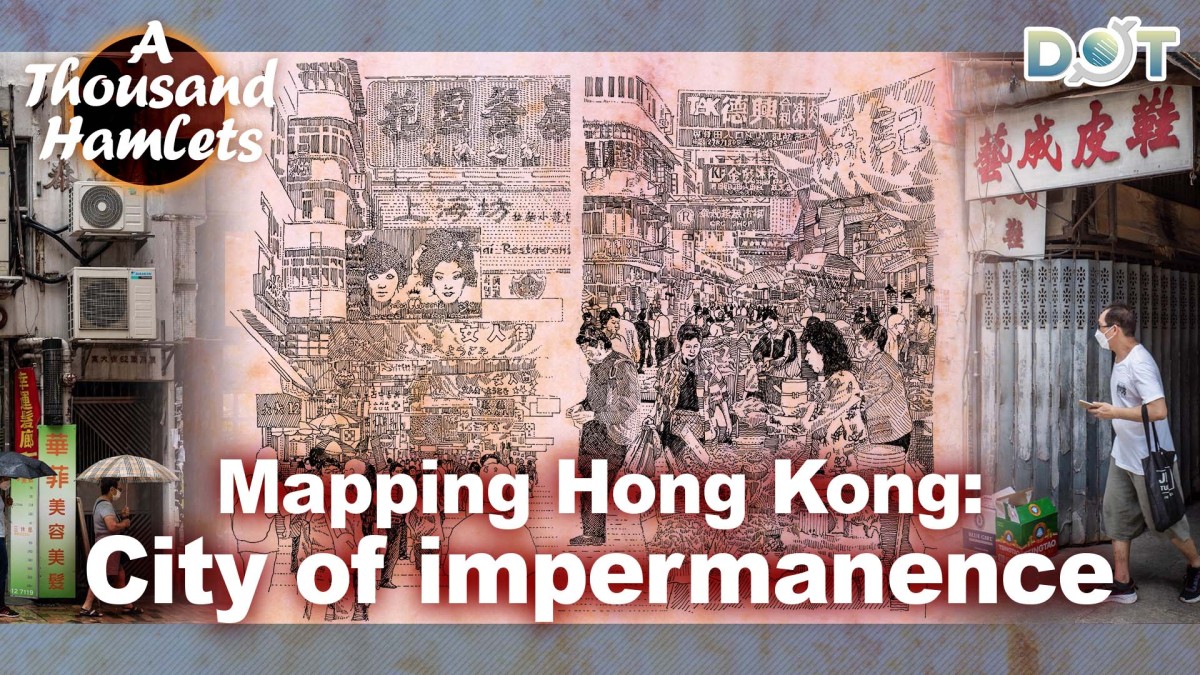
The Urban Design of Impermanence is grounded in an architect's and urban planner's solid grasp of physical and material fabric, but it is illuminated by an artistic vision of Hong Kong's vibrancy and change. Many of these dynamic sketches of city life are attracted to the iconic laddered streets of Central or crowds in Mong Kok and Sham Shui Po. Like an Impressionist painter rendering evanescent open-air life on the Parisian streets of the nineteenth century, Cookson Smith is a participant in harmony with the ecology of city life. The difference is that his ink drawings are concerned less with subtle nuances of color that register the time of day than recording snapshots of moments that no longer exist.
A map is an abstraction frozen in time, not a palimpsest inscribing the tangible memories of generations who have existed in the same place. The Victorian public moralist John Ruskin was eloquent on the haunting aura that an old building communicates to those familiar with its history. In "The Lamp of Memory" section of The Seven Lamps of Architecture, Ruskin said that "the greatest glory of a building" lies in its age, conveying a "deep sense of voicefulness" of successive generations. A spatial map silences this voice of the built environment, ruling out of bounds the lived experience of multiple perspectives, flattening deep layers of memory.
Two ongoing digital humanities projects skillfully chart interactive maps to overcome these limitations. Each speaks to what Cookson Smith calls the "mesmerizing realm of graphically supercharged frontages". These resources bring Hong Kong's unique history into the digital age in ways that reanimate the linear narratives of a printed book.
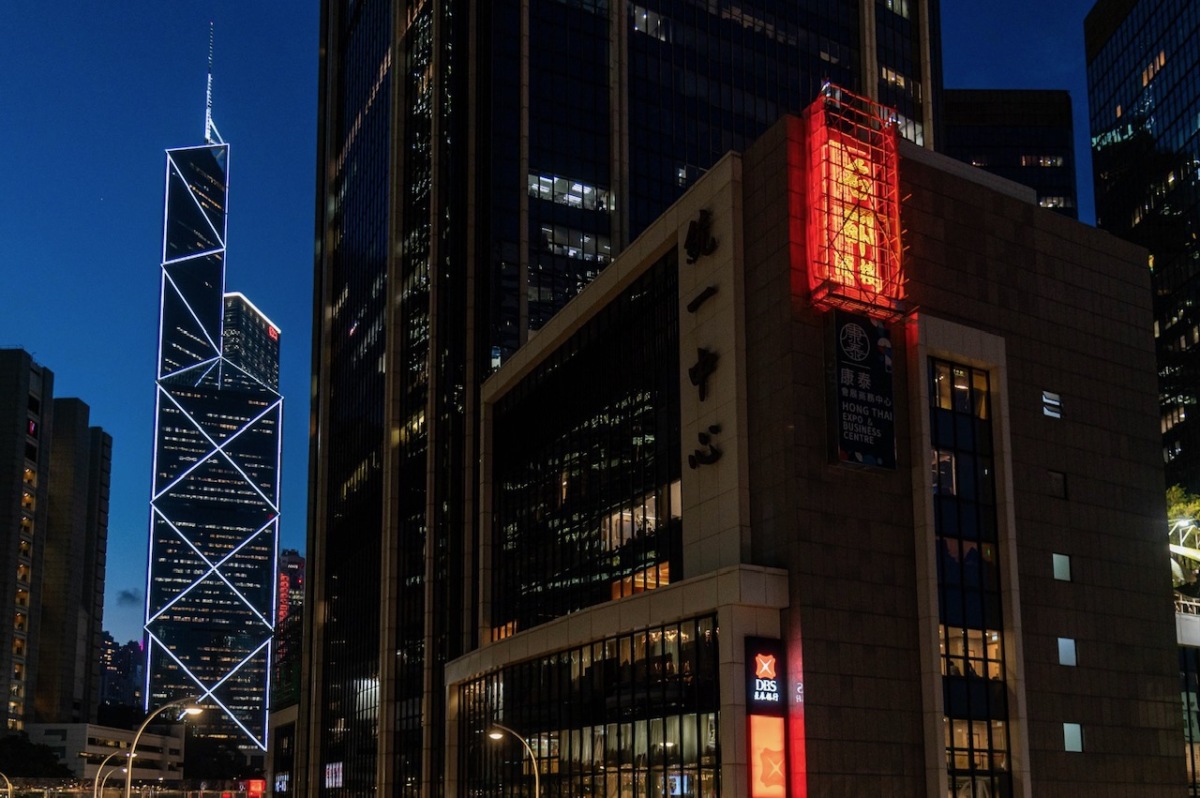
Hong Kong's "ghost signs" project is a fascinating venture that reveals in its interactive map the vanishing commercial signs of Hong Kong's streets, photographed by Ben Marans. The map was conceived by designer Billy Potts to show how time and space can be visualized to illustrate the street textures of languages, calligraphy, art styles, folklore, cuisines, and expressions of what social science terms "thick description" of a culture. This website, hkghostsigns.com, was engineered by the data scientist Mart Van De Ven so that visitors can zoom into the live links dotted over a map of Hong Kong, uncovering fading painted signage on weather-beaten or now demolished buildings.
It is not only superstitious Hong Kongers who will find exploring this map uncanny. Virtual signs come to life, evoking revenants from the past, casualties of urban redevelopment. In a city built by newcomers, it is an indication of Hong Kong's imagined communities that this platform—compare the nostalgia behind the recent exhibitions on Kowloon's Walled City and Wan Chai's charismatic neon signs—preserves expiring collective memories before they are lost. This project echoes Ruskin's concern for the craft of ancestors, binding generations through older buildings that embody a spiritual legacy in their marks of decay.
Diana Pang's website dianapang.net provides immersive storytelling by interpreting Hong Kong's quirky array of Chinese and English street signs. Names possess a talismanic power. Hong Kong is rare among Asian cities in retaining most of its colonial English street names alongside Chinese characters, often, as Diana Pang shows us, with something lost and added in translation. Her thoroughly researched semiotic topics are enriched by interactive maps. Visitors to the site will scroll through illustrated reflections on Hong Kong religions, Chinese folklore and superstition, women's stories, social welfare and public housing, as well as a full examination of Hong Kong's development from fishing village to East-meets-West entrepot.
There are, of course, other media representing the effervescent, ever-shifting nature of life in Hong Kong. Cinema has been a prominent industry, exporting visually striking images of the city to a global audience. Less widely known but arguably more profoundly rooted in intimate knowledge are the urban narratives told by generations of Hong Kong novelists.
The fantastic, episodic narratives of Xi Xi's My City (1975) and Dung Kai-cheung's Atlas (1997)—a metafictional reconstruction of the legendary city of Victoria (Hong Kong) from old maps—are postmodern riffs on stories embedded in the city's streets, secret histories, and myths. These authors represent Hong Kong as a site of imaginative reinvention, forging new cultural identities from cosmopolitan, hybrid genealogies and dreamlike desires. They guide readers on idiosyncratic itineraries, opening unexpected vistas, entering blind alleys, avoiding claims to omniscience or scientific objectivity.
Dung writes, "Fiction is the essential character of Victoria and even of all cities, and city maps are by necessity novels expanding, altering, embellishing, and repudiating themselves."
What could be more postmodern than a city of finance capitalism? Hong Kong fabricates sublime glass, steel, and concrete marvels in the sky that recede after each land-reclamation growth from the harbor that gave birth to this city, washed by fresh waves of immigration. In the fictional worlds of Xi Xi and Dung, contingency and confusion are essential ingredients in the unfolding, contested stories of Hong Kong's urban life. Mapping Hong Kong is an elusive, ceaseless process of unpicking and reweaving the variegated threads from millions of lives, remaking this city of impermanence.
Jason Harding is the Head and Professor of the Department of English at Lingnan University. He holds a PhD from King's College, Cambridge.
The views do not necessarily reflect those of DotDotNews.
Related Readings:
A Thousand Hamlets | Hong Kong's spoken-word poetry communities: Nests of singing birds




Comment