






By Xu Xi
Christmas is just around the corner. How do you plan to spend it this year? In Hong Kong, meeting friends for shopping and festive meals, or taking advantage of the holiday to travel abroad, seems to be the choice of many. In my memory, Christmas in Hong Kong is always filled with a lively, celebratory atmosphere. Tall, stately Christmas trees rise in the centers of shopping malls; shop windows glitter with an array of dazzling decorations; hotels and restaurants display posters advertising special Christmas menus, their brightly colored lettering designed to entice passers-by. In short, in modern commercial society, the religious significance of Christmas has gradually faded, and the holiday has become a festival open to the general public, centered largely on consumption and entertainment.
Nowadays, many people gather friends and head out to celebrate Christmas. Yet in our everyday lives, we are already driven relentlessly by the fast pace of work. Holidays should not become an additional social burden; rather, they ought to be an opportunity to slow down and savor life. If you are weary of the noise of shopping malls and wary of the crowds that come with peak travel season, why not stay at home instead? Brew a pot of warm mulled wine, make some gingerbread men or a Christmas pudding, watch a few wonderful Christmas films, read a handful of beautiful Christmas poems, and enjoy a relaxed, distinctive holiday with your family.
Composing or reading poetry for festive occasions is a long-standing literary tradition shared by both East and West. In English, there is a rich body of Christmas poetry, much of it set to music and widely sung—such as Jingle Bells and The Twelve Days of Christmas. Renowned British and American poets, including John Milton, T. S. Eliot, Robert Frost, and Ted Hughes, have also written poems on Christmas themes. This time, I would like to share two poems that I particularly love, and to wish all readers a very merry Christmas.
Tree
a
raw
frost
bites and
winds
rattle my
branches, but
out here is where
I am at home. Yet men
cut me from
my roots, heave
me on trucks away
to the walled prisons
they live in. And there
garla
nded,
in ga
udy f
inery, they sacrif
ice me to god
This poem is written by Dave Calder, a poet from Liverpool. Christmas trees are a familiar decoration during the festive season. Not only do enormous Christmas trees appear in shopping malls and public parks, but many households also like to buy a tree for their living rooms, adorning it with glittering bells, colorful baubles, and ribbons to enhance the holiday atmosphere. This poem about a Christmas tree is remarkable in two respects.
First, the entire poem takes 「tree」 as its subject and, through careful design, arranges words and letters into the shape of a Christmas tree, allowing form and content to complement each other perfectly. In the final lines, the poet even boldly breaks words such as garlanded, gaudy finery, and sacrifice into individual letters to emphasize the straightness of the trunk. This distinctive poetic form is known as "concrete poetry." It often disrupts conventional lineation and linear syntax, freely arranging words and letters and using spatial form to create images related to the poem's theme. In this way, the visual appearance of the poem becomes an important means of generating and conveying poetic meaning, enriching both its connotations and its aesthetic dimensions.
Second, firs, pines, and spruces are the trees most commonly used as Christmas trees. We tend to regard them as inanimate "objects" and think little of them. A sensitive and reflective poet, however, takes an original approach by examining Christmas customs from the perspective of the "tree" itself. The speaker of this poem is a tree, narrating in the first person its experience of being cut down and sold, forced to wear garish decorations, and its longing for the open fields and wilderness outside. While human homes become beautiful and cozy through the decoration of a Christmas tree, for the tree, forests without walls and the natural world are its true home.
Traditionally, Christmas trees have been made from freshly cut natural trees, but as environmental awareness continues to grow, more and more people are choosing artificial trees that can be reused in order to protect the environment. This concrete poem treats the "tree" as a living being rather than merely an object for festive display, and from the tree's perspective reflects on the impact of human consumer practices on the environment. It can rightly be regarded as an outstanding example of Ecopoetry.
Of course, one should have fun during festivals. Now let's read a hilarious short poem.
fr xmas' txt msg (by Mike Harding)
where r u? mrsx
lost. frx
where lost? mrsx
fi nu I wunt b lost. frx
nt funny. diner n'ly redi. mrsx
rudolph nose went out in fog. lost. frx
told u it ws goin dim!!! still fogi? mrsx
no – fog gone bt dunt recognise were am now. frx
describe. mrsx
big pointy stone things and camels. frx
u in egypt. mrsx
2morrow I sack rudolph. frx
i give dinner to elves. mrsx
i is sorry. frx
nt haf as sorry as u will be!!! mrsx
Isn't this just a text message on social media? Can a dialogue cobbled together from non-standard English really count as poetry? In fact, there are no fixed rules about what kind of language or vocabulary must be used to write modern poetry. Poets are the most sensitive observers of language changes, and good poets are alchemists of words, constantly experimenting and innovating to push the boundaries of language and enrich the expressive power of literature. This short poem adopts the form of text-message communication, invents a wife for Santa Claus, and playfully stages a humorous exchange between husband and wife.
In the poem, Santa Claus (frx: Father Christmas) drives his reindeer Rudolph as he busily delivers presents to people. According to folk legend, Rudolph's nose is bright red and glowing, and Santa relies on it to find his way. This time, however, Rudolph's nose goes out at a critical moment, causing Santa to lose his way in the thick fog and mistakenly end up in Egypt, unable to make it home in time for dinner with his wife. She had already reminded Santa to keep an eye on Rudolph's nose (which was going dim), but he clearly did not take her words seriously and ended up missing the carefully prepared meal. The three consecutive exclamation marks allow us to sense the wife』s anger even through the screen; yet beneath this irritation lie her concern and affection for her husband, subtly conveyed in the brief replies "describe" and "u in egypt." Angry though she may be, she still helps her husband efficiently and sensibly to figure out where he is, hoping for his safe return.
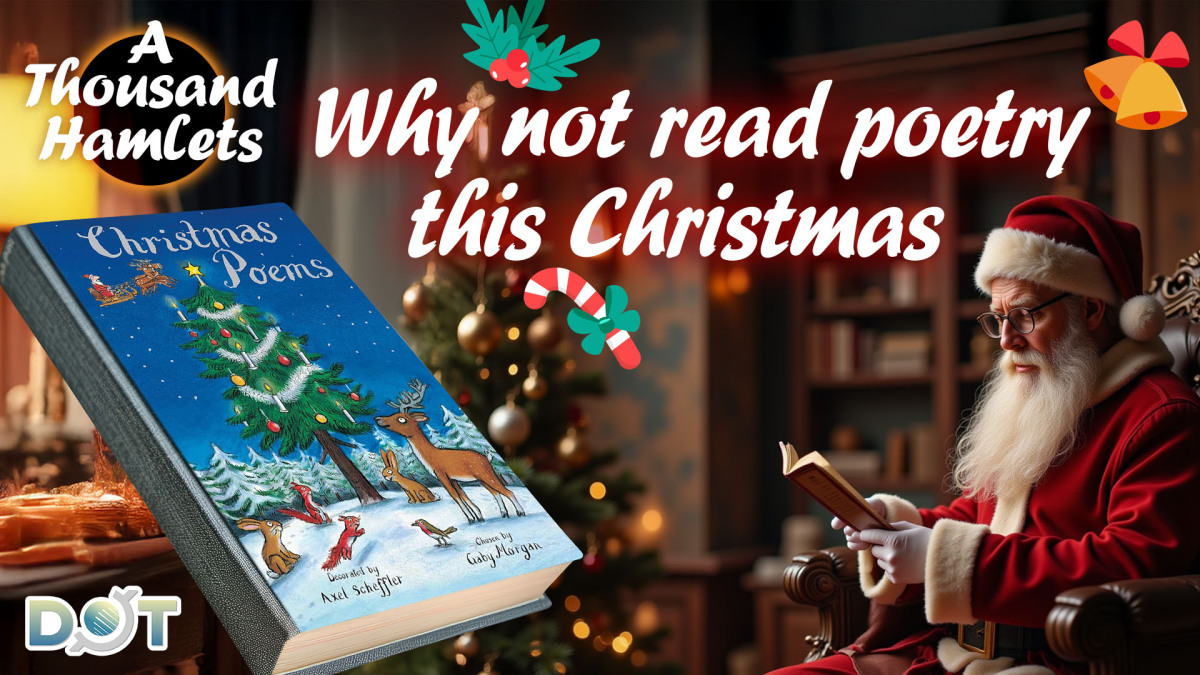
The two poems discussed above are both taken from Christmas Poems (Macmillan Children's Books), published by Macmillan. The anthology is edited by Gaby Morgan, who has over thirty years of experience selecting poetry for children and has published many bestselling collections. The illustrations are by the renowned illustrator Axel Scheffler, whose lively and engaging artwork for Julia Donaldson's The Gruffalo has been immensely popular with young readers. If you are worrying about what Christmas present to give a child, this beautifully produced and entertaining poetry collection is well worth considering.
Xu Xi is a literary scholar teaching at Beijing Normal-Hong Kong Baptist University, Zhuhai. Xu holds a PhD from HKU.
The views do not necessarily reflect those of DotDotNews.
Related Readings:
A Thousand Hamlets | The dialectic of fast and slow: Reflections on trains and railway travel
A Thousand Hamlets | Slow it down: Walking together into László's labyrinthine sentences




Comment