






By Liu Yu
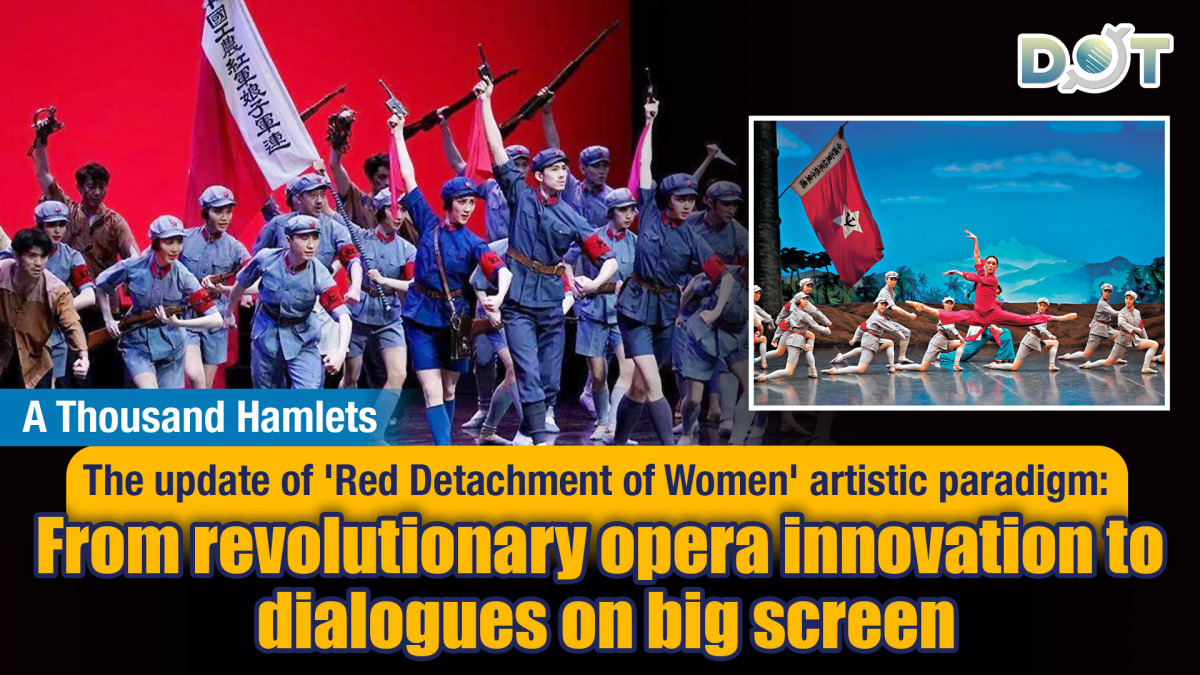
The artistic breakthrough of The Red Detachment of Women began with its ballet creation in 1964, which shattered the traditional interpretations of Western ballet: replacing the swan-like classical imagery with the spirited figure of female warriors, infusing elements of Chinese opera, martial arts, and folk dance into the dance vocabulary, and reconstructing narrative logic with a non-three-act structure that deeply resonated with the Chinese national spirit of perseverance and self-reliance. This innovation was not merely a fusion of techniques; it injected the spirit of resilience needed by the times into the fabric of ballet, creating a template for Chinese ballet that allows classical and modern coexistence, as well as dialogue between the national and the global. As a model of China-Western cultural integration, it was recognized early on in America and garnered international acclaim on its world tours, proving the powerful appeal of Chinese artistic vocabulary in a cross-cultural context.
From Ballet to the 1960s Film and the 2006 Television Adaptation, the artistic expression of the work has always synchronized with the context of the times. The film strengthened ideological narratives through its visual language: the shadows of the Ye Lin Zhai (coconut grove) contrasted with the bright daylight of the liberated area, creating a spatial metaphor of "oppression — liberation." The whip marks on the protagonist Qiong Hua became a visual symbol of class suffering, while the collective exercise uniform rows dissolved individual gender characteristics, highlighting the spiritual core of the "revolutionary community." The television series, on the other hand, conformed to the context of consumer society, integrating fashionable elements and exquisite props into its visual presentation, thus merging revolutionary narratives with popular aesthetic demands, successfully translating the classic IP.
Rediscussing Class Discourse in Revolutionary Narratives
The class expression in The Red Detachment of Women has always been in dynamic evolution, reflecting the social structures of different eras. The film and ballet versions from the 1960s strictly followed Mao Zedong's artistic thought, guiding towards "the broad masses of the people," constructing a clear binary opposition of classes: the proletariat is the absolute subject of revolution. Qiong Hua's status as a slave and Hong Changqing's working-class background reinforced class struggle as the core driving force of the narrative. This narrative echoed the social thoughts of the time and provided artistic endorsement for the legitimacy of revolution.
The 2006 television adaptation of The Red Detachment of Women offered a nuanced reinterpretation of class dynamics, shifting Hong Changqing's identity from the "son of a sailor" to a descendant of wealthy overseas Chinese, and introducing middle-class figures like a Malaysian girl into the revolutionary narrative. This transformation reflected broader societal changes in post-reform China, where the rise of the middle class and consumerism prompted narratives to encompass a wider array of social identities. Director Yuan Jun, in a 2014 interview, who investigated the surviving female members of the Red Army in Hainan, emphasized that the series highlights the journey of ordinary rural women from oppression to becoming warriors. While he acknowledged that red classics tend to attract an older audience, he argued that the themes of resilience and struggle are vital for younger viewers, advocating for authentic storytelling that resonates beyond mere slogans. Yuan Jun believes that a diverse range of artistic expressions can effectively convey positive energy and engage contemporary audiences.
Representations of Gender Politics in the Dissolution of Identity
In the anatomy of gender politics, the different versions of The Red Detachment of Women constitute a micro-history of feminist liberation thought. In the 1960s film and model opera versions, female identity is completely merged with class identity: Qionghua's body becomes a symbol of breaking through class oppression, and her awakening process represents a transformation "from woman to proletarian." By embracing revolutionary ideology, individual gender characteristics dissolve into collective identity—the female soldiers, dressed in uniforms and with their hair cut short, become "gender-neutral" symbols of revolution. This form of "liberation" reflects women's struggle to break free not only from the constraints of feudal patriarchal families but also from the social oppression inherent in class divisions.
The 2006 television series version, however, offers more diverse possibilities for the portrayal of female characters. The female lead, with her delicate makeup and fashionable attire, actively engages in revolution. Her consumerist "worldly" tendencies coexist with her revolutionary beliefs, breaking the stereotype that "revolution inevitably entails suffering." This shift resonates with the contemporary feminist focus on "multiple differences"—gender liberation is no longer confined to a class framework but is intertwined with factors such as class, culture, and personal choice. However, it is worth pondering whether, in both the film's "Mulan-style" gender disguise and the television series' "fashionable" revolutionary women, the relationship between female liberation and collectivist narratives is built upon the awakening of individual gender consciousness—a question that remains to be further clarified.
Nevertheless, after the broadcast of the 2006 television series, the Beijing Daily also highlighted some social criticisms, noting that the actors' reinterpretation of the classic film did not receive unanimous approval from the audience. For instance, it was mentioned that Liu Peiqi's portrayal of Nan Batian appeared overly refined, lacking the ruthless and formidable aura of a regional tyrant, which made it difficult to perceive the character's domineering and ferocious nature. There were also criticisms that the actresses playing the detachment members were too graceful and delicate, with overly melodious and gentle demeanors, neglecting the historical reality of these deeply oppressed rural women who were forced onto the path of resistance. There remains a clear distinction between heroic icons and youthful idols.
The Vitality of the Classic Lies in Its Response to the Times
The continued vibrancy of The Red Detachment of Women across more than half a century lies in its constant resonance with the times. From the ballet's breakthrough of artistic paradigm, to the film's interpretation of revolutionary ideology, and the television series' response to social structural changes, each adaptation has reactivated the "classic." It exemplifies not only the integration of Chinese and Western arts but also serves as a cultural text that records the evolution of Chinese social thought, class structure, and gender concepts — embodying the eternal spirit of "perseverance and innovation," while continuously absorbing the nutrients of the times and completing a cross-era cultural dialogue in its adherence and reformation. As a symbolic representation of Chinese art, its value lies not only in the breakthrough of artistic forms but in its multidimensional interpretations, proving that a true classic can always offer a spiritual code for understanding itself across different eras.
Liu Yu is the lead editor of the cultural commentary "A Thousand Hamlets." Liu holds a BA in English Literature from HKBU and an MA in History from HKU.
The views do not necessarily reflect those of DotDotNews.
Related Readings:
A Thousand Hamlets | Why not read poetry this Christmas
A Thousand Hamlets | Hong Kong's spoken-word poetry communities: Nests of singing birds




Comment