





As Hong Kong promotes the application of artificial intelligence (AI) in the field of education, aligning AI education with contemporary needs and enhancing teaching quality still requires ongoing refinement and exploration.
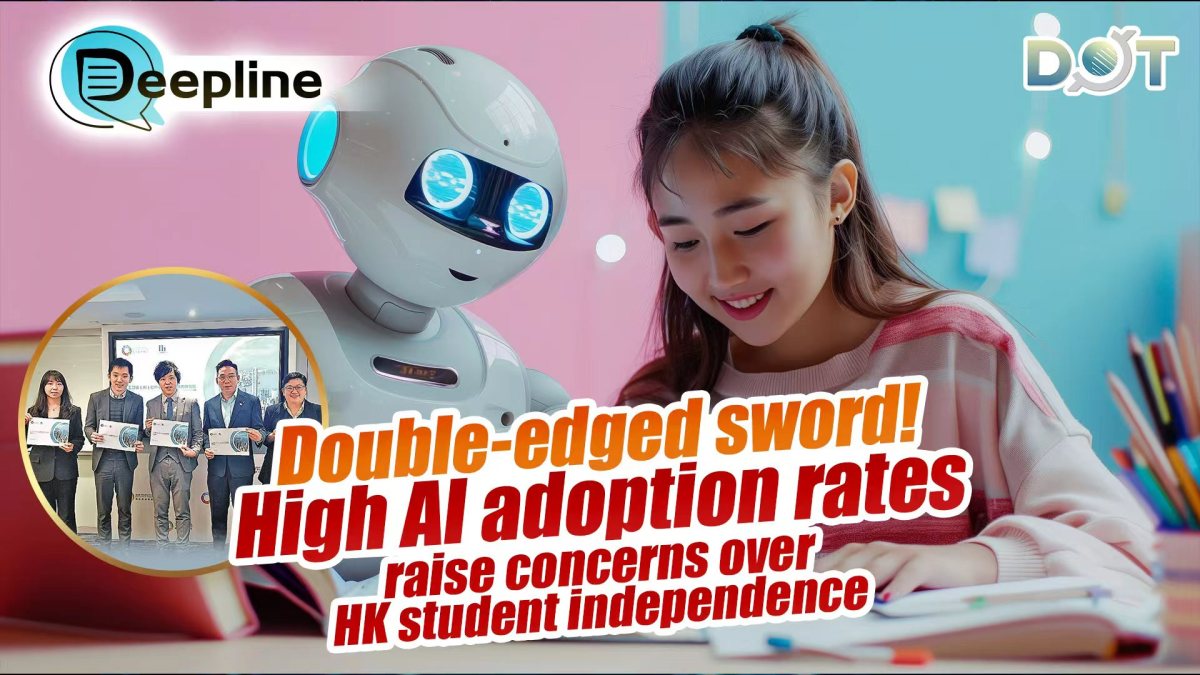
The Our Hong Kong Foundation conducted a research survey on the current usage, needs, and challenges related to AI among primary and secondary school teachers and students in Hong Kong. The study found that while the adoption rate of AI in teaching and learning in Hong Kong currently exceeds 90%, it has also led to noticeable dependence on AI among some students.
From July to December last year, the Our Hong Kong Foundation surveyed 1,200 primary and secondary school teachers and students via questionnaire, with secondary students comprising 71% and teachers 25% of the respondents.
The results show that 91% of teachers currently use AI, and the rate among students is even higher at 95%. Regarding application scenarios, teachers primarily use AI for teaching assistance (57%) and administrative tasks (56%), such as lesson preparation, designing teaching materials, and scheduling. Subjects like information technology, languages, and science see wider AI application, reaching 70% or more. In contrast, AI use is lower in areas like classroom interaction, student assessment, and parent-teacher communication. As for students, they mainly use AI for gathering information (35%) and completing assignments or reports (29%). They also use it to summarize key class points, generate practice questions, or explore personal interests.
Only 3% of teachers believe AI has "no negative impact on students"
Regarding self-assessed AI proficiency on a 10-point scale, surveyed teachers rated themselves only 5 points on average, while students rated themselves 6.5. Furthermore, 54% of teachers expressed concern that AI could lead to data leakage and misuse, and 37% of students shared the same worry.
It is noteworthy that 16% of students have once entered personal information into AI tools.
While AI is becoming widespread, it also brings new concerns for learning. Over 70% of teachers stated directly that AI could weaken students' problem-solving abilities, 63% worried about its impact on critical thinking, followed by creativity (59%), memory (43%), and communication skills (34%). Only 3% of teachers believed AI has no negative impact on students.
The survey also asked students if they could complete homework independently without AI assistance. The results were concerning: 23% of students admitted it would be difficult to finish, while only 39% felt confident in handling it independently, indicating that some students have already developed a reliance on AI.
"Generation gap" in tool preferences
As AI has been integrated into educational settings, the discussion has shifted from "whether to use it" to "how to use it well" and "which tools to choose."
The study found a "generation gap" in the AI tool preferences between teachers and students. Data shows that teachers most frequently use Poe (87%), DeepSeek (57%), and Copilot (42%), while students primarily use DeepSeek (69%), Doubao (67%), and Poe (63%).
Doubao is one of the most commonly used tools among students, often used for image generation, video production, etc., but its usage rate among teachers is 14%. Additionally, some schools have developed their own AI tools, but these are still in the minority.
A researcher from the Our Hong Kong Foundation said that the situation where some students "don't know how to do homework without AI" precisely illustrates that while over-reliance on AI may offer temporary convenience, it could accumulate "cognitive debt" in the long run, weakening students' abilities for self-directed learning and deep thinking.
She noted that this research also reflects that some students still have insufficient awareness of AI risks, and there is a need to promote AI literacy education to cultivate students' critical thinking when using AI. Furthermore, the content and methods of teacher training must keep pace with the times, strengthening guidance on application and teaching methodologies to help teachers more effectively guide students in using AI to enhance learning outcomes.
Expert voices out: How to use AI correctly?
To help primary and secondary schools use AI tools well, Victor Kwok, Deputy Research Director of the Our Hong Kong Foundation, pointed out that in formulating a framework for AI teaching applications, Hong Kong can refer to the experiences of Singapore, Finland, and the Organization for Economic Co-operation and Development (OECD). This involves standardizing the fairness, safety, and accessibility of AI tools, providing contextual examples to guide teachers in instructing students on proper AI use, and regularly reviewing and updating the framework in response to technological advancements to ensure its relevance. The framework content should cover aspects such as teaching methods, usage scenarios, and tool selection.
Kwok also mentioned that many teachers are unable to utilize AI effectively due to time and resource constraints. He recommended that training should emphasize combining "AI pedagogy" with subject teaching and expanding the existing AI for Empowering Learning and Teaching Funding Program to cover all subjects in primary and secondary schools. Teachers who complete the training should be encouraged to share their experiences externally to drive overall improvement.
Furthermore, he suggested designing a "digital education teacher professional training course." The Education Bureau could also partner with universities to train STEM students as AI teaching assistants, alleviating teachers' burdens and promoting AI integration into teaching. Simultaneously, enhancing AI literacy training for pre-service teachers, focusing on the integration of AI and pedagogy, would comprehensively improve prospective teachers' application and teaching capabilities.
(Source: Wen Wei Po; Journalist: Luk Nga-nam; English Editor: Darius)
Related News:
Malaysia temporarily bans Grok, becoming second country after Indonesia to impose restrictions




Comment