





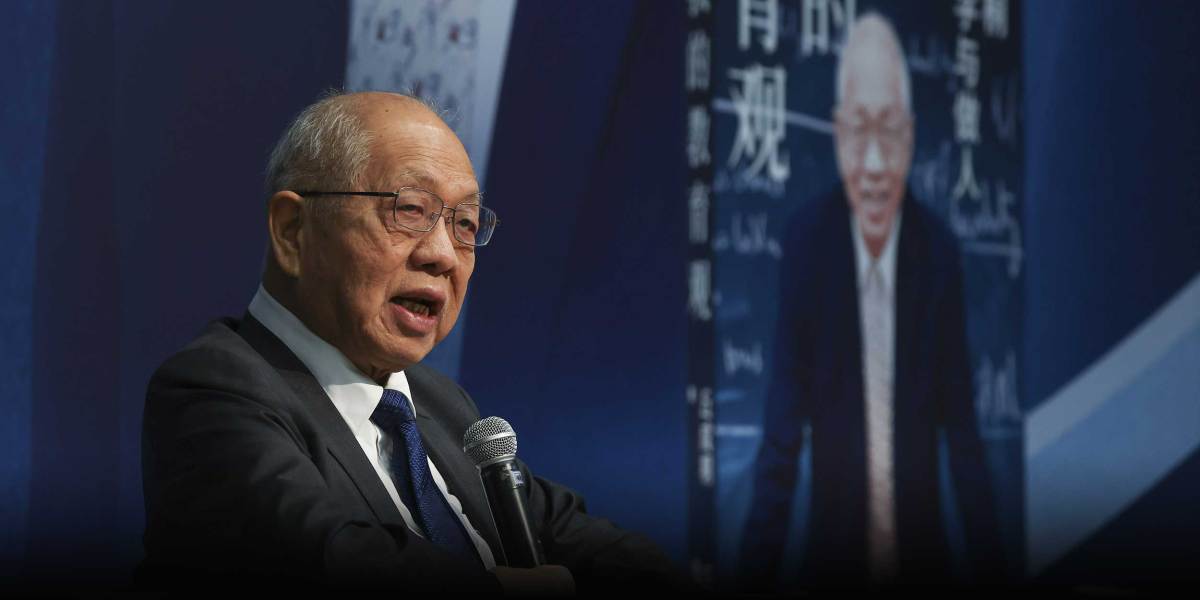
Chinese American mathematician Shing-Tung Yau, a 1982 Fields Medal winner, has called for stronger collaboration among mathematicians in Asia, saying rapid advances in artificial intelligence could help propel the region to the forefront of mathematical research.
Speaking to a Shanghai-based outlet, Yau said in the paper on Nov. 23 that he remains optimistic about AI's impact on the discipline. "Mathematics is not in crisis. It will only get better," he said, adding that much of the anxiety about AI stems from an overly narrow focus on problem-solving rather than the broader pursuit of mathematical discovery.
Yau is the founding president of the Asian Mathematical Union, described as the first pan-Asian academic organization dedicated to mathematics. At the union's launch ceremony on Tuesday at the Chinese University of Hong Kong, he said AI's rapid development presents an opportunity for Asian mathematicians not only to catch up with international peers but potentially to surpass them.
Over the past year, AI has recorded a series of headline-making advances in mathematics. In May, a model from U.S. AI company OpenAI disproved the Erdős conjecture about unit distances, a problem that had remained open for 80 years. On Nov. 20, mathematician Levent Alpöge, who works for U.S. AI firm Anthropic, unveiled a proof of the Riemann hypothesis developed with the assistance of the company's AI system Claude. Mathematicians are now working to better understand the proof's reasoning.
Yau noted that mathematical results often require time to be fully validated. He said it is usually only after a theorem has been used repeatedly over a long period that researchers gain confidence in the soundness of its proof, and he expects mathematicians to fully digest the Riemann hypothesis proof within five years.
He added that, in his view, it is less important whether a major breakthrough comes from a machine or a human mind than whether it leads to truth. "Whether the Riemann hypothesis was proved by a machine or the human brain, it's an exciting achievement," he said, describing credit and attribution as secondary to discovery.
Yau compared mathematical research to mountain climbing, arguing that AI can help researchers reach an initial summit and then open pathways to greater heights. He also emphasized that progress depends on cooperation, saying machines could accelerate collaboration by helping scholars integrate ideas from scientists worldwide.
Reflecting that emphasis, the Asian Mathematical Union plans to recruit about 100 postdoctoral researchers each year. According to the plan, 50 will be selected by an academic committee; five each will be nominated by China, India, Russia, Japan, South Korea, and Iran; and 20 will come from other countries and regions. The union also plans to regularly invite 25 senior mathematicians and 30 early-career researchers to Hong Kong for research, academic exchanges, and training.
The union will focus on four areas: pure mathematics, applied mathematics, statistics, and AI.
Separately, on Oct. 11, Yau established another initiative—the Yau Laboratory Alliance for Mathematics and Artificial Intelligence— at Tsinghua University in Beijing. The alliance will focus on AI models designed specifically for mathematics, AI-assisted mathematical proofs, and interdisciplinary applications.




Comment