






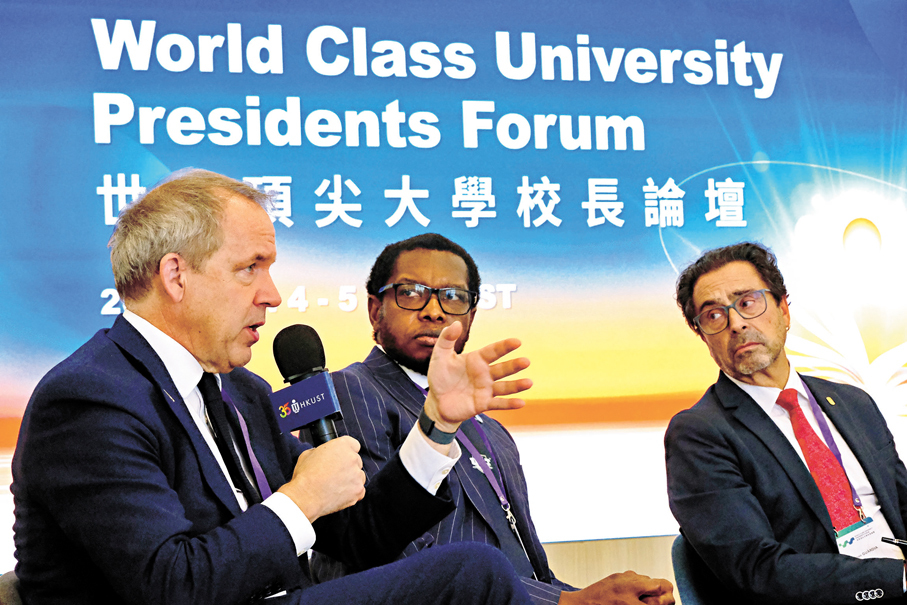
Presidents of several world-leading universities have expressed strong interest in Hong Kong's plan to develop a university town in the Northern Metropolis, highlighting the importance of industry-academia-research collaboration, international partnerships and supportive government policies in driving the project's success.
The World Class Universities Presidents Forum 2026 was held at the Hong Kong University of Science and Technology (HKUST) on Nov. 4 and 5, bringing together more than 130 university presidents, renowned scholars and international education leaders from around 50 leading universities worldwide.
The forum highlighted HK's unique strengths and role as a bridge connecting the mainland with the global higher education system. Among the key topics discussed was the city's ambitious plan to establish a university town in the Northern Metropolis.
During interviews with Wen Wei Po, university leaders shared their views on potential participation in the project, their expectations of the Hong Kong Special Administrative Region (HKSAR) government, and innovation and development in the age of artificial intelligence (AI).
While expressing considerable interest in the initiative, they stressed that the "triple helix" model of collaboration among government, industry and academia, together with deeper international cooperation, would be crucial to its future development.
Duncan Ivison, president of the University of Manchester in the UK, described the HKSAR government's vision as "very ambitious". He particularly praised the project's plan to establish a "triple helix" framework involving universities, industries and other stakeholders from the outset.
Ivison said the university was closely following developments and hoped to gain a better understanding of the government's overall vision. He added that HK already had established models of collaboration and that the government had sent a strong signal about the role of higher education in driving economic development, something that was difficult to achieve in many other regions.
Stuart Croft, president of the University of Warwick in the UK, also praised the government's strategic vision, describing the initiative as a "very rare opportunity". He noted that few places around the world had undertaken entirely new development projects centred on university towns, with economic growth driven by collaboration among government, industry, academia and research institutions.
Croft made clear that Warwick would seek to participate in the Northern Metropolis development through partnerships with local universities rather than taking the lead independently. He added that funding coordination could also be handled by a locally led organization.
Joan Guàrdia, president of the University of Barcelona in Spain, said the university was shifting its focus from Latin America towards China, particularly HK and Shanghai. He hoped to establish high-level research and innovation projects in HK through strategic agreements, helping turn research outcomes into practical applications.
Call for policy framework to attract international talent
Stephen McArthur, president of the University of Strathclyde in the UK, said HK could draw on Scotland's experience with innovation districts to explore opportunities for international collaboration involving multiple stakeholders.
Mosa Moshabela, president of the University of Cape Town in South Africa, revealed that his university was already working with HKUST and would also establish a hospital jointly with the University of Bristol. He hoped the development of an innovation cluster would help attract international talent.
Several university leaders also called on the HKSAR government to provide clearer guidelines as soon as possible.
Moshabela said the government should clearly define what would constitute "project success" for the Northern Metropolis university town and set out its expectations for international partners. He also called for a guiding policy framework to attract international talent.
Guàrdia stressed that attracting talent required policy support and urged the government to provide greater flexibility in funding and policy arrangements.
Asked how the Northern Metropolis university town could reshape HK's global standing, Croft said its development would give HK universities the opportunity to achieve deeper global integration at an earlier stage.
Guàrdia said modern universities should move beyond simple cooperation agreements and establish new, structured frameworks for deeper collaboration, similar to European university alliances.
Moshabela highlighted the importance of balancing the development of an innovation ecosystem with adequate living space and community integration. He stressed that development projects should not exclude existing residents and that affordable housing and a liveable environment should be incorporated into the planning process from an early stage.
Universities urged to harness AI to nurture talent
Addressing the challenges posed by the AI era, McArthur said AI would not undermine education but should instead serve as a tool to help students develop deeper understanding and stronger judgment.
He said universities should use AI as an opportunity to redefine the future workplace and cultivate talent with the skills needed to meet emerging demands.
On innovation and technology transfer, Ivison and Croft both stressed that the speed at which research findings are translated into practical applications was a key factor distinguishing leading universities.
Faced with real-world challenges such as climate change, universities must accelerate the transformation of fundamental research into practical value, while helping large, medium-sized and small enterprises apply innovative technologies to reduce costs and improve efficiency, they said.
However, the pursuit of speed should not come at the expense of fundamental principles.
Moshabela warned that amid the spread of misinformation and growing scepticism towards science, transformation must be built on "trust", which he described as the most valuable contribution universities could offer society.
Guàrdia also noted that public funding alone was no longer sufficient to support the transformation of universities. Institutions must uphold their research values while pursuing strategic partnerships with the private sector, thereby rebuilding and strengthening their role as trusted institutions in society.
(Source: Wen Wei Po; Reporter: Yang Yingying)
Related News:
HKU retains top spot in QS Asia Rankings 2027, CityU climbs to fourth




Comment