






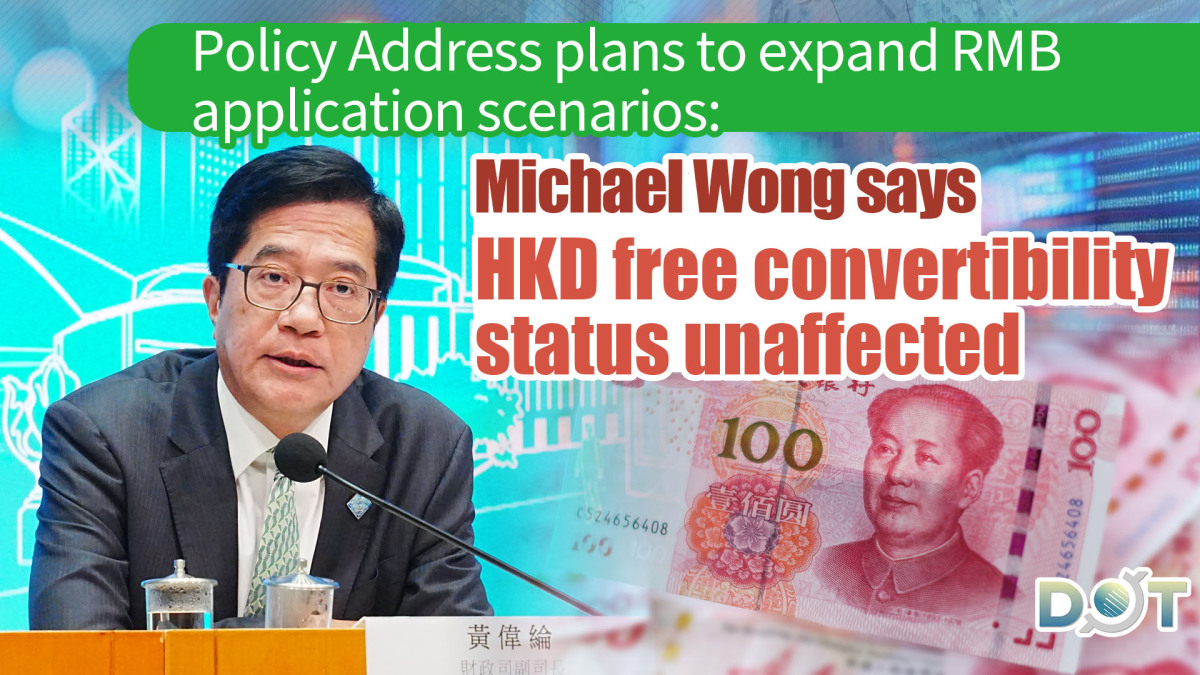
The new Policy Address proposes expanding the use of renminbi in payments, including a study on paying government expenses in RMB. Deputy Financial Secretary Michael Wong said on a radio programme today (Sep. 23) that Hong Kong has the world's largest offshore RMB liquidity pool. As offshore RMB business develops, finding more application scenarios is an inevitable process. If a service or product is itself priced in RMB, paying directly in RMB can save exchange costs and procedures.
Wong gave an example: under a future "HKD-RMB dual counter model", part of stamp duty revenue could be paid directly in RMB. He stressed, however, that the vast majority of Hong Kong's services are still priced in Hong Kong dollars, and the currency's status as a freely convertible currency will not be affected.
The Policy Address also proposes studying whether the Exchange Fund should moderately increase its gold holdings. Wong said the government is actively building Hong Kong into an international gold trading market and a commodities trading ecosystem. The Hong Kong Monetary Authority's decision to increase its gold allocation is based on overall asset allocation and risk management considerations.
Wong explained that amid changes in the international political environment in recent years, many central banks and enterprises want to store gold in places they have greater confidence in and where deposits and withdrawals are convenient. Hong Kong has advantages including the rule of law, respect for private property and an excellent transport hub. In the first quarter of next year, the government will launch a central gold clearing and settlement system and plans to raise Hong Kong's total gold storage capacity to 2,000 tonnes, with airport storage accounting for 1,000 tonnes. He said the HKMA's moderate increase in gold holdings at a time when Hong Kong is enhancing its gold storage and settlement functions is not only a sound portfolio decision but also serves as a demonstration effect.
Related News:
Policy Address 2026 | Ten measures to support SMEs, including expanding funding scope of 'BUD Fund'




Comment