






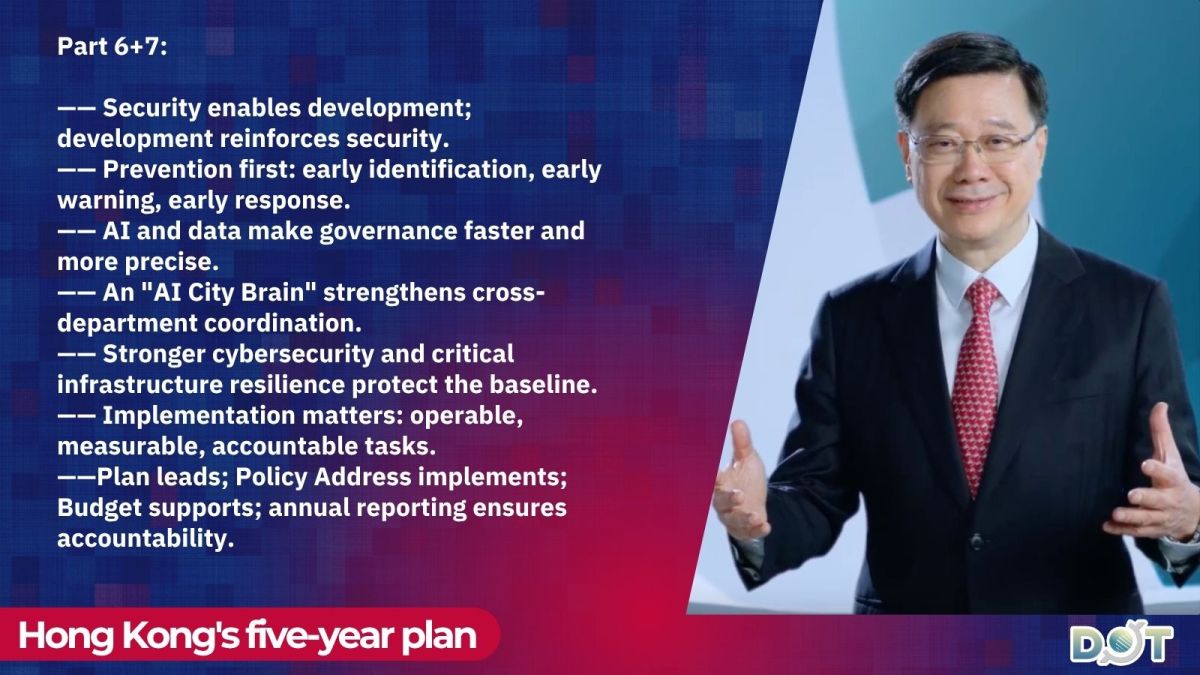
Hong Kong Chief Executive John Lee unveils the city's first five-year plan today (Sept. 16). Parts 6 and 7 present a governance blueprint that treats security and development as mutually reinforcing: security is the prerequisite for development, while development, in turn, strengthens security. The overall objective is to shift Hong Kong's public governance toward a prevention-based model, improve interdepartmental coordination, reduce unnecessary procedural friction, and use technology—especially AI and data—to upgrade decision-making, public services, and risk management. At the same time, the plan stresses institutional discipline: clear accountability, measurable tasks, steady resource support, and continuous monitoring to ensure that the Five-Year Plan is implemented effectively and consistently.
Part 6: Development–Security Integration and Stronger Governance Efficacy
1) Security governance: legal foundations, education, and technology-enabled resilience
Part 6 begins with national security as a core governance responsibility. It emphasizes improving Hong Kong's legal system and enforcement mechanisms in alignment with the national security framework and strengthening cross-departmental synergy to prevent and combat acts that endanger national security. It also highlights an authoritative chain of command and stronger risk monitoring, warning, and emergency response mechanisms for major incidents.
National security education is framed as regularized and wide-ranging—covering civil servants, schools, communities, and enterprises—with youth-targeted programs designed to strengthen national awareness and identity. Counter-terrorism preparedness is also reinforced through specialized training, updated contingency planning, broader intelligence networks, and deeper cross-boundary and international cooperation. The plan includes operational targets such as around 120 counter-terrorism exercises annually and a large-scale interdepartmental exercise every 12 to 18 months.
Technology plays a central role in modern security governance. The plan calls for stronger cybersecurity defense, early identification of emerging cyber threats through cooperation with mainland and overseas institutions, and enhanced protection and resilience for critical infrastructure systems. Data governance and data security management are to be strengthened in ways that align with national and international safety rules and facilitate collaboration on standards, innovation, and information sharing.
2) Disaster prevention and city resilience: toward an "AI City Brain"
Beyond national security, Part 6 expands to a broader "all-hazards" resilience agenda. It proposes developing a smart city management system—often described as an "AI City Brain"—integrating AI, big data, and the Internet of Things to enable real-time data sharing, smart analysis, risk alerts, instant prediction, and coordinated response across departments. This approach aims to improve resilience under extreme weather and other hazards, including through remote sensing, radar systems, and high-density land-sea monitoring networks.
Specific resilience upgrades include R&D for an AI-based flood forecasting and alert model and the digital intelligence transformation of infrastructure (transport, energy, drainage, water supply, and communications) using tools such as digital twins, condition monitoring, and predictive maintenance. Fire safety governance is also strengthened through improved legislation, accountability mechanisms, and higher-capability rescue teams for extreme conditions (including high-rise incidents). For older buildings, the plan prioritizes building safety reforms, enhanced owner support (technical and financial), stronger tender "gatekeeping," and targeted anti-corruption measures against bid-rigging in maintenance works.
Community-level resilience is emphasized through regularized inspections, improved complaint mechanisms that feed into risk management, and the "Emergency Responder Scheme" to mobilize local organizations and residents for training and drills—building a "Safe Hong Kong." The plan also deepens cross-boundary emergency response collaboration within the Greater Bay Area through a more systematic joint operational plan.
Public order governance focuses on tackling telecommunications and cyber fraud, drug offenses, and cross-boundary crime through stronger intelligence sharing and public education, alongside enhanced interception capabilities at boundary points and across logistics chains.
3) Public governance capabilities: civil service reform, digital-first government, and integrity
Part 6 also targets improvements in the civil service system. It stresses training management, government-wide training requirements, and structured cooperation with Mainland units—aiming to strengthen public service ethos, strategic awareness, and the capacity to innovate and respond. Governance performance management is reinforced through accountability systems, improved appraisal mechanisms, and "reward and discipline" structures that recognize commitment and performance, while controlling establishment size by using digitalization and AI to shift staff focus toward higher-value work and strategic decisions.
Digital governance reforms seek to accelerate real-world AI application scenarios across government, improve data governance, and expand internal data sharing through mechanisms like departmental data catalogues and consent-based data exchange. A "digital-first" principle is promoted, supported by strengthened cloud infrastructure and common data platforms. Public-facing digital service delivery will expand through "iAM Smart" and one-stop e-services, which will include functions such as digital documents and AI assistant-style support. For businesses, the Digital Corporate Identity platform (CorpID) is positioned as core infrastructure, with a target that corporate-related digital government services and forms will support CorpID by 2028.
Finally, Part 6 underlines public integrity and anti-corruption as the bedrock of society: zero tolerance enforcement, stronger prevention, technology-enabled internal supervision, integrity education, and expanded international collaboration to share Hong Kong's anti-corruption experience and strengthen regional leadership.
Part 7: Institutional Safeguards for Effective Implementation of the Five-Year Plan
Part 7 shifts from policy content to implementation discipline. The guiding goal is to enhance the HKSAR's governance efficacy so that the Five-Year Plan is not merely aspirational but operational. It calls for a more proactive and pragmatic governance philosophy, stronger coordination across bureaux and departments, improved continuity of major projects and policies, and fuller mobilization of society through the dual emphasis on an "effective market" and a "capable government." Public participation is framed not only as support but also as monitoring to strengthen execution.
A central mechanism is the "four-link framework":
- Five-Year Plan leads (strategic direction)
- Policy Address implements (annual work plan)
- Budget supports (resources and financial arrangements)
- The annual report gives accounts (transparent review and responsibility).
Under this structure, the annual policy address becomes the phase-by-phase translation of medium- and long-term objectives into operable and assessable tasks, with regular monitoring and adjustments based on real circumstances. The budget is positioned as the financial backbone—supporting strategic projects while safeguarding fiscal sustainability and maintaining sustained commitment in key areas. Finally, the chief executive's annual duty visit reporting mechanism provides a formal channel for reviewing progress against objectives and indicators, enabling methodical assessment and continuous improvement.
Related News:




Comment