






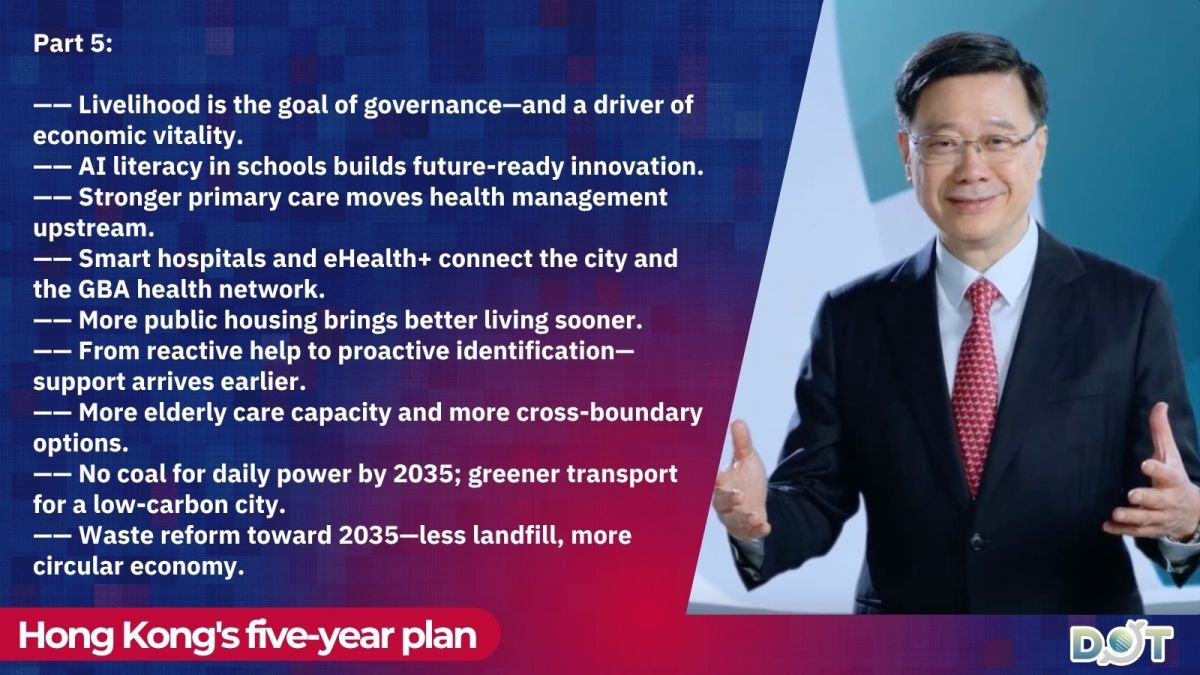
Hong Kong Chief Executive John Lee unveils the city's first five-year plan today (Sept. 16). Part 5 frames social policy as both a governance objective and an engine for sustainable growth: improving livelihoods strengthens people's sense of fulfillment, happiness, and security, while also stimulating market demand and energizing economic activity. Against the backdrop of demographic shifts—especially population aging and a declining birth rate—the agenda emphasizes "high-quality population development" through coordinated upgrades in education and training, healthcare, housing, labor and welfare, youth development, and child care support. The overall direction is clear: build stronger institutions, deliver better services, and ensure that social protection remains effective, preventive, and future-ready.
Advancing quality education: future-ready learning, values, and talent pipelines
Part 5 begins with education, calling for a future-ready education system that strengthens both students' competencies and teachers' professional capacity. A key priority is to enhance students' AI literacy and progressively integrate AI into learning, teaching, and assessment across different key learning areas—including physical education and arts education—and across cross-disciplinary domains such as STEAM. The education vision stresses not only technical skills but also a humanistic orientation—cultivating a "Technology for Good" mindset.
To support digital transformation, the plan promotes cross-sector collaboration to create a digital education ecosystem, strengthening STEM foundations in primary and secondary schools and improving the digitalization of kindergarten administration and school support systems. It also commits to improving teaching materials and textbook review mechanisms, using digital tools to strengthen learning and teaching support.
Values education is also central: the plan highlights deeper patriotic education, national education, national security education, and values education, integrated into daily teaching. At the same time, it supports biliterate and trilingual education and the learning of other languages, reinforcing Hong Kong's role as an East-meets-West center for international cultural exchange. Post-secondary institutions should expand exchange activities and international learning experiences, which will cultivate students' global horizons and a diverse, inclusive campus environment.
To align resources with demographic realities, the plan proposes a more dynamic allocation of basic education resources, including consolidation and mergers where appropriate to enhance efficiency and quality. The plan strengthens teacher professional standards through improved training frameworks, refined registration mechanisms, and clearer training targets, alongside deeper cooperation with the Mainland. For post-secondary education, Hong Kong aims to expand capacity and quality, develop basic and emerging disciplines and interdisciplinary studies, and strengthen international cooperation—further consolidating its standing in the international education arena.
Finally, Part 5 addresses employability and industry needs by promoting vocational and professional education and training (VPET), including the development of universities of applied sciences, expansion of applied degree programs, and deeper collaboration with Mainland and overseas partners. Continuing vocational training will be strengthened through an upgraded Employees Retraining Board—repositioned as "Upskill Hong Kong"—to provide more personalized, trend-responsive skill development for the workforce.
Supporting youth, women, families, and social cohesion
Part 5 calls for a more supportive ecosystem for young people's education, employment, entrepreneurship, and home ownership, building on the Youth Development Blueprint. It aims to broaden youth horizons through diverse exchange platforms and practical experiences, including deeper youth exchanges with the Mainland, and positions the Youth Development Summit as a flagship event for international youth exchange and collaboration.
Youth talent development will be expanded through a widened Young Talent Training Programme across more sectors, while support services for youth employment will be strengthened with attention to how technology reshapes the labour market. Entrepreneurship is encouraged through funding and incubation, including stronger use of one-stop platforms such as the Alliance of Hong Kong Youth Innovation and Entrepreneurial Bases in the Greater Bay Area. The plan also notes targeted support for ethnic minority youth via internships, language education, and district-level support.
Women's development is framed as a commitment to building an environment that protects rights, promotes well-being, and enables women across life stages to realize their potential. For families and communities, the plan promotes good family virtues and cohesion, supports engagement with rural communities, and recognizes the role of religious communities in education, medical, and welfare services—aiming to foster an equal, caring, diverse, and inclusive society, including stronger support for ethnic minorities.
Deepening healthcare reform: primary care, resilience, smart hospitals, and public health
Healthcare reform is structured around prevention, sustainability, quality, and system resilience.
A major institutional move is developing a sustainable governance system for primary healthcare, including legislative empowerment of a Primary Healthcare Commission to establish evidence-based service and referral standards and a statutory register of primary healthcare providers. Service models will expand through the coordinated development of the Primary Healthcare Co-care Network and the District Health Network, with a target of substantially completing District Health Centres in all 18 districts within five years. Primary care will connect with secondary and tertiary services, and we will strengthen community mental health support. A personalized life course preventive care plan under a family medicine model will promote screening and health advice across life stages to realize early prevention, early identification, and early management.
System resilience includes deeper public healthcare reform, including subsidy structure reform while strengthening protection for "poor, acute, serious, critical" patients, and ensuring sustainability without reducing the government's overall commitment. The private healthcare sector will be strengthened through premises-based regulation for safety and service quality, improved price transparency, and more standardized data and clinical guidelines. The plan also promotes the higher-quality and higher-standard development of Chinese medicine.
Healthcare infrastructure expansion is a key pillar: the public hospital development plan is expected to increase public hospital beds to about 35,000 in 2031 and operating theaters to about 360. Digital health transformation continues through eHealth+, integrating government-subsidized health programs and upgrading the eHealth app into a more comprehensive health tool. Smart hospitals will advance via digitalization, data, and AI across "smart care," management, support, staff, and facilities.
Public health preparedness is strengthened through upgraded communicable disease monitoring, early warning, emergency response capacity, smarter anti-epidemic measures, and deeper joint prevention and control with the Mainland (particularly GBA cities). The plan also includes health promotion initiatives—weight management, health behavior surveys, big data analytics for policy, mental health promotion, and stronger tobacco control to build a smoke-free city. Internationally, Hong Kong will increase participation in global health affairs and continue hosting major events such as the Asia Summit on Global Health.
Enhancing and diversifying housing: supply, standards, land creation, and urban renewal
Housing policy is presented as a foundational livelihood issue, with a strong focus on both eliminating substandard living conditions and strengthening long-term supply.
Part 5 sets a target to resolve the issue of substandard subdivided units in residential buildings by 2030, alongside the rollout of a Basic Housing Unit regime to ensure statutory compliance on safety, fire protection, and hygiene. Public housing supply will significantly increase, including the completion of around 30,000 Light Public Housing units, with the remaining units scheduled for completion in 2027. Over the coming five years (2026–27 to 2030–31), total public housing production (including Light Public Housing) is projected to reach around 196,000 units, which would support a reduction in the composite waiting time for subsidised rental housing to 4.5 years in 2026–27 and below four years by 2030–31.
The Long Term Housing Strategy will be updated through annual demand projections and rolling 10-year supply targets, with a planned distribution of 40% public rental housing, 30% subsidised sale flats, and 30% private housing. The plan also seeks to strengthen the housing ladder, increase larger-unit proportions, and refine designs to better match younger generations' lifestyles.
Construction technology is positioned as a productivity driver: modular integrated construction and smart construction are to be expanded, aiming to adopt MiC earlier and more widely in public housing projects, while turning public housing into a "housing innovation and technology incubation hub" and linking it to GBA innovation and industry chains.
To support supply, the plan will enhance land creation and a transparent land reserve strategy through annually updated "spade-ready sites" forecasts. Urban renewal will be advanced with a "new mindset," including using new development areas to enable redevelopment of old districts, refining "Flat-for-Flat" arrangements, reviewing compensation mechanisms, committing substantial resources to renewal, and piloting innovations such as cross-district plot ratio transfer—shifting from isolated demolition-rebuild to integrated, greener, better-connected community regeneration. Public rental housing resources will also be safeguarded through better monitoring and data-driven enforcement against abuse, improving unit turnover for families in need.
Strengthening livelihood protection: targeted support, proactive welfare, and child well-being
Part 5 reinforces inclusive public services and multi-tiered social security, balancing a dignified safety net with encouragement of self-reliance. Poverty alleviation efforts will become more targeted through a combination of macro data and micro-level care and through stronger tripartite collaboration among government, business, and community.
Support for individuals with disabilities and carers includes expanding capacity across residential care, rehabilitation, placement services, and carer support, while promoting technology applications (e.g., through innovation funding for elderly and rehabilitation care) and fostering disability-inclusive workplaces. For grassroots families, the School-based After School Care Service Scheme will be expanded to support parents' employment capacity, and more Community Living Rooms will be created to support subdivided-unit households with facilities and service referrals.
A key system upgrade is moving from reactive welfare to data-driven proactive identification and targeted support, including exploring a welfare information sharing e-platform (subject to privacy protection, legal compliance, and public confidence) that consolidates cross-sector data—welfare, healthcare, education, housing, and transport—to detect risk signals earlier and deploy resources more effectively.
The Government will strengthen child protection reporting and handling mechanisms, enhance support teams, and improve oversight and quality of childcare services to better address children's well-being. Family support services will be expanded under "family-focused" and "carer-centric" principles, and child care places are targeted to rise from about 1,500 (2025) to about 3,300 (2030)—an increase of 1,800 places—to reduce pressure on working families, particularly single parents. The plan also deepens exchange and cooperation in social services with Mainland counterparts, including GBA social service cooperation projects, talent exchange, and adoption of new technologies and smart equipment.
Enhancing labor protection: supply, rights, safety, and technology-enabled services
Labor policy aims to increase labor supply while protecting rights and safety. Employment services will be improved through AI-enabled job matching, personalized vacancy recommendations, and diversified job fairs, with targeted support for youth, women, older persons, ethnic minorities, and people with disabilities to reduce barriers.
Labor importation is framed as orderly and appropriately scaled, on the premise of protecting local workers, with dynamic adjustments based on supply-demand conditions. The plan also seeks to expand sources of foreign domestic helpers and admit domestic carers with better elderly care skills to meet aging-related home-care needs.
Rights protection includes systematic review and enhancement of labor legislation, exploration of new legislation for new forms of employment, annual review of the statutory minimum wage rate, and stronger tripartite consultation mechanisms. Occupational safety and health will be strengthened via technology—AI-assisted inspection and enforcement, smarter complaint-handling systems, and data analytics for risk-based inspections—supported by a one-stop industry-based OSH information platform.
Building an age-friendly society: care capacity, cross-boundary options, and the silver economy
Part 5 proposes expanded elderly care capacity, including building more government-funded community and residential facilities and increasing vouchers under community and residential care schemes. It targets 8,000 additional subsidised long-term care places by 2030 (from around 69,500 at the end of 2025 to around 77,500 at the end of 2030). Public-private collaboration is encouraged, including pilots for government-built elderly welfare premises operated by the sector.
Cross-boundary elderly care is to be strengthened within the GBA through expanded networks of quality care homes under the Residential Care Services Scheme in Guangdong, improved insurance arrangements, and more portable cash assistance options delivered through remittance. Active aging, elderly community participation, volunteerism, and elderly employment support will be promoted.
The plan also looks to scale up the silver industry—products, services, tourism, leisure, and culture—while improving service standards through stronger mutual recognition of qualifications and "one inspection, two certificates" arrangements and upgrading certification standards toward national standards to increase competitiveness.
Building a green and liveable city: energy transition, green transport, waste reform, and ecological protection
Part 5 integrates environmental policy into livelihood quality and long-term resilience. It aims to optimise the energy mix, increase the share of zero-carbon energy, and cease using coal for daily electricity generation by 2035, targeting around 60%–70% zero-carbon energy in the electricity generation fuel mix. Building energy efficiency standards will be strengthened, with long-term electricity reduction targets for commercial and residential buildings and staged milestones by 2035.
Green transport will advance through electrification and new energy transport, expanded charging and hydrogen refueling networks, and the introduction of smart and green mass transit systems, with works commencing progressively from 2027 in several areas. Waste management reform targets reduced reliance on landfills by 2035 and progress toward "Zero Landfill," supported by technology-enabled waste sorting, a digital recycling network, stronger waste-to-energy capacity, and expanded producer responsibility schemes (including EV batteries and plastic bottles), helping build a circular economy and a regional waste material refining hub.
Green tech and hydrogen development are supported via funding, commercialization pathways, and a move toward a carbon trading hub, including establishing lifecycle greenhouse gas values for green and low-carbon hydrogen, developing standards and certification, and supporting infrastructure planning, investment, and green finance. Ecological protection includes stronger management of protected areas, expanded terrestrial and marine protection networks, stronger enforcement against illegal wildlife trade, cross-boundary ecological cooperation (including Shenzhen–Hong Kong corridors), and improved smart environmental monitoring and targeted air and water quality measures, including support for "Beautiful Bays" initiatives.
Related News:




Comment