






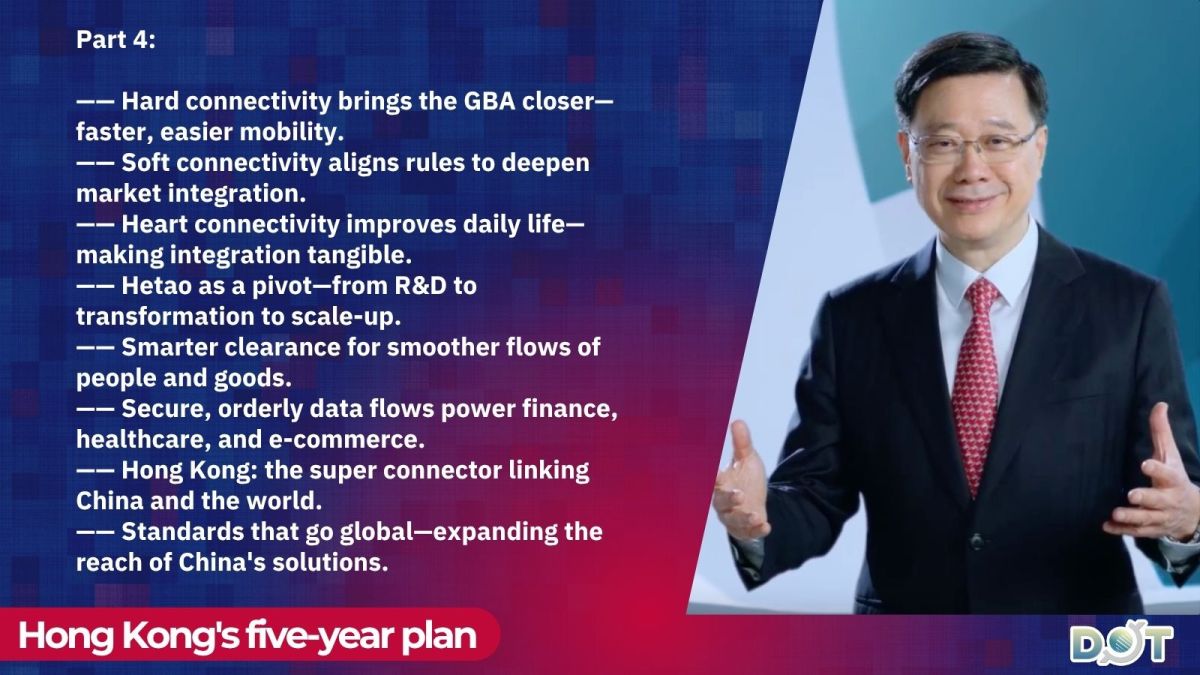
Hong Kong Chief Executive John Lee unveils the city's first five-year plan today (Sept. 16). Part 4 of the plan outlines Hong Kong's strategy to deepen integration with the Guangdong–Hong Kong–Macao Greater Bay Area (GBA) while expanding an international collaboration network. It positions the GBA as a national strategic fulcrum under the new development paradigm, a demonstration zone for high-quality development, and a pioneer of Chinese modernization. Within this broader agenda, Hong Kong commits to helping build the GBA into an international first-class bay area and a world-class city cluster with global influence by strengthening cross-boundary connectivity, rule alignment, people-to-people ties, and global outreach.
Strengthening innovation and technology (I&T) cooperation: from R&D to industrial scale-up
A major focus is building a GBA-wide I&T industry chain that can accelerate the transformation of research outcomes into large-scale production and real-world applications. Hong Kong will encourage local research institutions to participate in Guangdong–Hong Kong–Macao Joint Laboratories and will enhance the overall I&T ecosystem to better serve both research institutions and Mainland enterprises.
The plan highlights the Loop Hong Kong Park as a key focal point for strategic alignment with GBA cities—especially Shenzhen's strategic emerging industry clusters—so that cross-boundary flows of talent, capital, and innovation inputs can support the full pathway from research → transformation → production → application across the region. Hong Kong and Shenzhen aim to pursue "cooperation in R&D, collaborative transformation, and sharing development benefits," strengthening the role of the Shenzhen–Hong Kong–Guangzhou corridor as a leading global innovation cluster.
Beyond general innovation, Part 4 identifies sectoral cooperation directions, including hydrogen development (standards, demonstrations, technology, finance, and professional services) and exploratory collaboration in satellite and aerospace-related areas (technology, data applications, education, and cultural tourism). It also links innovation to cost and capacity challenges in construction: by leveraging the GBA's industrial output and module production capability, Hong Kong will strengthen supply-chain technologies such as Modular Integrated Construction (MiC) and integrated MEP approaches to stabilize materials supply and help reduce construction costs—supporting the GBA's positioning as a hub for building technology and construction.
At the talent level, Hong Kong will seek to attract high-quality I&T leadership talent from the Mainland and overseas, encouraging them to base businesses, investment, and R&D outcomes in Hong Kong. The plan also emphasizes better mechanisms for IP transformation and application, helping energize the broader GBA innovation ecosystem.
Promoting "hard connectivity": transport, ports, computing infrastructure, and 6G
Part 4 advances "hard connectivity" through cross-boundary infrastructure that improves mobility for people and goods. Hong Kong will contribute to a "GBA on the Rail" by pressing ahead with the Hong Kong–Shenzhen Western Rail Link and the Northern Link Spur Line, enhancing passenger capacity and service quality on key boundary corridors. A future southward extension study for the Western Rail Link is proposed to strengthen connectivity between the Northern Metropolis and Hong Kong International Airport.
New infrastructure is not limited to transport. The plan emphasizes computing infrastructure interconnectivity among GBA cities, aiming to accelerate the formation of large-scale intelligent computing clusters and support a cooperation hub that enables Guangdong–Hong Kong–Macao computing power to "go global." It also points to coordination on extended boundary control point operating hours to facilitate global passenger and cargo flows through Hong Kong and calls for stepped-up planning and cooperation for 6G to support advanced mobile communications and innovation applications across the region.
Building "soft connectivity": rules alignment, standards, and market integration
Part 4 places strong emphasis on "soft connectivity"—the alignment of rules, mechanisms, and professional systems—to raise the level of market integration.
Key initiatives include:
Mutual recognition of professional qualifications, including pilot work on common standards for skilled workers and technicians in the construction sector, and wider use of national advanced construction technologies and materials.
Legal and dispute resolution cooperation, including encouraging Hong Kong legal professionals to take GBA examinations and practice in other GBA cities, and developing more complementary arbitration regimes across Guangdong, Hong Kong, and Macao. The plan also explores a pathway toward model arbitration rules for the GBA.
Healthcare alignment under the "Healthy Bay Area" direction: strengthening collaboration on medical talent, regulatory frameworks, and professional standards, and expanding specialist training via the Shenzhen–Hong Kong Medical Specialist Training Centre, with the potential to cover more Mainland physicians and disciplines.
GBA Standards and Certification, expanding product and service coverage with technical specifications that raise quality and help Hong Kong enterprises access GBA markets.
A notable new domain: developing Hong Kong into an international hub for high-quality development of the country's water sector, using Hong Kong as a platform for pilot testing and showcasing advanced water-related technologies to global counterparts.
Facilitating cross-boundary flow of factors: people, goods, vehicles, capital, and data
To make integration practical, the plan proposes measures to enhance cross-boundary flows.
People & border efficiency:
Hong Kong will enhance clearance capacity, improve boundary control point layout and efficiency, and leverage the redeveloped Huanggang Port through co-location and a "collaborative inspection and joint clearance" model that allows passengers to complete procedures of both places in one go (via document reading or face scan). A similar approach is proposed for the Sha Tau Kok Control Point redevelopment, with possible extension to other control points if conditions permit. Coordination mechanisms and multi-point information exchange are also planned to improve predictive and operational management.
Logistics & trade digitalization:
The plan supports cross-boundary logistics, leveraging the Hong Kong–Zhuhai–Macao Bridge to develop a new trade corridor, investing in capacity expansion, upgrading, and digitalization of cross-boundary freight ports, and promoting trade digitalization by improving Mainland–Hong Kong Single Window connectivity and expanding "Single Submission for Dual Declaration" to cover more documents and transport modes—reducing duplicate data entry and lowering logistics costs.
Food trade hub:
Hong Kong will consolidate its role as a food import/export hub, facilitating exports of a wider spectrum of Hong Kong food products to the Mainland and supporting premium-quality imports from across China, positioning Hong Kong as both a base for Mainland food enterprises and a window to overseas markets.
Vehicles & autonomous driving:
Measures will continue to facilitate cross-boundary vehicle travel (including "Northbound Travel for Hong Kong Vehicles" and "Southbound Travel for Guangdong Vehicles"), improve charging infrastructure interconnectivity, and develop cross-boundary autonomous driving demonstration projects to support scaling and commercialization.
Finance & fintech:
Hong Kong will promote cross-boundary capital flow and financial policy innovation, strengthen collaboration with Shenzhen and Guangzhou markets, and support fintech through cross-boundary data validation platforms. It also proposes exploring broader cross-boundary insurance products, settlement facilitation, greater interconnectivity of insurance markets, and cooperation in green finance, sustainable investment, and carbon market development.
Data governance & digital government:
The plan calls for a sound cross-boundary data management mechanism, stronger data governance cooperation, and facilitated secure data sharing in areas such as fintech, e-commerce, and electronic health records, while exploring electronic identity mutual recognition and integration of digital government services.
"Connectivity of hearts": education, youth mobility, healthcare, elderly services, environment, culture, and tourism
Beyond systems and infrastructure, Part 4 emphasizes people-to-people integration. Hong Kong will strengthen higher education cooperation and cross-disciplinary partnerships, promote knowledge transfer and commercialization, and expand joint talent cultivation and exchanges.
For youth development, the plan supports entrepreneurship and career opportunities through platforms such as the Alliance of Hong Kong Youth Innovation and Entrepreneurial Bases in the GBA and continued implementation of the Greater Bay Area Youth Employment Scheme, enabling internships, employment, and entrepreneurship across GBA cities, while supporting two-way talent exchange.
On public services, Part 4 proposes building a cross-boundary medical network and expanding the "Healthy Bay Area" model—potentially extending the Elderly Health Care Voucher GBA Pilot Scheme, facilitating cross-boundary medical consultations and resource sharing, and enabling worldwide applicability of key items under certified plans of the Voluntary Health Insurance Scheme. It also aims to improve cross-boundary elderly services through expansion of residential care service schemes in Guangdong and stronger cross-boundary cash assistance arrangements and to extend the Direct Cross-boundary Ambulance Transfer Pilot Scheme for more point-to-point two-way transfers.
Environmental cooperation is also elevated: Hong Kong will work with Guangdong and Macao on ecological civilization, biodiversity, "Beautiful Bays" initiatives (including water quality management, marine refuse prevention, and blue carbon restoration), smart environmental monitoring, and a Zero Waste Bay Area direction, alongside ecological monitoring along the Shenzhen–Hong Kong ecological corridor.
Cultural, sports, and tourism integration will be promoted through multi-destination itineraries, co-organization of major sports leagues and events, and deeper cultural exchanges that highlight Cantonese opera and Lingnan cultural characteristics, as well as cross-boundary exhibitions and promotion of Hong Kong publications.
Leveraging major cooperation platforms: Qianhai, Nansha, Hengqin, and Hetao—and deeper ties with Macao
Hong Kong will continue participating in major GBA cooperation platforms—Qianhai (Shenzhen), Nansha (Guangzhou), Hengqin (Zhuhai), and the Hetao Shenzhen–Hong Kong Co-operation Zone—to share infrastructure and industrial resources, deepen strategic alignment, and use these platforms' pilot and demonstration roles to advance reforms and opening-up.
Qianhai focuses on modern services, technology–finance integration, cross-boundary IP cooperation, legal/arbitration/mediation alignment, youth innovation hubs, offshore RMB business expansion (including cross-border RMB settlement and digital RMB exploration), and building secure cross-boundary data channels.
Nansha strengthens maritime transport cooperation and differentiated port development, supports Hong Kong maritime services in upgrading the Mainland maritime industry, explores new modes of cooperation in projects, improves tender participation mechanisms, and promotes talent mobility and vocational qualification recognition.
Hetao advances "one river, two banks" and "one zone, two parks," building Hetao into a high-level I&T demonstration zone and an important focal point of the GBA international technology and innovation center.
Macao collaboration: deepens cooperation in economic development, culture and tourism, talent attraction, law, airspace management, boundary coordination, and emergency response, while encouraging Hong Kong's sectors to participate in the Hengqin Guangdong–Macao Intensive Co-operation Zone opportunities.
Deepening Mainland cooperation and expanding global networks
Part 4 extends beyond the GBA. Hong Kong will strengthen regional cooperation with other Mainland areas through multi-layered collaboration, regular interdepartmental exchanges, policy alignment, and investment promotion and business matching platforms to support two-way investment and market expansion. It also strengthens cultural, youth, and professional exchanges—joint research, student exchanges, Sister School activities, and creative industry cooperation.
Internationally, Hong Kong will leverage its advantages under "One Country, Two Systems" to deepen global exchanges as a "super connector." The plan includes active participation in international organizations, attracting international organizations and multilateral institutions to establish offices or regional headquarters in Hong Kong, and consolidating specialist roles such as the Hong Kong Observatory's Regional Specialized Meteorological Centre for Nowcasting.
Hong Kong will also organize more high-level international conferences and forums (including long-running platforms such as the Belt and Road Summit) and expand mega events across finance, I&T, green development, and healthcare to enhance global influence and help Mainland enterprises connect with international markets. Cultural platforms—exhibitions, festivals, performances, and film and music—will support Chinese culture going global.
A distinctive theme is using Hong Kong to promote Chinese standards internationally through technology empowerment, cross-boundary collaboration, and institutional innovation—covering R&D, standards formulation, certification, and export facilitation. Key areas include railway standards, LAE standards, Chinese medicine standards, hospital accreditation standards, and green/low-carbon hydrogen standards and certification framework.
Belt and Road cooperation: professional services, green development, and clean business environment
Finally, Part 4 connects regional integration with global engagement through high-quality Belt and Road cooperation. Hong Kong aims to solidify its role as a premier partner and multilateral cooperation hub by providing internationally recognized professional services—financing, project management, and risk management—for infrastructure and sustainable development projects, including green infrastructure. It will also support Silk Road maritime and air connectivity, expand science and technology exchange participation, grow cultural and people-to-people channels, promote Hong Kong rules and best practices, and advance a "clean Silk Road" through anti-corruption cooperation and clean business environments.
In summary, Part 4 positions Hong Kong to integrate deeper with the GBA through connected infrastructure, aligned rules, smoother factor flows, and stronger people-to-people ties—while simultaneously expanding global reach via international organizations, conferences, standards promotion, and Belt and Road cooperation.
Related News:




Comment