






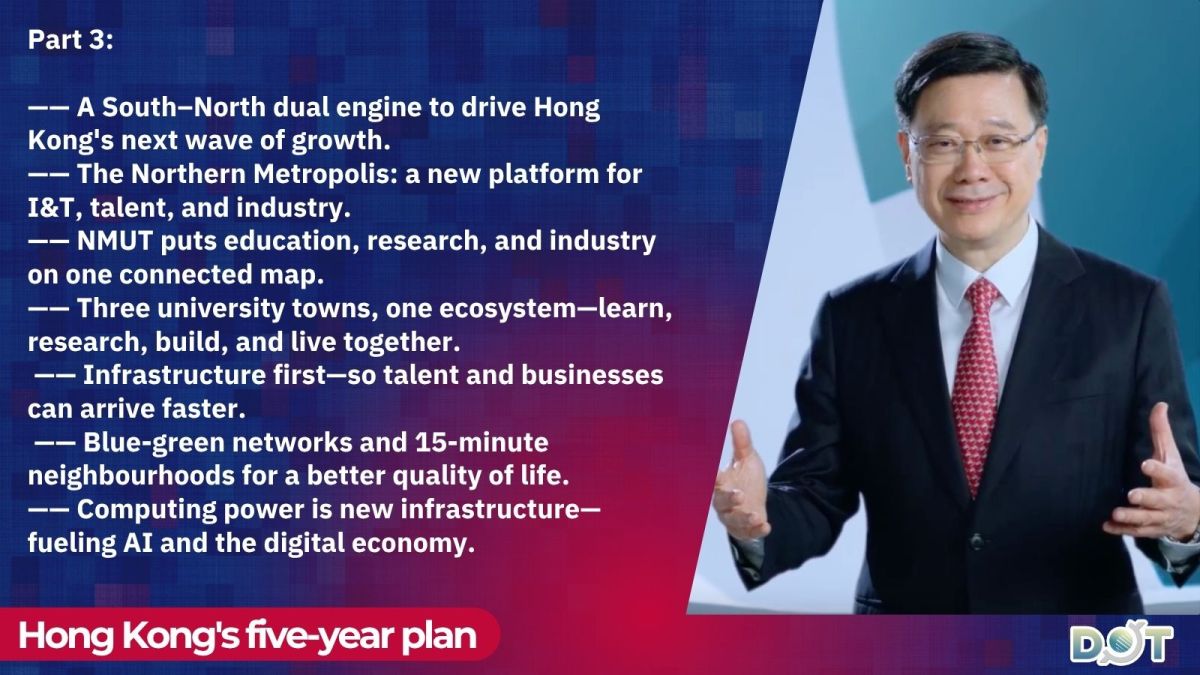
Part 3 of the five-year plan sets out Hong Kong's next major spatial and economic transformation: accelerating the planning and development of the Northern Metropolis while optimizing the city's overall spatial layout under the vision of a "South–North Dual Engine (Finance–I&T)." In this framework, the Harbour Metropolis continues to concentrate Hong Kong's most competitive sectors—especially finance—while the Northern Metropolis becomes the strategic growth platform for innovation and technology (I&T), new industrialization, and talent-led development. The Northern Metropolis is positioned not only as a new development zone but also as a long-term engine for new quality productive forces, deeper participation in the Guangdong–Hong Kong–Macao Greater Bay Area (GBA), and stronger integration into overall national development.
Building the Northern Metropolis University Town (NMUT): education–technology–talent integration
A central pillar is the Northern Metropolis University Town (NMUT), designed as an internationalized university town that integrates talent cultivation, scientific research, transformation of outcomes, and industry development. The plan aims to foster closer industry–academia–research synergy by expanding post-secondary capacity and quality, encouraging joint programs, joint faculties, and laboratories, and attracting world-class institutions and research bodies to establish a presence. In parallel, Hong Kong will strengthen global education exchanges by hosting and participating in international higher-education events and deepening research collaboration and student/talent mobility networks.
NMUT is structured around three university towns—San Tin, Hung Shui Kiu (HSK), and Ta Kwu Ling (TKL)—built on the concept of "One Town, Five Elements": education, technology, industry, talent, and urban development, planned to function together as a complete ecosystem. The campus areas (about 300 hectares) are designed to connect with nearby strategic industry zones, conservation areas, recreation/sports/cultural facilities, and surrounding living communities, with the overall area of the three towns expanded to over 1,000 hectares. Development is to be prioritized for San Tin and HSK, including site allocation for the HSK campus area starting in 2026, with institutional move-in supported in 2027–2028, aiming to create a landmark project.
Three differentiated university towns with distinct roles
San Tin University Town is positioned as the Northern Metropolis' I&T core, focusing on medicine, life and health technology, AI, robotics, microelectronics, and other emerging industries. It leverages strategic proximity to the Hetao Shenzhen–Hong Kong Science and Technology Innovation Co-operation Zone, including the Loop Hong Kong Park and San Tin Technopole, to become a major talent magnet and research platform. Over the next five years, the plan calls for advancing infrastructure and commencing construction of HKUST's medical school and an integrated medical teaching and research hospital, while enabling joint laboratories and national-level research platforms through collaboration with renowned Mainland and overseas institutions.
HSK University Town is positioned as a cultivation center for smart manufacturing, applied post-secondary education, and internationalized talent. It is anchored by a cluster of industry platforms: high-end professional services space, the Hung Shui Kiu Industry Park (smart production), Enterprise and Technology Park sites, the Lau Fau Shan Digital Technology Hub, microelectronics R&D facilities at Yuen Long InnoPark and the Hong Kong Microelectronics R&D Institute, and the Yuen Long South Advanced Construction Industrial Park. It also aims to test cross-boundary facilitation measures that make student and talent mobility between Guangdong and Hong Kong more seamless. As part of a "one-stop" ecosystem integrating learning, research, living, and employment, the plan includes housing solutions such as student hostels and talent accommodation. The anticipated opening of HSK Station on the MTR Tuen Ma Line in 2030 will further strengthen transport connectivity.
TKL University Town adds a forward-looking layer: besides education–industry synergy, it incorporates arts and blue-green development elements and reserves strategic land for future needs. From 2030 onwards, sites will be made available progressively to support emerging industries, advanced construction, and the upgrading of traditional industries, accelerating the commercialization of research outcomes and nurturing talent for new sectors.
A technology-driven industry–academia–research innovation system
Beyond universities, Part 3 maps a wider innovation architecture: developing the Hetao Co-operation Zone into a world-class I&T platform while speeding up industry zones such as San Tin Technopole, the Sandy Ridge Data Facility Cluster, and the HSK/Lau Fau Shan nodes. The plan emphasizes building science and technology services institutions and transformation platforms to form innovation consortia—linking basic research to pilot production, proof-of-concept validation, and market rollout.
Coordination with Shenzhen follows the vision of "one river, two banks" and "one zone, two parks," aligning spatial layout, planning, and infrastructure connectivity while establishing a unique regulatory regime. A key goal is enabling secure, efficient movement of people, materials, capital, and data across the boundary for research and industrialization.
On industrial land and platform delivery, milestones include the phased release of I&T land parcels in San Tin Technopole starting from the end of 2026. The plan also upgrades Hong Kong's digital infrastructure: the Sandy Ridge Data Facility Cluster (already in construction) is targeted to commence operation by 2029, with computing power expected to rise sharply by 2032—supporting Hong Kong's AI development and regional competitiveness in advanced data and computing.
Reform-oriented development, faster land supply, and a more liveable metropolis
To move faster, the plan adopts a reform and pilot mindset: planning-led, infrastructure-led, industry-driven, and people-oriented development. It proposes streamlining development processes, enacting a Northern Metropolis Development Ordinance, and using diversified delivery models, including public–private partnerships and dedicated industry park companies, to combine "capable government" with an "effective market." Market incentives include the "Pay for What You Build" Pilot Scheme (phased premium aligned with actual built floor area/use) and a "two-envelope" tendering approach that balances premium and non-premium proposals to encourage integrated development. It also supports phased development strategies—allowing lower-density facilities to come first to generate footfall and revenue before larger-scale build-out.
On land and housing, the Northern Metropolis is tasked with increasing both housing and economic capacity: within the coming five years, the plan targets making land available to support over 70,000 housing units and one million square meters of economic floor space. It also signals a push for higher living standards by improving the mix of public housing and raising minimum unit size requirements for private residential projects in new Northern Metropolis developments, with a higher proportion of larger subsidized sale flats over time.
Transport connectivity: "Eight Vertical and Eight Horizontal Corridors"
Infrastructure connectivity is treated as the backbone of development. The plan presses ahead with major Northern Metropolis rail and road projects under the territory-wide "Eight Vertical and Eight Horizontal Corridors" layout. Key milestones include:
- Kwu Tung Station (East Rail Line): commissioning in 2027
- HSK Station (Tuen Ma Line): commissioning in 2030
- Northern Link Main Line + Spur Line: gazettal for Spur Line scheme within 2026, tunnel boring progressively from 2028, with a target of simultaneous commissioning in 2034
- Hong Kong–Shenzhen Western Rail Link (HK section): tender for detailed design and construction in 2027, striving for simultaneous commissioning (HK & Shenzhen sections) in 2035
- Major road projects include the Northern Metropolis Highway (San Tin Section) (gazettal in 2027, target commissioning in 2034) and the Tsing Lung Bridge (Route 11 southern end, target commissioning in 2033).
- A feasibility study is also planned for a southern extension of the Hong Kong–Shenzhen Western Rail Link to strengthen connectivity between the Northern Metropolis and the Hong Kong International Airport.
Community services, "15-minute neighborhoods," and blue-green networks
Part 3 ties economic growth to quality of life. It calls for stronger planning of public services and community facilities—housing, jobs, education, healthcare, social welfare, recreation, greening—and the development of diversified arts/cultural facilities and performance/exhibition spaces. Land-use planning will adopt the "15-minute neighborhood" concept, supported by improved transport links and high-quality public space, plus an expanded blue-green network (wetlands, rivers, open space, and hills). A key service milestone is the launch in 2027 of the New Territories North Cluster plan and progress on an integrated teaching and research hospital in Ngau Tam Mei. The goal is a Northern metropolis that is not only productive but also a model for quality living, attracting talent to reside and work long-term.
Overall, Part 3 defines the Northern Metropolis as Hong Kong's next-generation growth platform: a connected, innovation-led, talent-rich, and liveable metropolitan region that complements the Harbour Metropolis—turning "South–North Dual Engine" planning into a tangible pathway for competitiveness, capacity, and better livelihoods.
Related News:




Comment