






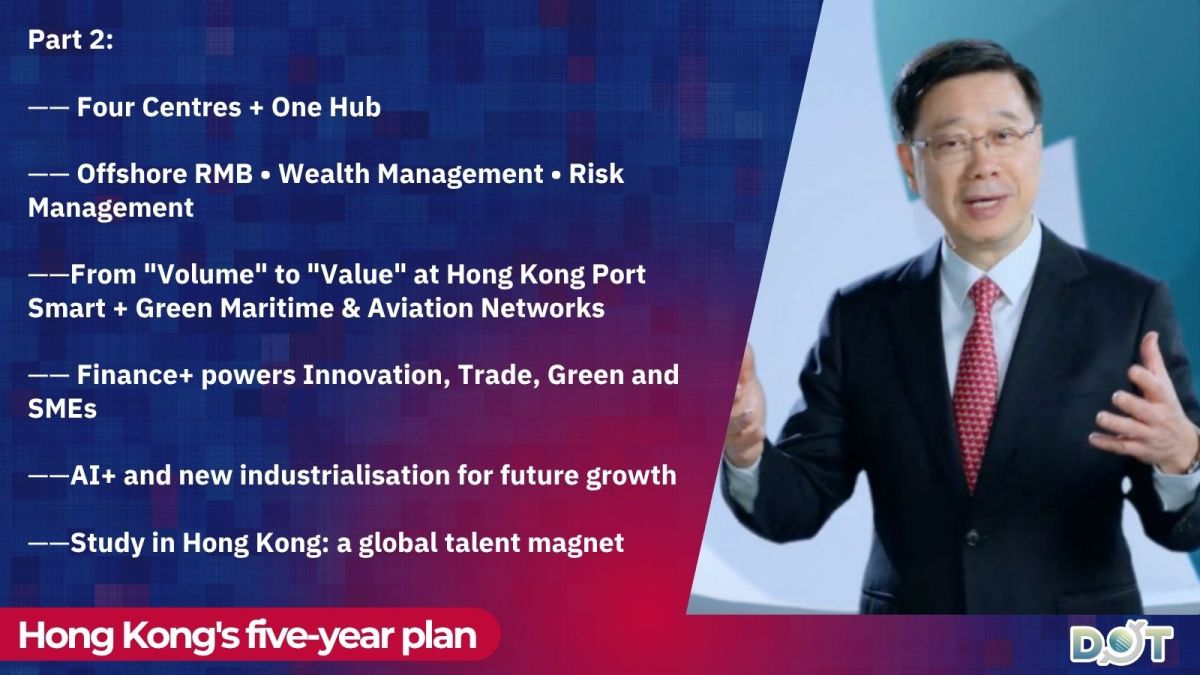
Hong Kong Chief Executive John Lee will unveil the city's first five-year plan today (Sept. 16). Part 2 of the plan focuses on strengthening Hong Kong's "four centers and one hub": consolidating the city's roles as an international financial, maritime, and trade center, while accelerating development into an international innovation and technology (I&T) center and a global hub for high-caliber talent. The overarching aim is to deepen Hong Kong's connectivity with both the Mainland and the world under "One Country, Two Systems," develop new quality productive forces, and translate growth dividends into improved livelihoods and stronger social well-being.
Reinforcing Hong Kong as an international financial center
Finance is positioned as Hong Kong's core advantage and a key engine for the real economy. The plan emphasizes stability alongside growth, supported by resilient infrastructure, robust capabilities, and manageable risks. Key directions include strengthening Hong Kong as the leading offshore Renminbi (RMB) hub by improving liquidity support mechanisms, expanding offshore RMB product offerings (such as a deeper Dim Sum bond market), and promoting broader RMB usage in trade, investment, and suitable government expenditure.
At the same time, Hong Kong aims to expand its role as a cross-boundary asset and wealth management center, attracting sovereign wealth funds and family offices through improved regulation, professional services, and tax regimes. The city also seeks to become a stronger international risk management center, leveraging insurance, reinsurance, and capital markets—including insurance-linked securities and specialty risk pools—to enhance regional and global risk transfer capacity.
Building deeper, more liquid capital markets—and new commodity strengths
To enhance equity and bond market competitiveness, the plan proposes improving listing efficiency, attracting leading firms (including emerging industries), and strengthening linkages with Mainland and overseas markets via mutual access mechanisms and Connect schemes. It also highlights modernization of fixed-income and currency infrastructure, including refining Southbound Bond Connect, developing electronic trading platforms, and exploring regular issuance and wider adoption of digital government bonds, supported by upgraded legal and market frameworks.
Beyond traditional finance, Hong Kong plans to develop a commodity trading ecosystem with gold as an entry point—strengthening clearing, storage, refining capacity, and policy support—while exploring RMB-denominated gold and commodity markets and deeper cooperation with Mainland exchanges.
"Finance+": using finance to power innovation, trade, green transition, IP, maritime, and livelihood
A major theme is "Finance+," which treats finance as a platform capability serving multiple sectors. Initiatives include mobilizing patient and venture capital for I&T (including a HK$10 billion I&T industry-oriented fund targeting thematic areas with a larger blended target size), expanding fintech, and advancing a licensing and regulatory approach for digital assets under the principle of "same activity, same risks, same regulation." The plan also promotes trade digitalization, green and sustainable finance (including an international carbon market), IP financing tools, maritime finance to support shipping's green transition, and more inclusive services for households and SMEs. In parallel, it underscores stronger financial risk prevention, cybersecurity, and anti-money laundering capacity.
Upgrading maritime and aviation—toward smart, green, and integrated transport corridors
For maritime development, Hong Kong aims to move from volume-based port competitiveness to value-driven growth, enabled by digitalization, logistics data integration, and green fuel development. Targets include raising the use of green maritime fuels to 7% for Hong Kong-registered vessels by 2030, cutting Kwai Tsing terminal emissions by 30% by 2030 (vs. 2021), and establishing five Green Energy Corridors by 2030. Cooperation with Greater Bay Area ports and stronger intermodal transport systems are designed to improve resilience and reduce transshipment costs, while high value-added maritime services and talent pipelines are also prioritized.
In aviation, Hong Kong plans to expand routes and long-haul connectivity—especially with Belt and Road partner economies—and build an aviation industry ecosystem spanning aircraft parts processing and trading, support for home-developed aircraft certification, and a regional Sustainable Aviation Fuel (SAF) value chain. It also elevates the low-altitude economy (LAE) through regulation, standards, infrastructure planning, and sandbox pilots, positioning Hong Kong as an Asia-Pacific hub for innovative low-altitude applications, including cross-boundary low-altitude logistics in the Greater Bay Area.
Strengthening trade through networks, digitalization, and "going global" services
On trade, Hong Kong will maintain free-trade principles and broaden market reach, consolidating ties with Europe and the United States while cultivating ASEAN and Middle East markets and exploring Central Asia and Africa. The plan also calls for expanded overseas offices and more targeted investment attraction, including annual action plans in areas such as AI, the digital economy, health tech, new industrialization, and green development.
A key enabling mechanism is the build-out of high-value-added supply chain services that support both "bringing in" and "going out," including the GoGlobal Task Force established in 2025 to help Mainland enterprises expand overseas via Hong Kong's professional services—market analysis, legal and dispute resolution support, branding, supply chain collaboration, and cross-border financing. Digital trade and cross-border e-commerce are positioned as major growth engines, backed by legal and platform upgrades to accelerate e-document adoption and data connectivity for trade finance.
Innovation, new industrialization, healthcare innovation—and a global talent hub
To become an international I&T center, Hong Kong will leverage its universities and research base, build major platforms and R&D institutions, and align with national strategic technology priorities such as life and health, AI and robotics, microelectronics, new energy, advanced manufacturing, and new materials. The plan outlines a "north-central-south" I&T spatial pattern via three major parks (the Loop Hong Kong Park and San Tin Technopole, Science Park, and Cyberport), alongside five key R&D institutions, including dedicated bodies for microelectronics, AI, and life and health technology.
It also promotes new industrialization: upgrading traditional industries while scaling emerging ones and preparing for frontier fields such as quantum technology and embodied intelligence, supported by patient capital and stronger commercialization pathways. On AI specifically, the plan points to expanded computing infrastructure (including the Sandy Ridge Data Facility Cluster targeted to operate by 2029) and improvements in AI and data governance.
In healthcare, the plan proposes strengthening medical product regulation capacity (including phased "primary evaluation" with full implementation by 2030), building a premier early-phase clinical trial ecosystem, and using real-world data to help speed access to life-saving treatments. Talent policies will integrate education, technology, and workforce strategy, refine targeted attraction measures, and promote the "Study in Hong Kong" brand to bring in and retain global talent.
Leveraging Hong Kong's "international city" strengths
Beyond the four centers, Part 2 also highlights complementary pillars: strengthening Hong Kong as an international legal and dispute resolution services center (including steps toward an International Commercial Court and arbitration reforms), building a regional IP trading center through stronger IP regime alignment and patent system reform, and enhancing Hong Kong as an East-meets-West cultural exchange center. Culture, sports, and tourism are framed as growth sectors, with measures to develop mega events, improve visitor services, and expand multi-destination tourism across Hong Kong and the Mainland.
Overall, Part 2 outlines a coordinated competitiveness agenda: deepen Hong Kong's finance and trade strengths, transform transport and logistics with digital and green upgrades, accelerate innovation-led industrial growth, and strengthen the institutional and talent foundations that keep Hong Kong connected to both national development and global markets.
Related News:
LIVE: John Lee unveils HK's first five-year plan and 2026 Policy Address




Comment