






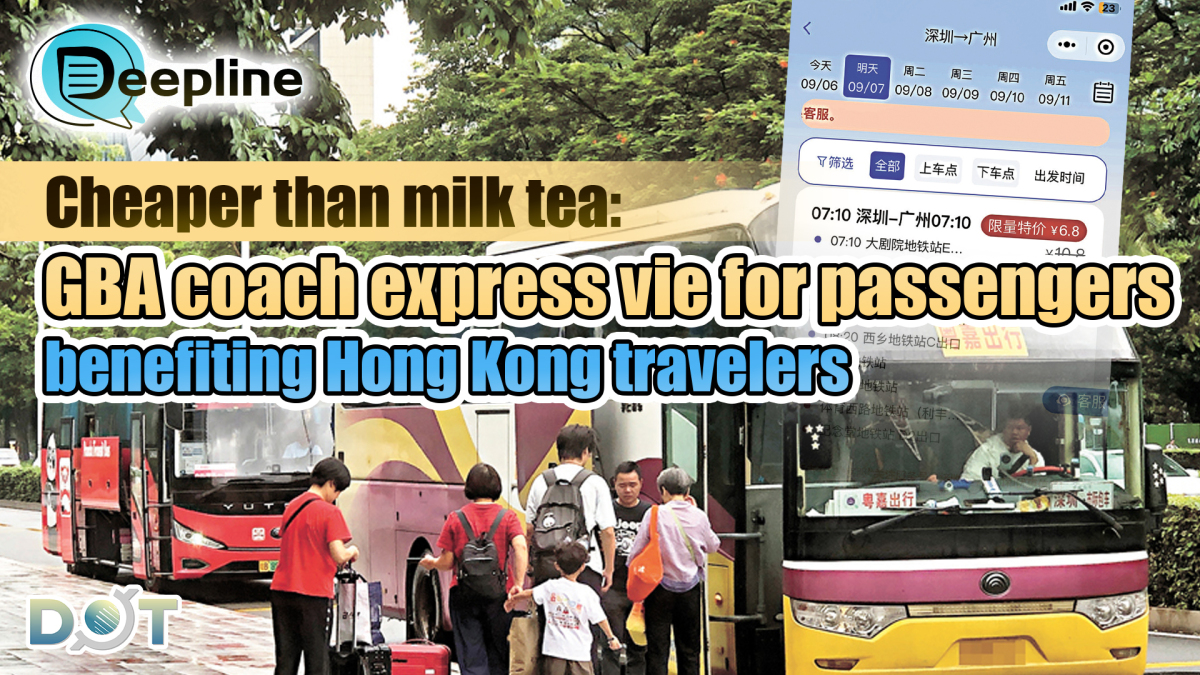
Once squeezed out of the market by high-speed rail, intercity railways, and private cars in the Greater Bay Area, long-distance bus passenger transport has made a "full comeback" thanks to internet platforms. According to data from Guangdong's transportation authorities, last year the province's internet-based bus services saw a year-on-year surge of nearly 70% in both trips and passenger volume, with the upward trend continuing into this year. At present, various internet bus platforms are stepping up their competition for passengers, with routes such as Guangzhou–Shenzhen and Guangzhou–Zhuhai being the most popular. Internet buses have now become the "cheapest" new alternative to high-speed rail and intercity railways.
Some Hong Kong travelers heading north have noted that internet bus fares in the Pearl River Delta are "cheaper than a cup of milk tea." For example, "door-to-door" buses between metro stations in Guangzhou and Shenzhen can be as low as RMB 6.8, with regular fares also around ten-plus yuan—only about 10% to 20% of a one-way ticket on the Guangzhou–Shenzhen high-speed rail or intercity railway.
A new-energy bus was parked at the roadside opposite Exit B of Guangzhou Tianhe Park Metro Station. Like other passengers, our reporter boarded after scanning a QR code for verification, and the bus departed a few minutes later. After a 10-minute ride, the bus arrived at Exit B of Chebeinan Metro Station, picked up waiting passengers, and headed south. Ten minutes later, it arrived at Exit A of Dashadi Station, picked up the last batch of passengers in Guangzhou, and headed straight for Shenzhen. In less than 1.5 hours, it arrived at Exit C of Xixiang Metro Station. After some passengers got off, it continued into downtown Shenzhen, passing by metro stations such as Shenzhen University, Window of the World, Chegongmiao, Gangxia North, and Grand Theater along the way.
Buy tickets online, board at the nearest station
For this trip, passengers do not need to enter a bus terminal. Instead, they search for the internet bus platform's mini-program on their phones to purchase real-name tickets. Regardless of which stop they board at, the fare is the same, and after payment, a travel QR code is generated. This is a brand-new road passenger transport model emerging in Guangdong in recent years. Unlike traditional "station-to-station" service, it now offers "door-to-door" travel. "Platform companies use big data analytics to map passenger flow distribution and set up stops at metro exits, bus stops, and other locations. The entire route bypasses traditional bus terminals, allowing passengers to choose the nearest or most convenient boarding point," said Fan Weixian, Secretary-General of the Guangdong Provincial Urban Public Transport Association. He added that this flexible operating model also complements rail transit rather than competing directly with it.
Cost-cutting secrets: eliminating bus terminals and using big-data dispatch
"Compared with Guangzhou–Shenzhen high-speed rail and intercity railway one-way fares starting at RMB 74.5 and RMB 68 respectively, the Guangzhou–Shenzhen metro-station 'door-to-door' bus can be as low as RMB 6.8, and even weekend fares are only around ten-plus yuan. Compared with the Guangzhou–Zhuhai intercity railway's one-way fare starting at RMB 65, buses from multiple Guangzhou metro stations to Zhuhai Station/Gongbei Port can be as low as 9.9 yuan, with regular fares around RMB 13.8. That's cheaper than a cup of milk tea," said Hong Kong traveler Mr. Ng. He expressed hope that internet bus services will continue to improve in terms of route support, safety checks, and boarding procedures, offering travelers more diverse and convenient options.
When asked why internet buses are so "low-cost and affordable," staff at several platforms explained that after intercity buses in Guangdong joined online passenger transport platforms, they shed traditional bus terminals, saving substantial costs on site leasing and maintenance. Many routes have also switched to pure electric buses, significantly reducing energy costs. At the same time, digital online operations and big-data intelligent dispatch—with all ticketing and check-in done online—not only lower labor and dispatch costs but also boost occupancy rates, achieving high volume with thin margins. Fan Weixian pointed out that with big data enabling dynamic vehicle allocation, idle capacity has been revitalized, and vehicle turnover efficiency has greatly improved. Internet buses meet the rigid demand for cross-city commuting and still have broad market potential.
Convenient travel: building "bus terminals at your doorstep"
The Guangdong Provincial Department of Transportation revealed that the "Guangdong Online Passenger Transport Aggregation Platform," developed in collaboration with Amap, recently went live, marking a key step in the digital transformation of Guangdong's road passenger transport industry and accelerating the "revival" of bus services.
According to the department, passengers can open the Amap app, go to the "Train & Flight" section and select "Bus," then enter their origin and destination to query schedules, stops, fares, and other information for all online passenger transport routes across the province in one click. They can enjoy one‑stop services including ticket booking, route inquiry, and travel guidance, truly achieving "one‑stop search, one‑click purchase, and convenient travel." This signifies Guangdong's passenger transport shift from "station‑to‑station" to "door‑to‑door."
Notably, the "aggregation platform" consolidates offline bus terminals, temporary stopping points, and other stopping points, building an integrated "electronic map" for passenger collection across Guangdong. The platform intelligently recommends nearby stop information, precisely guides passengers via navigation to conveniently reach the station for boarding, and regulates transport enterprises to pick up and drop off at designated stops, further improving the travel service experience. Data shows that Guangdong has already launched over 100 online passenger transport routes in four categories: education commuting, medical travel, tourism and leisure, and business travel. Meanwhile, more than 500 temporary stops and over 1,000 stopping points have been set up in transportation hubs, metro stations, commercial districts, scenic areas, schools, hospitals, residential communities, and other areas, striving to create "bus terminals at people's doorsteps."
(Source: TKWW | Editor: Liu Yu)
Related News:




Comment