






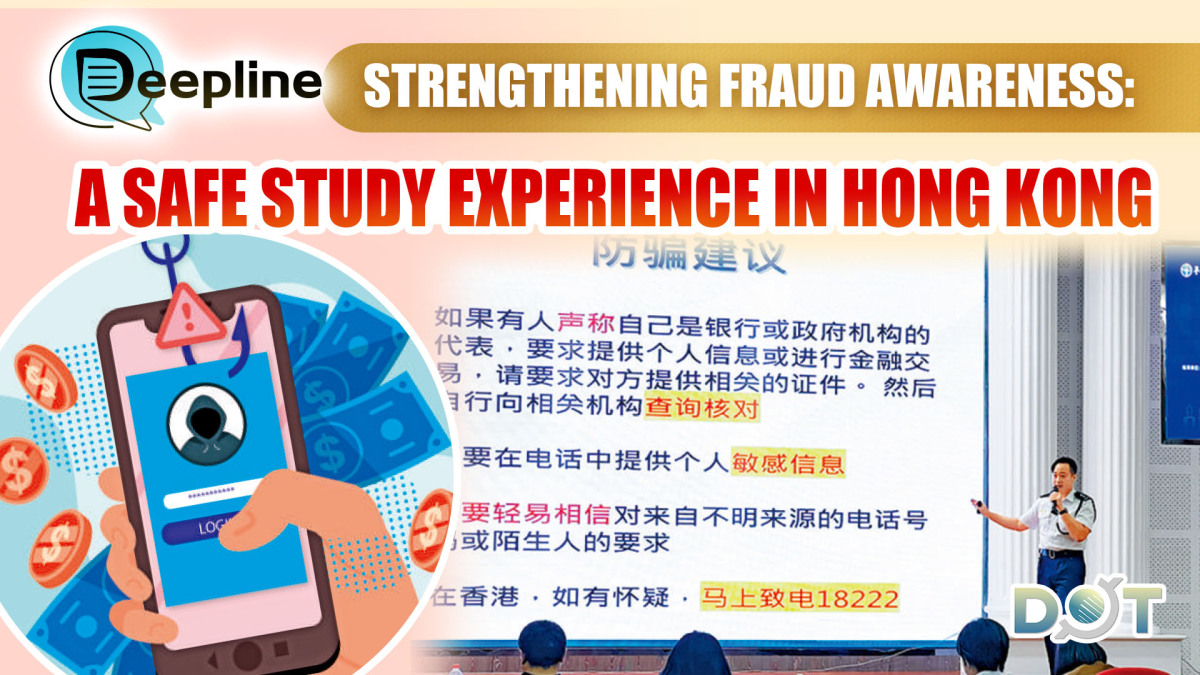
As the new academic year approaches and a large number of mainland students arrive in Hong Kong, they have become prime targets for telephone scammers. In recent years, phone and online fraud targeting "Hong Kong-bound" students has remained persistently high, with scammers employing an ever‑evolving array of tactics that are difficult to guard against. In the first six months of this year, Hong Kong police recorded 344 fraud cases involving mainland students studying in Hong Kong, involving a total of HK$75 million.
Anti‑fraud experts have advised mainland students to protect their personal information, refrain from clicking on unfamiliar links, and build a strong security defence. Reporters from Ta Kung Pao have compiled a rundown of common scams and prevention tips to help students safeguard their wallets, stay alert against telecom fraud, and start the new semester with peace of mind.
Telecom scams are pervasive
According to police data, 164 cases of impersonation of government officials were recorded in the first quarter (the first three months) of this year, of which 42 involved mainland students – accounting for more than 30% of the total. The single largest loss involved a 22‑year‑old male mainland student who was defrauded of HK$8.21 million by scammers posing as mainland public security officers on the pretext of money‑laundering allegations.
Among fraud cases targeting mainland students, up to 80% of victims were first‑year newcomers, with some even falling prey before the semester began. In phone scams impersonating officials, victims lost an average of HK$830,000 – several times the amount lost by local students. Some newly arrived students, after being defrauded, were further exploited by scammers who played on their desire to "clear their name" or "recover losses," and were instead recruited as "tool people" for fraud syndicates. In August this year, a 26‑year‑old female mainland student was arrested by police for possessing false documents and impersonating mainland public security officers to collect "deposit money" from other victims.
Three key vulnerabilities make mainland students easy prey for fraud syndicates: first, being alone in a foreign place and unfamiliar with Hong Kong's and the mainland's judicial and administrative procedures, making them susceptible to intimidation by "official authority"; second, having essential needs during their studies – such as renting accommodation, seeking part‑time work, and cross‑border payments – which scammers exploit as entry points; and third, being inexperienced and, when faced with "confidentiality demands," afraid to seek help from family or the school, thus being isolated and manipulated by scammers. Currently, fraud tactics targeting mainland students fall into four main categories, each with harrowing case studies to serve as warnings.
Law enforcement authorities will never demand cash payments or bank transfers
Impersonation of government departments is the most common and financially devastating scam. Scammers typically pose as mainland public security, procuratorate, or court officials, or as staff of the Immigration Department or the Independent Commission Against Corruption. They accurately recite the student's name, ID number, and study information, claim that the student is involved in money‑laundering, visa violations, sending prohibited items, or criminal cases, and send fake arrest warrants or detention orders. They demand "absolute secrecy" – threatening visa freezes, academic dismissal, or cross‑provincial manhunts – and coerce the student into transferring money to a "safe account" for "asset verification" or "bail payment," or handing cash in person to someone claiming to be an "agent," or even buying gold bars for face‑to‑face delivery.
One 23‑year‑old female master's student from the mainland was told over the phone that she was involved in money‑laundering and was required to cooperate with a confidential investigation. In a state of fear, she not only lost all her tuition and living expenses but also, as instructed by the scammers, posed as an "agent" to collect cash from other victims, involving about HK$1 million across four fraud cases. She was arrested by police on the spot in June this year, having turned from victim into accomplice. Hong Kong police remind the public that neither mainland nor Hong Kong law enforcement agencies will ever demand cash payments or bank transfers over the phone for asset reviews, nor will they ask for gold purchases, nor will they engage ordinary citizens in "law enforcement" activities.
Beware of part‑time job offers that require upfront fees or account lending
Newly arrived students often need to sort out accommodation and find part‑time jobs, giving scammers an opening. Fraudsters post below‑market rental listings on social media, asking for deposits and holding fees before the student has viewed the property in person, then block the victim after receiving payment. Others pose as sub‑landlords, concealing illegal subdivided flats or damaged furnishings and withholding deposits maliciously upon check‑out. Part‑time job scams lure students with promises of "high daily pay," "campus agent" roles, or "remote internships," requiring upfront payments for uniforms, deposits, or training fees, or coaxing students to lend their bank cards or transfer money, thus turning them into money‑laundering tools.
A mainland student surnamed Huang saw an online post advertising "part‑time job for international students, HK$2,000 daily." After adding the contact, he was asked to pay a HK$3,000 "membership fee" and provide his bank card for "money transfers." After making the transfer, he was blocked; not only did he lose money, but he also came under police investigation for allegedly aiding cybercrime by lending his bank card, severely affecting his studies. Student affairs offices at multiple Hong Kong universities have reminded students to always view properties in person and sign written contracts, and to treat any part‑time offer that requires upfront fees or account lending as a scam.
"Online romance and investment" scams start on dating apps
In romance and investment scams, fraudsters use messaging apps like WeChat to add students, posing as alumni or opposite‑sex friends. They first gain trust through emotional exchanges, then recommend "exclusive investment platforms" or "cross‑border wealth management projects," promising "low risk, high returns." After offering small initial returns to lure the victim, they encourage larger investments, then shut down the platform and disappear with the money.
A student surnamed Zheng, who came to Hong Kong to study, fell for such a scheme after meeting a person posing as a "Hong Kong investment expert." He was recommended a cryptocurrency investment app. After an initial investment of HK$5,000 yielded profits, he gradually put in HK$150,000 of his savings. When he tried to withdraw, the app could not be accessed, and the contact had vanished.
"Cross‑border customer service" scams send phishing links
Targeting mainland students' habit of using Alipay and WeChat Pay, scammers impersonate cross‑border customer service agents, claiming account anomalies, order failures, or the need to unfreeze funds. They send phishing links or ask for verification codes and bank card details to steal funds. They also send fake utility or management fee payment notices embedded with phishing links, prompting victims to enter personal information and payment passwords.
In addition, scammers impersonate school staff or professors, contacting students via email or social media with messages about "scholarship disbursement," "tuition adjustments," or "activity registration," and request transfers to designated accounts before disappearing. Such scams have already affected multiple Hong Kong universities, even trapping doctoral students. Other scammers pose as friends or relatives, claiming to be in distress in Hong Kong, having lost their phones, or urgently needing money, and ask for private transfers.
(Editor: Liu Yu)
Related News:
Deepline | Coordinating development and security to create an even brighter future
Deepline | HK must never let its guard down on national security




Comment