






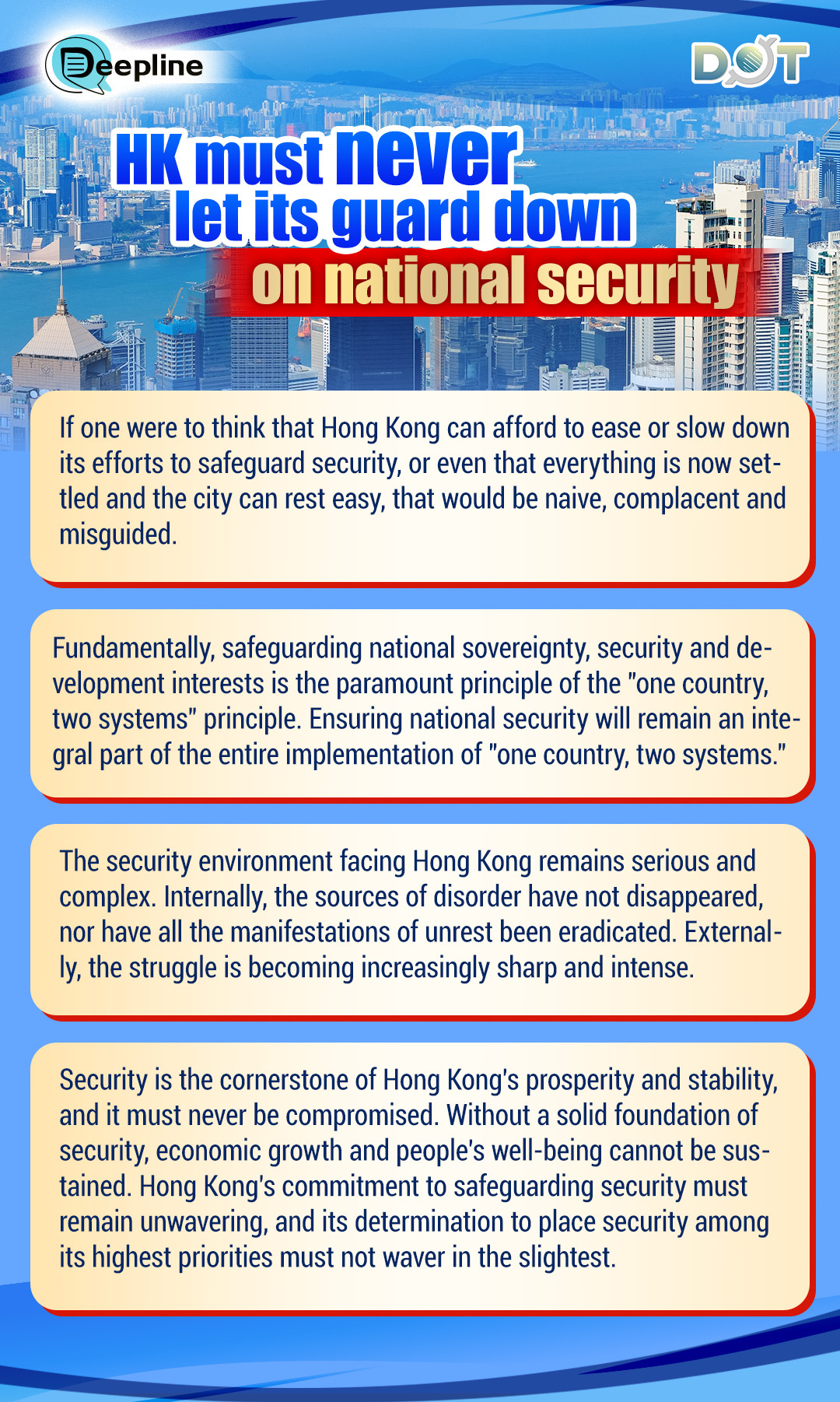
Hong Kong is forging ahead, moving from a transition from chaos to order toward a new stage of governance and prosperity. The city is currently enjoying overall social stability, while its economic development and people's livelihoods continue to improve. This is certainly a source of encouragement for everyone who loves, cares about and supports Hong Kong. But it would be naive, complacent and misguided to conclude from this that Hong Kong can ease or slow down its efforts to safeguard security, or even that everything is now settled and the city can afford to rest easy.
Security can never be taken for granted. Security at one point in time does not mean permanent security, just as security today does not guarantee security in the future. Development can proceed in stages, but there can be no pause in safeguarding security. Governance may have different priorities at different times, but the bottom line must never be compromised. Hong Kong's transition from chaos to order and then toward prosperity is a continuous and integrated process, with the need to balance development and security running throughout. The road to prosperity is by no means smooth, nor is it a matter of pursuing development at the expense of security. Hong Kong must continue to address emerging risks and challenges and respond to new security concerns. Safeguarding security is an ongoing task, not one that can ever be declared complete.
Fundamentally, safeguarding national sovereignty, security and development interests is the paramount principle of the "one country, two systems" principle. Ensuring national security will remain an integral part of the entire implementation of "one country, two systems." The central government, the HKSAR government and the people of Hong Kong are committed to fully and accurately implementing the "one country, two systems" principle, promoting Hong Kong's long-term prosperity and stability, and enabling the city to better integrate into and contribute to the country's overall development, thereby contributing to the great rejuvenation of the Chinese nation. But anti-China groups in Hong Kong, together with the external hostile forces behind them, seek to challenge the principles of "one country, two systems", undermine Hong Kong's prosperity and stability, and turn the city into an independent or semi-independent political entity, or even separate it from the motherland, in an attempt to obstruct the process of the great rejuvenation of the Chinese nation. This is at the heart of the Hong Kong issue and determines why safeguarding national security must remain a top priority throughout the implementation of "one country, two systems" in Hong Kong.
It must be recognized that safeguarding security is a long-term and systematic undertaking, rather than a task that can be accomplished in a single phase. The national security law in Hong Kong and the legislation of Article 23 of the Basic Law have built a strong dam to protect Hong Kong's security. But for that dam to remain impregnable, it must be reinforced and maintained day after day. Legal provisions must be translated into a shared awareness across society; regulatory mechanisms must reach every level of society; and risk early-warning systems, grassroots governance, education and awareness in schools, and the management of public sentiment must all work together. Each of these elements is a brick in the dam. If even one section becomes weak, a breach could eventually develop. There can be no room for negligence or complacency when it comes to safeguarding security.
It is even more important to recognize that, as the old saying goes, "the trees long for peace but the wind will never cease." The security environment facing Hong Kong remains serious and complex.
Internally, the sources of disorder have not disappeared, nor have all the manifestations of unrest been eradicated. Those anti-China forces in Hong Kong may have been forced by circumstances to remove the labels they once wore openly, but they remain present, and their intentions have not changed. They may seize opportunities to strike back, while various forms of so-called "soft resistance" continue to evolve. After the Wang Fuk Court fire in Tai Po last year, some immediately revived tactics reminiscent of the 2019 protests, seeking to use a disaster to destabilize Hong Kong. During this year's Hong Kong Book Fair, when police took action in accordance with the law against shops suspected of violating the law, some again engaged in loud agitation and propaganda, aligning themselves with "Taiwan independence" separatist forces to attack and denigrate "one country, two systems." More recently, when an individual who had taken part in the violent unrest was released from prison, some people organized a flower-laying welcome and publicly celebrated his release, glorifying violence and encouraging crime. Each of these incidents serves as a warning: people must not underestimate the undercurrents beneath the surface of calm.
Externally, the struggle is becoming increasingly sharp and intense. Various hostile forces have never abandoned their efforts to destabilize the city or use the city as a means to contain China. Infiltration and sabotage, containment and suppression, media smears and cognitive warfare are being employed in ever-changing forms, becoming increasingly aggressive and insidious. The extensive evidence revealed during the trial of Jimmy Lai has fully exposed the depth of collusion between external forces and anti-China forces in Hong Kong. When the US launched its trade war last year, it imposed cumulative tariffs of as much as 145 percent on Hong Kong, which had previously maintained zero tariffs, in an act of blatant bullying and coercion. Last month, even as the US fulfilled the consensus reached in China-US economic and trade consultations by declining to extend the national emergency declaration concerning Hong Kong, it immediately claimed that this did not amount to any easing of sanctions against Hong Kong. To this day, US sanctions against the Chief Executive of the HKSAR and relevant officials remain in place. More recently, the US has continued to place a number of Hong Kong companies on so-called "blacklists" and impose unilateral sanctions and extraterritorial measures on the basis of unfounded allegations. Not long ago, a so-called senior US economist once again came forward with sensational claims and predictions of Hong Kong's decline, making his political intention to support the US and Western campaign to contain China plainly evident. All of this serves as a reminder that, given Hong Kong's prominent position in the broader international strategic contest, security threats can come from multiple directions. Hong Kong cannot afford the illusion that it can remain isolated from these struggles and simply look after its own interests.
Security is the cornerstone of Hong Kong's prosperity and stability, and it must never be compromised. Without a solid foundation of security, economic growth and people's well-being cannot be sustained. Hong Kong's commitment to safeguarding security must remain unwavering, and its determination to place security among its highest priorities must not waver in the slightest. The vigilance surrounding security must remain taut at all times, with awareness of potential risks kept constantly alert, like the ringing of a morning bell and an evening drum. Having experienced the transition from chaos to order, Hong Kong society must draw the profound lesson that "when security is lost, development will perish." By remaining mindful of potential dangers and continuously strengthening the foundations of security on the road toward prosperity, Hong Kong can ensure that security safeguards development and that the flower of "one country, two systems" continues to flourish.
(Source: Ta Kung Pao)
Related News:




Comment