






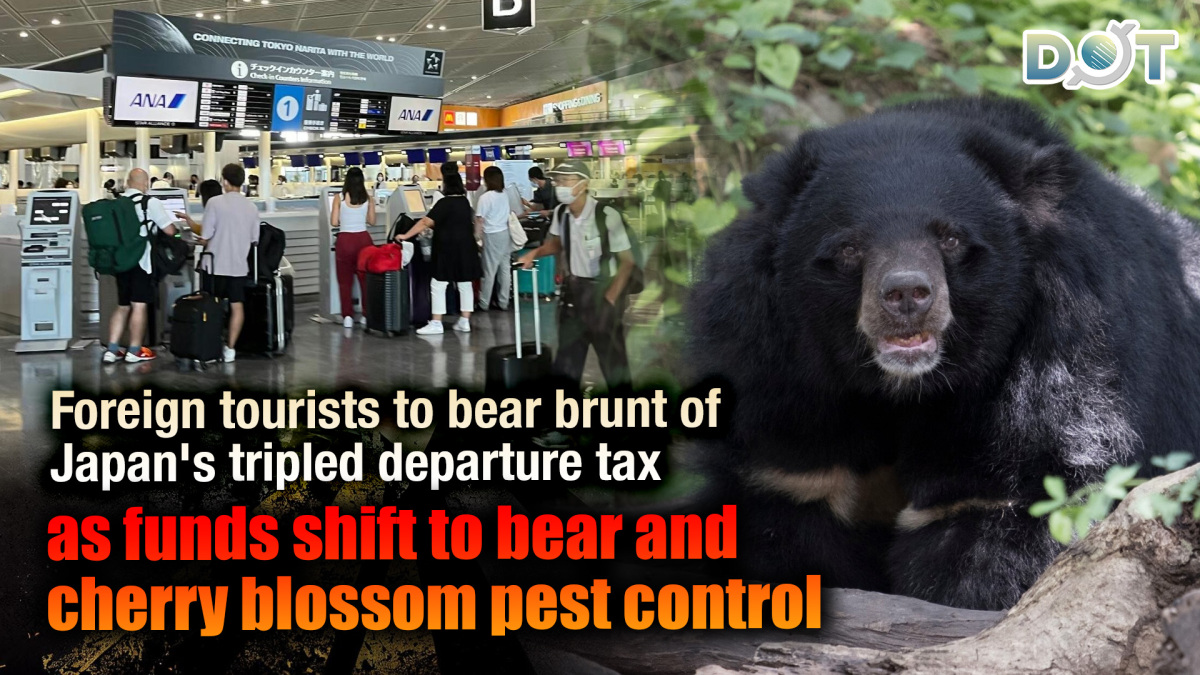
Japan's government has raised its "International Tourist Tax" — commonly known as the departure tax — from 1,000 yen to 3,000 yen effective July 1, a threefold increase that is expected to generate approximately 81 billion yen in additional annual revenue, according to Japanese media reports.
The tax was originally introduced to improve the tourism environment for foreign visitors and ease congestion at popular destinations. However, media disclosures have revealed that the new revenue, starting this fiscal year, will be channeled into projects such as "bear damage prevention" and "cherry blossom pest control" — a shift that has drawn widespread criticism for deviating from the tax's original policy intent.
Among the new allocations, the cherry blossom pest control program has been budgeted at 600 million yen this year, fully funded by the departure tax.
Critics argue that bear attacks primarily affect daily life for local residents and have only a tenuous connection to the tourism industry. Some analysts contend that by raising the departure tax, the authorities are effectively freeing up general-purpose fiscal resources to plug funding gaps in other policy areas — a practice at odds with the rationale for levying the tax on foreign tourists.
In response to the backlash, an official from the Ministry of the Environment defended the move, stating that foreign visitors to Japan could also face the risk of bear encounters, and that many tourists travel specifically to view cherry blossoms. Therefore, investing tax revenue in bear prevention and cherry blossom ecosystem protection would benefit tourists as well.
According to government projections, the additional tax revenue for this year stands at about 81 billion yen. Of that total, an estimated 16.4 billion yen will be borne by Japanese nationals — which will be used to reduce passport application fees — while foreign tourists will shoulder approximately 64.6 billion yen.
Previously, bear control and similar measures were funded by general fiscal resources, such as income and corporate taxes, which carry no specific spending restrictions. Sources close to the matter indicated that the government calculated that using the increased departure tax receipts would allow it to reallocate the general funds thus saved to cover shortfalls in other programs.
Related News:
Japan's 'lonely seat' service goes viral again: Pay 2,000 yen for 1.5x personal space on Shinkansen




Comment