






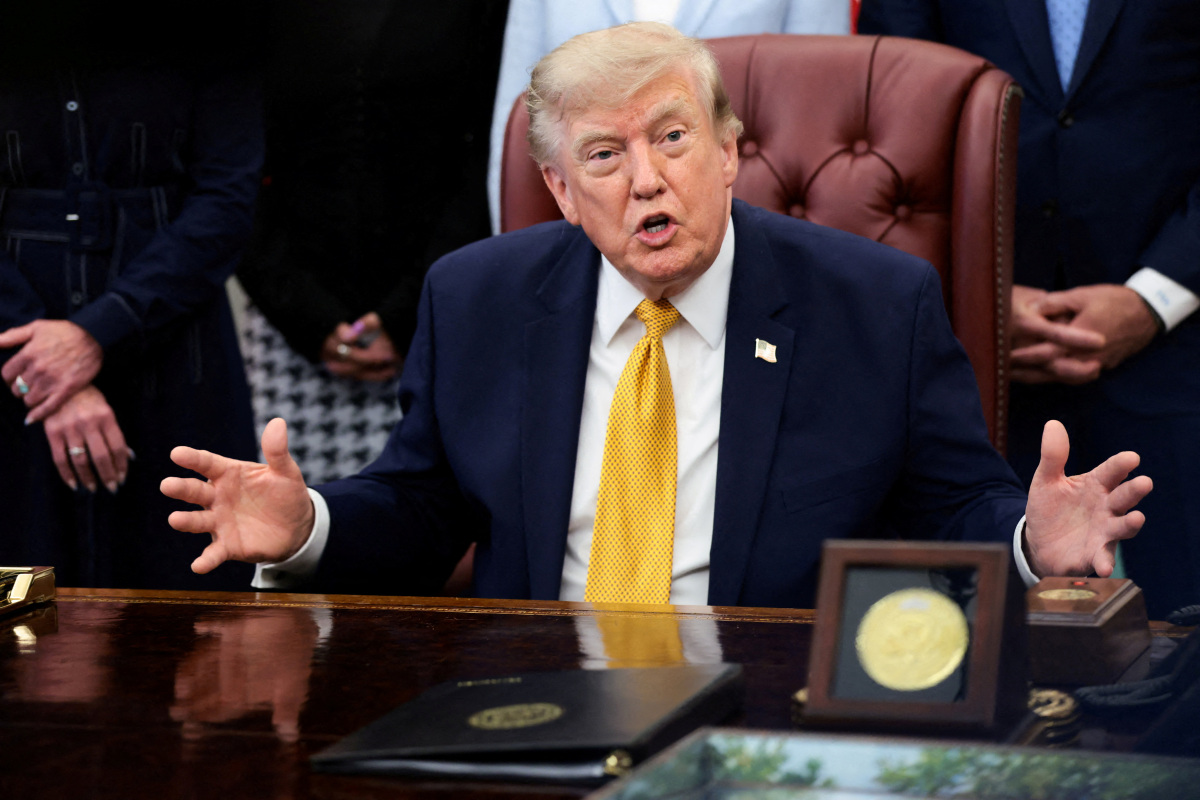
A coalition of 25 U.S. states filed a lawsuit against the Trump administration on Monday, arguing that President Donald Trump exceeded his legal authority by imposing sweeping new tariffs on goods from 60 trading partners, according to a court document.
The complaint, filed with the U.S. Court of International Trade, challenges the recently enacted levies of 10 percent or 12.5 percent on the vast majority of goods imported from the affected economies. According to the states, these economies collectively account for 99.4 percent of U.S. imports.
"This Court has twice invalidated those efforts, holding that neither the International Emergency Economic Powers Act nor Section 122 of the Trade Act of 1974 was a legal basis for the President's trade policy. The Administration's third attempt to impose worldwide tariffs -- now through Section 301 of the Trade Act -- is equally unlawful," the states said in the complaint.
The coalition is asking the court to block the tariffs, declare them unlawful, and order refunds for the duties already paid.
The legal challenge centers on the administration's effort to preserve Trump's broad tariff regime after federal courts rejected two earlier versions imposed under different statutory frameworks. The states argue that federal officials made use of Section 301 of the Trade Act of 1974 and (the so-called) "forced-labor" concerns merely as a pretext to rapidly recreate nearly identical global duties that the Supreme Court previously struck down in February.
"President Trump's illegal tariffs are nothing more than a tax on hardworking families, driving up the cost of groceries, household essentials, building materials, and countless everyday goods that New Yorkers rely on," said New York Governor Kathy Hochul in a statement.
Oregon Attorney General Dan Rayfield echoed the sentiment, highlighting the economic impact on local communities. "Today, we're filing our third lawsuit against Trump's illegal tariffs," Rayfield wrote on X. "Once again, the president is raising costs on everyday goods for Oregon families and small businesses, and once again, we're leading a multistate coalition stepping up to stop him."
"After losing at the Supreme Court, the administration is once again trying to illegally raise taxes on families and businesses with a new round of tariffs," New York Attorney General Letitia James said.
The White House rejected the coalition's arguments, asserting that Section 301 tariffs have proven to be a "legally durable tool" since Trump's first term and remain so under the current administration.
Joining New York in the lawsuit announced Monday are Arizona, California, Colorado, Connecticut, Delaware, Hawaii, Illinois, Kentucky, Massachusetts, Maryland, Maine, Michigan, Minnesota, Nevada, New Jersey, New Mexico, North Carolina, Oregon, Pennsylvania, Rhode Island, Virginia, Vermont, Washington and Wisconsin.
Monday's lawsuit marks at least the second major legal challenge to the new duties. A group of small businesses previously sued the administration, advancing a similar argument that Trump cannot leverage new legal authority to circumvent the Supreme Court's prior invalidation of his overarching tariff agenda.
Still, the plaintiffs may find it harder to win the case as Section 301 has previously been used to impose tariffs.
"Unlike those prior cases, this case will turn on how much the courts defer to the administration's seemingly pretextual rationalization that these tariffs are aimed at combating forced labor," Politico reported, quoting Matthew Seligman, founder of Grayhawk Law and an attorney representing importers seeking tariff refunds.
This case will really test the limits of that judicial deference, according to Seligman.
U.S. presidents have used Section 301 for decades, and Congress has built it with real guardrails, including investigation, consultation and a public record, according to Barry Appleton, a law professor and co-director of New York Law School's Center for International Law.
"The government's defense won't be 'I had no power to do this.' It will be, 'I stayed inside the lines Congress drew.' That is a real fight, not a formality, and it is the one that will decide this case," said Appleton, as reported by The Associated Press.
In February, the U.S. Supreme Court ruled that Trump's sweeping tariffs under the International Emergency Economic Powers Act were unconstitutional, and the president did not have the authority to impose import tariffs on goods from nearly all U.S. trading partners.
(Source: Xinhua)
Related News:
Spider-Man: Brand New Day tops North American box office in opening weekend




Comment