






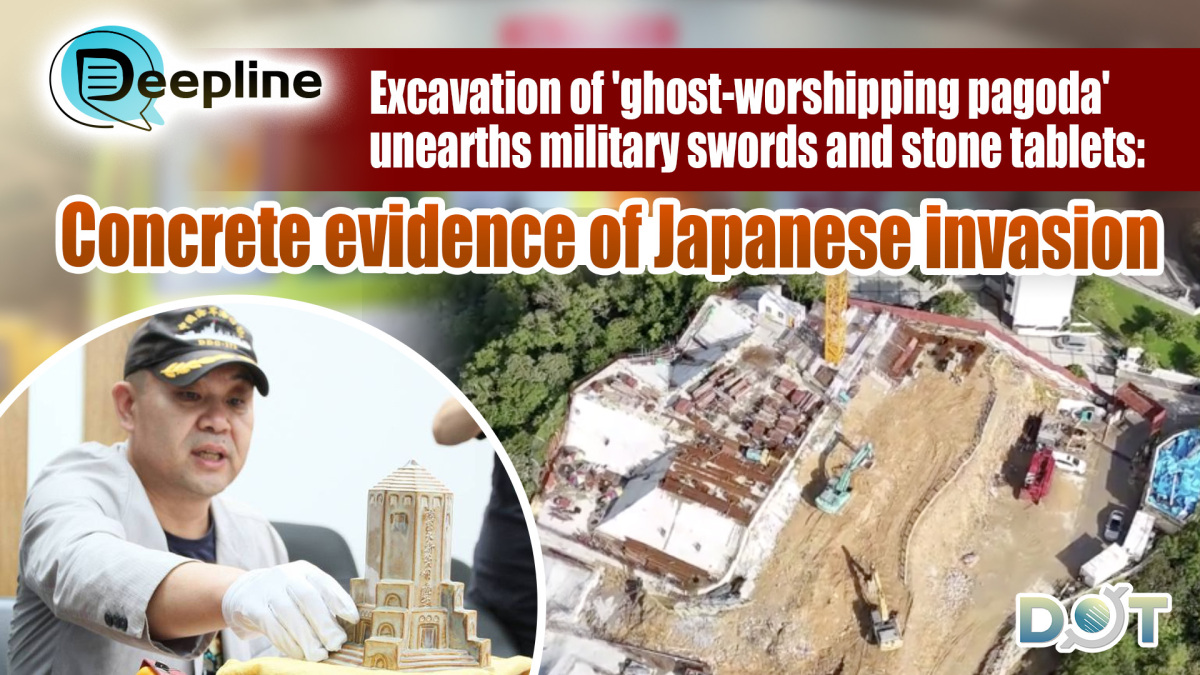
Eighty-Year-Old Evidence Sees the Light of Day
In July 2026, workers carrying out foundation demolition at a construction site on Magazine Gap Road, Bowen Hill, on Hong Kong Island, made a startling discovery. This land was once the site of the "Chureito" (Loyal Spirit Pagoda) – a symbol of Japanese militarism built during the Second World War with funds extorted from the local population, and derided by Hong Kong citizens at the time as a "ghost‑worshipping pagoda."
A year earlier, in July 2025, while preparing to chisel through the foundation, the workers unexpectedly uncovered a stone box that had been buried for more than eighty years. Inside lay a Japanese military sword, along with stone tablets and fragments of wooden artefacts. These objects have become direct physical evidence of the Japanese invasion of Hong Kong, shedding light on that dark period of three years and eight months of occupation.
Origins of the Sword: The Ground‑Breaking Ceremony
According to research conducted by the Hong Kong History Study Circle, documentary evidence confirms that this sword was the foundational object buried during the "Jichinsai" (the traditional Shinto ground‑breaking ceremony) held on 8 December 1942 for the construction of the Loyal Spirit Pagoda. The Japanese referred to such buried items that guard and stabilize the land.
Detailed historical records exist regarding the forging of the sword. At that time, the Japanese military invited several master swordsmiths to Hong Kong to craft military swords. One of them was Kurihara Hikosaburō, who had founded the Japanese Sword Academy in Japan before the Pacific War to train swordsmiths in support of the war effort. In 1942, Kurihara, along with several renowned Japanese swordsmiths, came to Hong Kong. In 1943, they took part in the opening ceremony for the forging of the sacred sword, located within the Hong Kong Zoological and Botanical Gardens now. The ceremony was presided over by Governor‑General Isogai Rensuke, who struck the first hammer blow to forge the divine sword. The sword buried in the foundation of the Loyal Spirit Pagoda is one of the blades forged by Kurihara and his fellow smiths.
Forced Construction: The Cultural Control of Militarism
The Loyal Spirit Pagoda was forcibly built by the Japanese military from 1942 onwards, on the summit of Bowen Hill in the central part of Hong Kong Island (at 30–38 Magazine Gap Road). The original plan called for a tower 80 metres high, with a granite base and a reinforced concrete shaft, covering a foundation area of 3,000 square feet. The Japanese intended to make it the largest landmark in East Asia, commemorating even Japanese soldiers who fell in operations on the Indochina Peninsula.
All construction costs were raised through extortion and outright seizure. The initial budget was 1 million Japanese yen, part of which was to be "donated" by the Hong Kong business community – in practice, compulsory levies. During the occupation, the Japanese authorities even compiled textbook passages about the "Chureito" to indoctrinate Hong Kong students, attempting to impose a brainwashing rule through cultural and educational manipulation.
However, the local population fiercely resisted this symbol of aggression. A popular ditty circulated at the time: "Chureito, Chureito, built this year, torn down next year," cursing its early collapse. Safety measures were woefully inadequate during construction, and many Chinese workers were killed or injured. By the time Japan surrendered in August 1945, this planned East Asian landmark remained unfinished.
Post‑War Justice and Demolition by Explosives
At 4:29 pm on 26 February 1947, the British colonial government demolished the unfinished pagoda tower by controlled explosion. In 1951, the Cameron Tower residential complex was built on the original foundation site. The land remained in the hands of the family of Loke Yew, the "Tin Mining King" of Malaysia, for over seventy years.
In 2023, parties affiliated with Chow Tai Fook Enterprises acquired the Cameron Tower site through a company transfer for approximately HK$5 billion, with plans to redevelop it into four two‑to‑three‑storey detached houses. Demolition work began in 2024.
At the same time, justice was not absent. Between 1946 and 1948, the Hong Kong Military Court tried Japanese war criminals, conducting 46 trials involving 123 defendants of Japanese and Taiwanese nationality. The court handed down 44 judgments against 108 individuals, of whom 21 were sentenced to death (by hanging or firing squad), including the notorious "murderer" Noma Kennosuke, commander of the military police.
Archaeological Value and Heritage Treatment
The Antiquities and Monuments Office has classified the foundation of the Loyal Spirit Pagoda as a "site of archaeological research interest," rather than a graded historical building. The main reasons are that the superstructure has been destroyed, leaving only the base, and that the construction of Cameron Tower in 1951 brought about various alterations to the foundation, affecting its authenticity.
Regarding the unearthed artefacts, the Antiquities and Monuments Office confirmed that licensed archaeologists are currently conducting research. Once the report is completed and accepted, it will be uploaded to the office's website. The artefacts will be restored, catalogued, and stored in the Central Archaeological Repository. As for whether the swords and other objects will be displayed to the public, a decision will be made after research and restoration are finished.
The Japanese occupation of Hong Kong lasted three years and eight months, from 25 December 1941 to 15 August 1945, during which the Japanese forces committed innumerable atrocities, including large‑scale economic plunder through the looting of resources, the forced exchange of military scrip, and the deliberate creation of food shortages that led to starvation among many residents; over 2,000 civilians were killed or reported missing in population purges; around 40,000 people were forcibly transported to Hainan Island for forced labour, of whom only about 5,000 survived; and even after Japan's surrender, Japanese troops continued to massacre villagers and burn houses on Lantau Island and elsewhere.
Historical Warning: Remember and Remain Vigilant
Collector Pei Fu once donated a porcelain stele of the Loyal Spirit Pagoda to the September 18th History Museum in Shenyang. The stele replicates at scale the structures that the Japanese built in various parts of China, including Hong Kong, Shenyang, Qiqihar, and Changchun, to house the ashes of fallen Japanese soldiers. Fired onto the base of the stele is the inscription "Souls of the fallen mixed with earth and sand from battlefields in Manchuria to form this pagoda, Showa 7 (1932)," indicating that it was made using Chinese soil – a tangible piece of evidence of the Japanese glorification of their own military aggression.
Scholars and civil researchers generally agree that the Loyal Spirit Pagoda was a product of Japanese militarism's cultural control and a display of wartime achievement – and, more importantly, material proof of Japan's war of aggression against China and its devastation of the region. Its purpose, like that of the Yasukuni Shrine, was to glorify the military power of the Japanese Empire and to propagate and beautify militarism.
Now, with the foundation demolition underway, this militarist relic, buried for more than eighty years, will pass into history. Yet the unearthed swords, stone tablets, and fragments have become irrefutable historical evidence. Academics stress that they constitute vivid materials for patriotic education, reminding people not to forget history and to cherish peace.
At the same time, we must remain alert to attempts by Japanese right‑wing forces to distort the history of Japan's invasion of China. Recently, China's Ministry of State Security disclosed that since 2015, Japanese right‑wing groups have invested heavily in using artificial intelligence to mass‑produce false short videos denying the Nanjing Massacre, in an attempt to mislead public opinion. History cannot be rewritten, and crimes must be remembered – this sword, now brought back to light, stands as a silent indictment against all those who seek to forget or distort the truth.
(Editor: Liu Yu)
Related News:
Deepline | Brazil denies visas to US officials, accuses Trump of election interference




Comment