






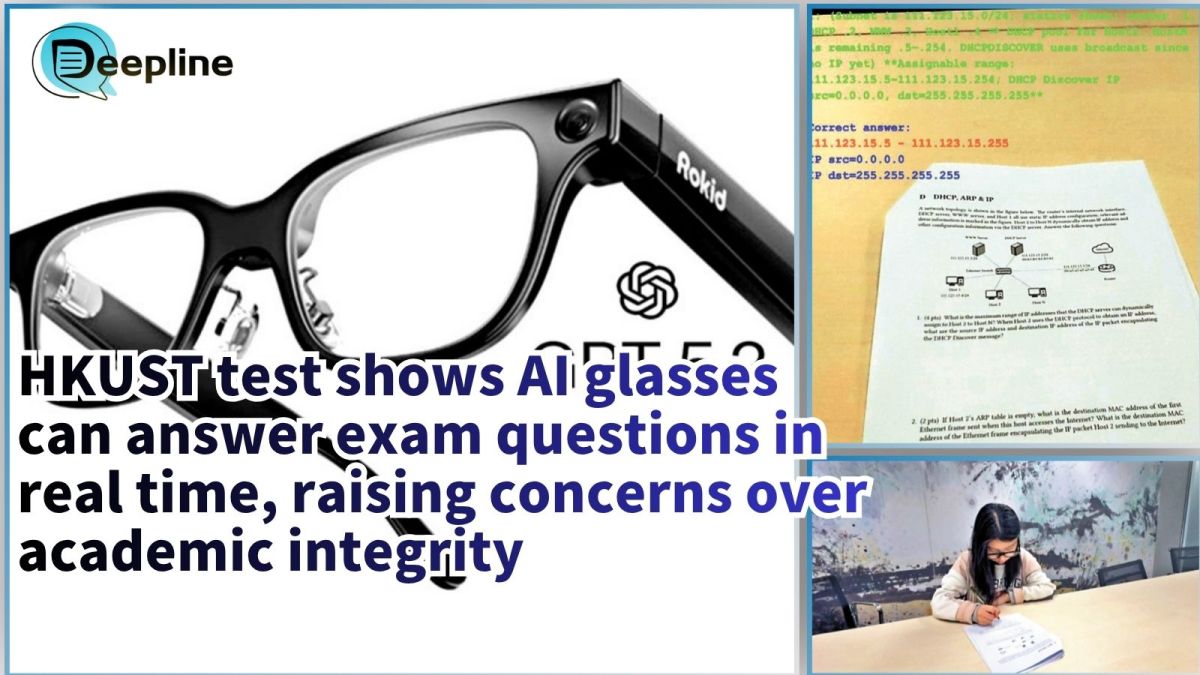
A research team at the Hong Kong University of Science and Technology (HKUST) has demonstrated that commercially available smart glasses, when paired with an advanced AI model and optimized algorithms and networking, can be turned into an "exam tool" capable of automatically generating answers during a test.
In the experiment, a student wearing the AI-enabled glasses sat a third-year undergraduate exam on Computer Network Principles. The candidate reportedly answered by transcribing content displayed on the glasses and finished the paper in 30 minutes, scoring 92.5 out of 100, placing within the top five among a class of more than 100 students.
The report said the team, led by Professor Zhang Jun and Assistant Professor Meng Zili from HKUST's Department of Electronic and Computer Engineering, evaluated existing commercial smart-glasses hardware and AI models for camera and display performance and response speed. The test system used Rokid smart glasses connected to GPT-5.2.
During the exam, the wearer simply looked down at the paper. The glasses' camera captured images of the questions, which were sent via a phone app to a remote AI model for analysis. The generated answers were then returned through the same pathway and displayed on the glasses' screen for the student to copy down.
Results cited in the report indicated the AI-glasses candidate achieved full marks on multiple-choice questions and single-page written questions, and still earned most points on cross-page questions despite limitations in capturing the full question set at once. The report added that even when final answers were incorrect, the model could provide partial reasoning and, in some cases, correct answers involving knowledge not covered in class.
According to the report, the AI-assisted score of 92.5 exceeded the exam's overall average of 72. While a top human score of 97.5 was recorded, that student reportedly took about three hours—roughly six times longer than the AI-glasses completion time.
The researchers said the test highlights both potential educational applications and serious risks. They described AI glasses as a "double-edged sword": on one hand, they could support personalized learning and reduce resource gaps; on the other, they could facilitate cheating and undermine fairness in assessment.
The report noted that cases involving AI-glasses cheating have emerged in multiple places, including a TOEIC exam incident in South Korea and other school-level cases in Taiwan and mainland China. It also described enhanced anti-cheating measures, including stricter entry checks for wearable devices, upgraded screening gates that can detect camera-equipped wearables, and AI-based monitoring systems that flag abnormal behavior.
A senior engineering professor interviewed in the report suggested immediate measures such as stricter inspections and bans on AI glasses and smartwatches in exam venues, while longer-term reforms could include shifting from large-scale written exams to one-on-one oral assessments or project-based evaluation that better fits the AI era.
(Source: Hong Kong Wen Wei Po)
Related News:
Frontier | South Korea exposes first cheating case using AI glasses




Comment