






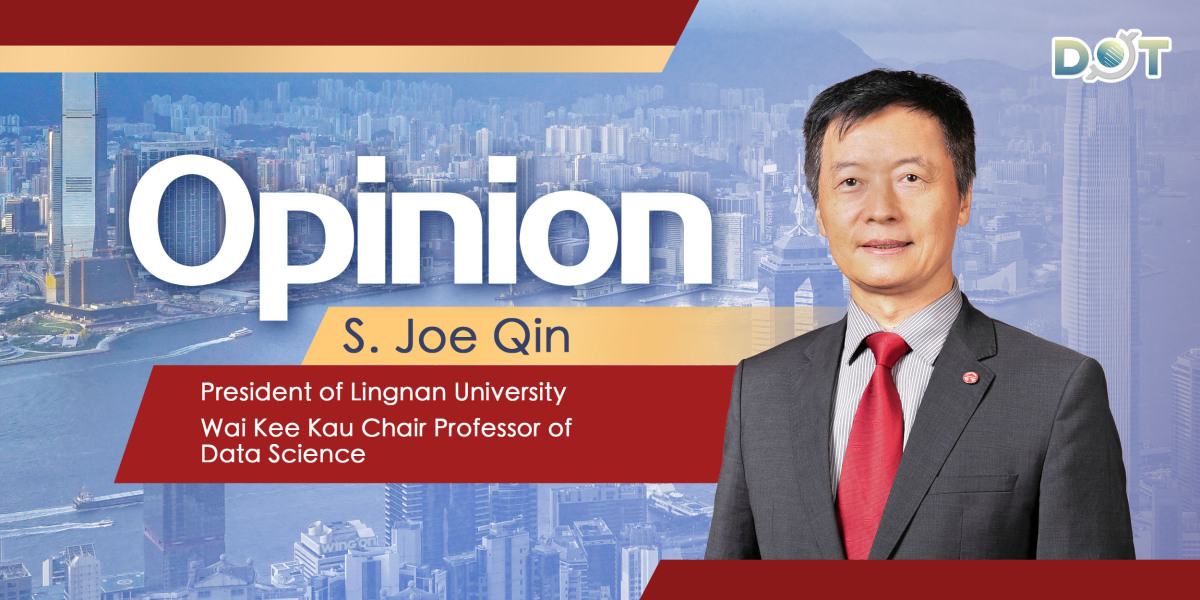
By Prof S. Joe Qin
Technology advances at an extraordinary pace, naturally drawing our attention towards the future. Yet 1 July serves as a reminder that this day is more than just an annual public holiday; it offers a moment to pause, reflect on history, understand our roots, and consider how cultural heritage can be sustained amid the changing times.
The study of history helps younger generations strengthen their cultural foundations, understand the transformation of Hong Kong in a complex and ever-changing landscape, and appreciate the broader context of our nation's development. The history of Lingnan University offers a valuable lens through which we may better understand how higher education institutions have remained anchored to their educational mission amid the torrents of times. As Hong Kong marks the 29th anniversary of its return to the motherland, it is worth revisiting Lingnan's century-long journey and the values that have helped shape education in Hong Kong today.
This year, on 1 July, Lingnan University held a seminar in Guangzhou entitled "The Present and Future of Liberal Arts Education through the Lens of Lingnan History". For Lingnan, returning to Guangzhou to discuss the future of education is a journey to reconnect with our roots. It also provides an opportunity to reflect on the long-standing educational and cultural bonds between Guangzhou and Hong Kong.
Long before it became part of Hong Kong's higher education landscape, Lingnan's story began in Guangzhou. Its origins can be traced back to the Christian College in China, founded in 1888. During the War of Resistance Against Japanese Aggression, the institution was forced to relocate three times, yet it continued to fulfil its educational mission despite severe resource constraints and uncertain circumstances.
Owing to geographical proximity and shared cultural heritage, Guangdong and Hong Kong have long maintained close educational ties. In 1938, as the war intensified, Lingnan relocated to Hong Kong and received support from the University of Hong Kong, which provided classrooms and facilities that enabled teaching to continue. During the same period, several institutions in the Chinese Mainland also moved south. Parts of Private Guangzhou University and Private National University in Guangdong established teaching operations in Hong Kong, enriching the city's educational landscape.
Following victory in the war in 1945, Lingnan returned to its campus in Guangzhou. In 1952, during the nationwide restructuring of higher education, Lingnan's original faculties and departments were incorporated into five institutions, including Sun Yat-sen University, and Lingnan University ceased operations.
With the support of its alumni, Lingnan was re-established in Hong Kong in 1967 and gradually took root in the city. At a time when Hong Kong's economy was entering a period of rapid growth but opportunities for higher education remained limited, Lingnan College provided an important pathway for young people seeking further study. Over the years, it nurtured generations of graduates who contributed to Hong Kong's development.
In the decades that followed, Lingnan strengthened its distinctive liberal arts tradition by combining the richness of Chinese cultural heritage with an international outlook, while placing strong emphasis on whole-person development and character formation. As Hong Kong expanded its higher education sector during the 1980s and 1990s, Lingnan moved to its Tuen Mun campus in 1995 and was renamed as Lingnan University in 1999, shortly after Hong Kong's return to the motherland and the establishment of the Hong Kong Special Administrative Region.
From relocating to establishing a lasting presence in Hong Kong, Lingnan's educational spirit has endured. Its story represents more than a geographical connection between Guangzhou and Hong Kong; it stands as living proof of the deeply intertwined historical, cultural and educational ties that have linked the two cities for generations.
Today, as society adapts to the challenges of the digital era, Lingnan University continues to uphold its commitment to whole-person education. Through initiatives such as "Liberal Arts + Technology" and "AI + Education", the University encourages students to engage with the classics, understand historical contexts and develop the capacity for critical and independent thinking. These qualities are increasingly important if technological innovation is to be applied responsibly and for the benefit of society.
This commitment to educational values has also gained international recognition. In the Times Higher Education Sustainability Impact Ratings 2026, Lingnan retained its position as the world's top university for THE Sustainable Development Goal 4 (Quality Education). The achievement demonstrates how historical values and sustainable development principles can be integrated into educational practice and highlights the enduring relevance of education in a rapidly changing world. Education is not merely preparation for future careers; it is also a process through which students learn to understand the past and transform historical experience into wisdom.
The nation has emphasised the integrated development of education, technology and talent. While higher institutions pursue technological innovation and academic excellence, they must also continue to uphold the educational mission and cultural traditions. Their responsibility is not only to equip students with professional knowledge, but also to cultivate sound judgement and critical thinking, helping them navigate an increasingly complex and fast-changing world.
Lingnan's century-long journey reminds us that the value of education lies not only in the transmission of knowledge but also in passing on historical experience and cultural heritage from one generation to the next. In times of change, these enduring values help young people understand where they come from, discern the direction ahead, and contribute meaningfully to society.
Prof S. Joe Qin is the President and Wai Kee Kau Chair Professor of Data Science at Lingnan University.
The views do not necessarily reflect those of DotDotNews.
Related News:
Xi says long-term prosperity, stability in HK and Macao essential for national rejuvenation




Comment