






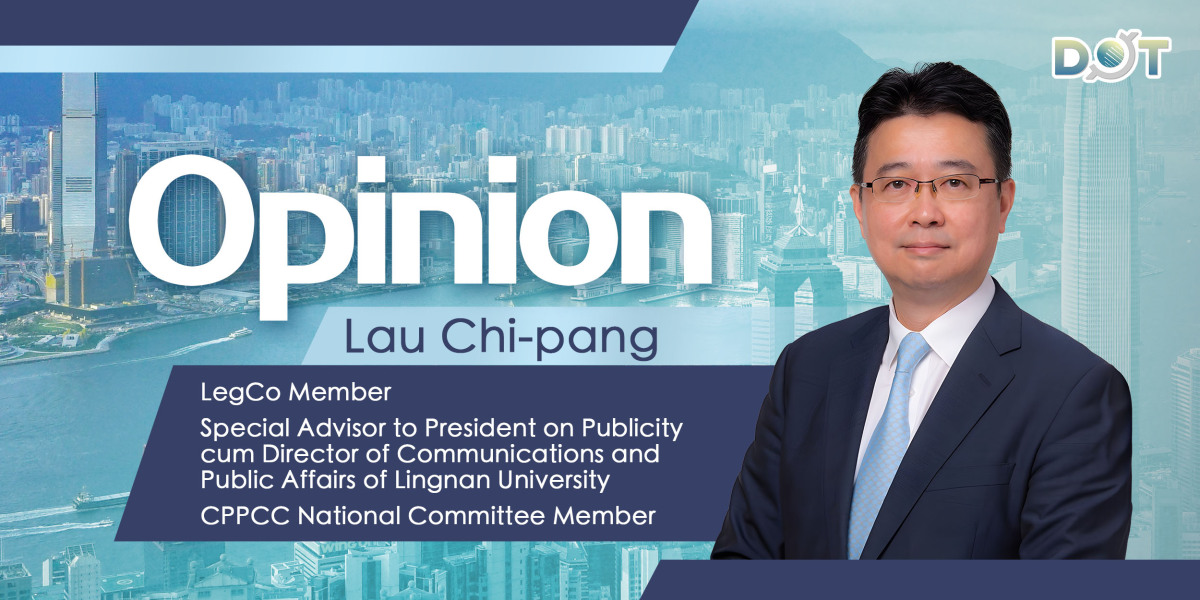
By Lau Chi-pang
The 29th anniversary of Hong Kong's return to the Motherland offers a timely moment to reflect on how the city has developed over the past three decades. Hong Kong today is often described in terms of its prosperity and stability, yet these outcomes did not emerge by chance. They are the result of long-term collective effort, built steadily across generations. Among the many factors that have supported this development, education has remained one of the most fundamental.
Education, in this sense, should be understood as a form of social infrastructure. In Hong Kong's earlier decades, expanding access to schooling was closely linked to improving life chances and enabling upward mobility. As the system of higher education developed over time, the city gradually evolved from an industrial economy into an international metropolis with a strong university sector. Education has consistently been part of its underlying structure of change.
Yet the significance of education goes beyond questions of skills or institutional ranking. At its core, it concerns the kind of people a society seeks to cultivate. A stable and prosperous society depends not only on economic growth or technological advancement, but also on individuals who have benefited from a whole-person education and act with a sense of responsibility. Universities are increasingly being asked to consider not only what they produce in terms of knowledge, but how that knowledge connects to wider social needs and challenges.
The national 15th Five-Year Plan explicitly calls for efforts to seize the historic opportunities presented by a new wave of technological revolution and industrial transformation, and advance the integrated development of education, science and technology, and talent cultivation. It also emphasises the deep integration of technological and industrial innovation. In other words, higher education is increasingly expected not only to create knowledge but also to serve as an active driver and practitioner of innovation.
Against this backdrop, two recent international rankings offer an interesting point of reference. Following the release of the QS World University Rankings in June, the Times Higher Education Sustainability Impact Ratings were also released. While both sets of rankings are widely followed, they are based on rather different priorities and, taken together, they highlight different dimensions of higher education performance.
The QS rankings continue to emphasise traditional indicators of academic reputation and research output. The THE Sustainability Impact Ratings, by contrast, are structured around the United Nations Sustainable Development Goals and place greater weight on how universities engage with social responsibility, sustainability, and real-world impact.
Since its launch in 2019, participation in the THE Sustainability Impact Ratings has expanded significantly, from just over seventy countries in its first edition to more than one hundred and thirty last year. The growing scale of participation itself suggests a widening consensus that universities are now expected to play a broader social role. In an era shaped by digital transformation and sustainability challenges, expectations placed on Hong Kong's education sector have shifted. Universities are now increasingly seen not only as centres of research, but also as institutions that help translate knowledge into social understanding and public value.
Lingnan University, where I teach, offers one example of how this evolving role is being interpreted in practice. In recent years, the University has integrated sustainability considerations into teaching, research and community engagement. It was among the first universities globally to provide free access to generative artificial intelligence tools for all staff and students, while also embedding AI literacy within its core curriculum to support responsible and equitable use of emerging technologies. In addition, Lingnan has partnered with the United Nations University to establish Asia's first UNU Hub at the University, bringing together interdisciplinary teams to explore humanitarian technologies through collaboration across engineering, data science and design.
The outcomes of such efforts are reflected in the latest THE Sustainability Impact Ratings. Lingnan University has risen to 63rd globally and entered the world's top 100 for the first time. It has also performed strongly across multiple Sustainable Development Goals, including maintaining a leading global position in SDG 4 on Quality Education for the second consecutive year. While such results are often presented in numerical form, their broader significance lies in how they reflect a sustained institutional commitment to a wider understanding of education.
At this point, it is perhaps worth returning to the wider question. Rankings will continue to attract attention, but they are ultimately only partial indicators. What matters more is how universities understand their purpose within society, and how education continues to shape the relationship between knowledge, individuals, and the communities to which they belong.
As Hong Kong marks the 29th anniversary of its return to the Motherland, the experience of recent decades serves as a reminder that the city's development has never depended on a single driver. Education has not only supported economic and institutional progress, but has also helped to shape the social foundations on which stability rests. In this sense, its value lies less in measurable output than in the longer and quieter process of cultivating people and sustaining the conditions for a society to grow.
The author is the Special Advisor to President on Publicity cum Director of Communications and Public Affairs of Lingnan University, and Chairman of the Legislative Council Panel on Education.
The views do not necessarily reflect those of DotDotNews.
Related News:
Opinion | What the latest QS rankings tell us about higher education in Hong Kong




Comment