






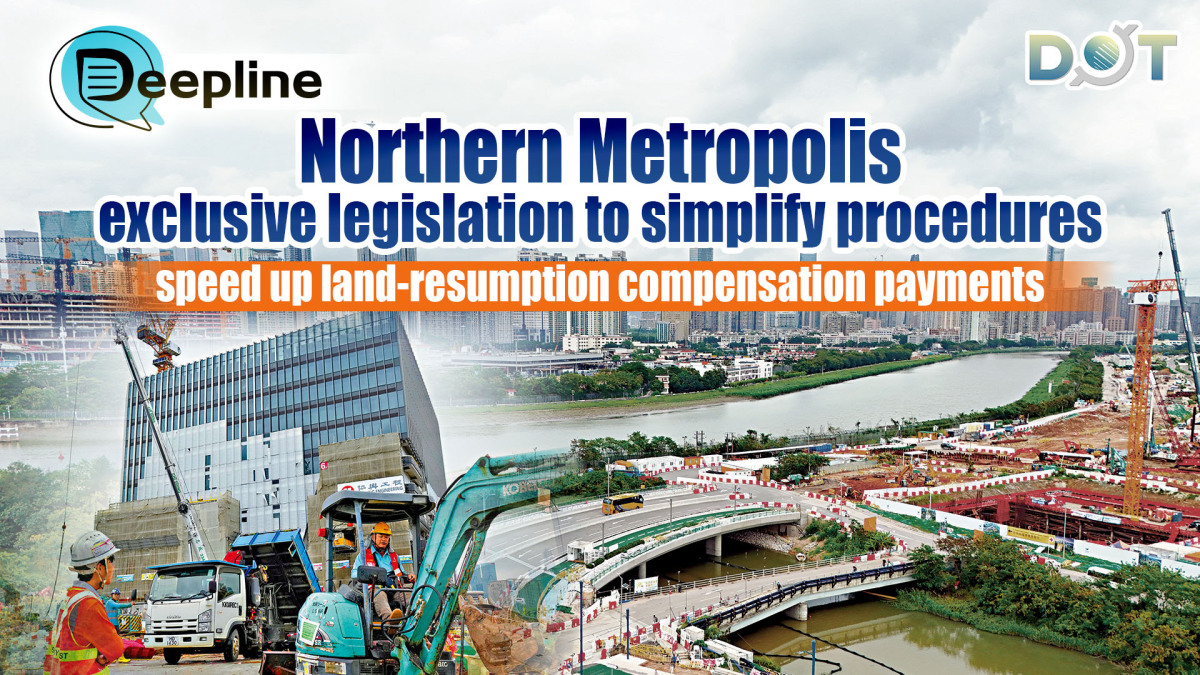
The Legislative Council Panel on Development yesterday (June 23) discussed legislative proposals for dedicated legislation for the Northern Metropolis. In response to public consultation views, the Development Bureau plans to fine-tune the legislative proposals, including scrapping the proposed six-month time limit for referring compensation cases to the Lands Tribunal, extending the scope of the simplified noise procedures to the Sandy Ridge Data Facility Cluster, and adding design and construction quality as factors to be considered in innovative construction technology. The Government also proposed extending the cross-boundary arrangements for the "flow of goods, data and capital" — originally applicable only to the Co-operation Zone (Hong Kong Park) — to other areas of the Northern Metropolis.
Secretary for Development Bernadette Linn said that a "white list" for the flow of personnel will be implemented first at the new dedicated boundary control point of the Hetao Park, while the flow of goods and data will be submitted in the form of subsidiary legislation with pilot schemes to be launched, hopefully within this year. She reiterated that the Northern Metropolis is Hong Kong's future development engine and is now entering the stage of large-scale construction and industry settlement, requiring "deregulation" arrangements. The Government aims to introduce the formal bill to LegCo in July and secure passage of the legislation by the end of this year.
The SAR Government is accelerating the enactment of dedicated legislation for the development of the Northern Metropolis to remove bottlenecks, expedite construction, and facilitate industry operations. In response to public consultation results, the Development Bureau has made corresponding fine-tuning to the legislative proposals.
Speeding up compensation payments for resumed land
Regarding speeding up compensation payments for resumed land, the Government had originally proposed a six-month time limit requiring former owners to reach a compensation agreement with the Government or refer their cases to the Lands Tribunal for adjudication within the period. The authorities now plan not to set such a time limit. So Wai-sze, Head of the Northern Metropolis Co-ordination Office of the Development Bureau, explained that "some owners were worried about missing the deadline, so they would file a claim with the Lands Tribunal regardless. This might backfire and increase the workload of the Lands Tribunal." She stressed that even without the time limit, other proposals for interim payments would still help the Government reduce interest expenditure on compensation. Whether or not a time limit is set would not affect the Government's pace of land resumption and development in the Northern Metropolis.
Facilitating adoption of innovative construction technology
In terms of facilitating the adoption of innovative construction technology, in addition to the original innovative construction design, technology, and materials, the Government has accepted public views and will include "design and construction quality, sustainability, and functionality" as factors to be considered by the Buildings Department when processing applications for modifications or exemptions.
Cross-boundary "four flows" may not be limited to Hetao Park
The Government also plans to use the dedicated legislation to facilitate the "four flows" across the boundary — namely the flow of personnel, goods, data, and capital — through facilitation measures such as a cross-boundary "white list". The arrangement, originally limited to the Hetao Hong Kong Park, may be extended to other areas of the Northern Metropolis.
At the meeting, several Legislative Council members raised concerns about the progress of cross-boundary flow facilitation measures in the Northern Metropolis. Ray Wong, a LegCo member, questioned that the specific routes for data, goods, and capital flows have yet to be announced, making it difficult for interested enterprises to assess when they would benefit. He also urged the authorities to extend the white list to the San Tin Technopole and to designate cross-boundary data flows at the Sandy Ridge Data Facility Cluster as one of the first batch of pilot schemes.
Secretary for Development Linn said the top priority is to facilitate the flow of personnel, with the first step being the movement of people through the new dedicated boundary control point at the Hetao Park. She added that when ready, the authorities would submit the flow of goods and data in the form of subsidiary legislation, and plan to progressively launch relevant small-scale pilot schemes within this year.
Kazaf Tam, a LegCo member, said that facilitation of capital and goods flows is key to attracting industries to settle in the Northern Metropolis. He was concerned about the progress of the SAR Government's discussions with the mainland on these matters. Lillian Cheong, Under Secretary for Innovation, Technology and Industry, said the SAR Government and the Shenzhen side have jointly submitted a proposal to the central ministries, and will also collect views from enterprises in the Hong Kong-Shenzhen parks, including the demand for the flow of data and biological samples in terms of volume and variety. She expects pilot projects and tests to be carried out in actual application scenarios within this year.
Two cross-boundary railways in the Northern Metropolis
The Northern Metropolis will have two cross-boundary railways, namely the Hong Kong-Shenzhen Western Railway and the Northern Link Spur Line. After public consultation on the dedicated legislation for the Northern Metropolis, the Government has proposed adding new provisions to the bill to allow the relevant authorities to waive or render inapplicable certain requirements for construction machinery and equipment in designated areas, subject to conditions specified by the Chief Executive-in-Council in the relevant subsidiary legislation, thereby enhancing project efficiency.
LegCo member Lam Chun-sing from the Election Committee constituency was concerned about how the authorities would consider the safety, performance, and efficiency of such machinery. Lee Lik-kong, Deputy Secretary for Transport and Logistics, said that some railway lines spanning the Northern Metropolis are cross-boundary projects extending from the mainland to Hong Kong, and there is no reason to switch machinery midway through construction, hence the need for exemptions. However, he stressed that the Government would maintain controls on air pollution and safety matters, and noted that national standards are in line with existing Hong Kong standards. The SAR Government would discuss with mainland regulatory authorities which areas could be further deregulated.
No relaxation of controls at any stage
Secretary for Development Linn said the dedicated legislation for the Northern Metropolis has three important principles and features. As the Northern Metropolis is Hong Kong's future development engine and is now entering the stage of large-scale construction and industry settlement, the legislation provides targeted and flexible "deregulation" arrangements in terms of planning uses, planning parameters, and industry operation needs to help accelerate and enhance efficiency.
Linn pointed out that the dedicated legislation features a primary bill setting out the scope, spanning multiple policy bureaux and departments, with implementation details to be submitted in the form of subsidiary legislation. In July, the first batch of draft subsidiary legislation will also be submitted for LegCo members' preview. She stressed that although the dedicated legislation involves many simplification measures, this does not mean there is no gatekeeping — rather, there will be approving authorities and conditions at every stage.
Inclusive Community Fund projects: operating periods can be adjusted
The Development Bureau plans to roll out six measures to promote "urban-rural integration" in the Northern Metropolis, and intends to apply to the LegCo Finance Committee for a HK$200 million allocation in the fourth quarter of this year to launch the Northern Metropolis urban-rural integration fund. Secretary for Development Linn said the authorities would not adopt a one-size-fits-all approach to set operating periods for pilot scheme projects, but would determine appropriate periods based on the circumstances of different projects. Early exit may result in penalties or withdrawal of funding. She also mentioned that project assessments would not rigidly require 100 percent stakeholder support, but would be calibrated according to the intensity of opposition.
LegCo member Lam Chun-sing was concerned that the pilot scheme projects would have an operating period of at least three years, noting that some organisations had ceased operations after losing certain government funding in the past, and expressed concern that overall sustainability might be relatively low.
Linn said that since application projects under the scheme involve private properties, the Government finds it difficult to control the operating models of private properties, making the prescribed operating period crucial. Three years is the starting point, but there will be no one-size-fits-all approach — the period will be determined according to different projects. If the relevant organisations fail to meet the requirements, the Government may impose penalties or withdraw funding.
(Source: Information Services Department, Ta Kung Pao, Wen Wei Po | Editor: Liu Yu)
Related News:




Comment