





In the summer of 2026, the whistle has yet to blow at the World Cup in the United States, Canada, and Mexico, but the frenzy of soccer has already made landfall.
48 teams, 104 matches—this is the first tournament since the World Cup expanded, and also a new battleground where global AI companies are collectively placing their bets. But this time, someone in the tech world has chosen the most dangerous path: going against the grain.
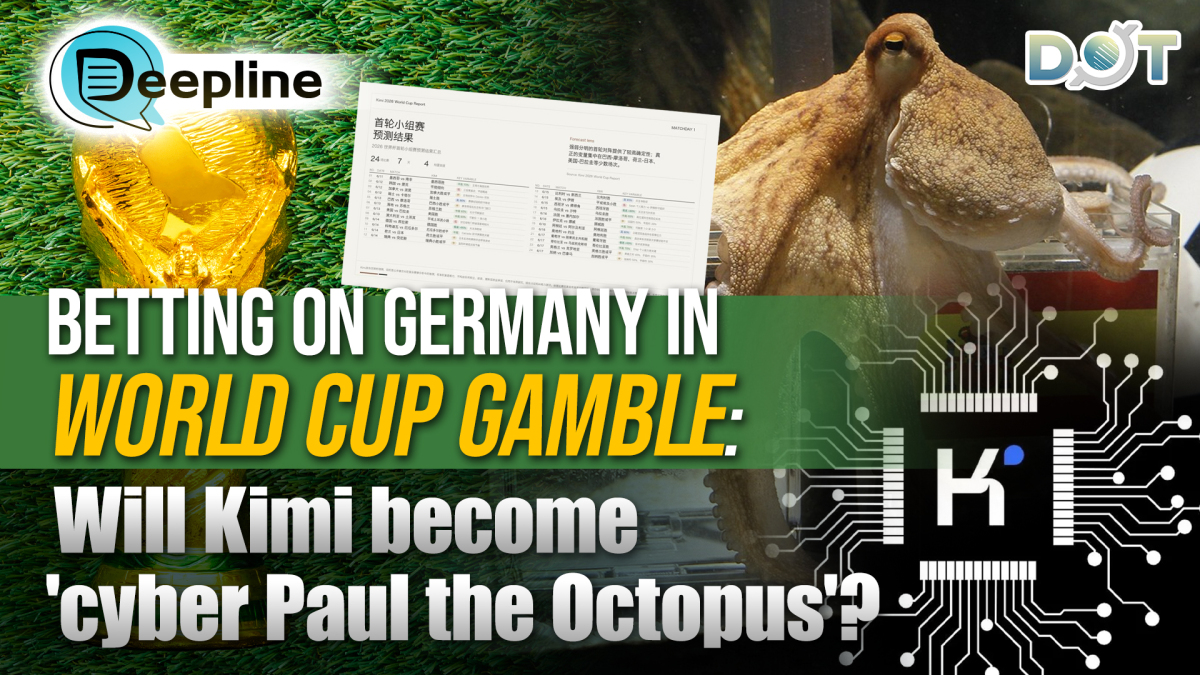
On June 8, news broke that Chinese AI Kimi's pre-money valuation had soared to US$30 billion, a sixfold increase in just six months. Then Kimi made another bold move: using its agent capabilities to "bet" on the World Cup. While all the mainstream models were putting Spain and France on the champion's throne, Kimi stepped forward and threw its support behind Germany.
Kimi, an AI assistant developed by Moonshot AI, recently announced that it will use its agent swarm feature to deploy 300 agents, providing public predictions and post-match reviews for all 104 games. If this were just another attempt to ride the wave of "AI predicts soccer" marketing, it would have gone unnoticed. But buried in the announcement was a thought-provoking line: "AI technology should be more transparent."
That's not all. Kimi also openly invited other AI model companies to join in the public predictions, saying, "We believe that AI should not be packaged as a system that is always right. A trustworthy AI system should be capable of clearly stating its own boundaries." In a year when the norm has been to open with phrases like "new SOTA" or "beyond human benchmarks" and close with disclaimers, this statement sounds less like grand rhetoric and more like an open challenge.
If you lived through the 2010 World Cup in South Africa, you probably remember the famous octopus that suddenly became a global sensation.
The name was Paul, and he lived in an aquarium in Oberhausen, Germany. His prediction method was almost absurdly simple: staff placed two transparent boxes into the water, each labeled with a team's flag and containing a mussel. Whichever box Paul swam to and opened was considered his "prediction" of the winning team.
It started as a gimmick by the aquarium to capitalize on World Cup fever. No one actually expected a mollusk to understand soccer, let alone believe it could read formations, form, odds, or national sentiment. But things spiraled: Paul correctly picked Germany's matches, then chose Spain before the semifinal. A day later, Spain beat Germany 1–0. When he then picked Spain to win the final, the world lost its collective mind. He got all eight predictions right, calculated as a 1 in 256 chance (0.39%) if we treat each as a simple binary choice.
Paul the Octopus became the Oracle of the World Cup.
Strictly speaking, he explained nothing. He had no training data, no model parameters, no confidence intervals, and no technical report. He simply extended a tentacle, opened a box, and let the media, fans, gamblers, and onlookers around the world do the explaining for him.
That was Paul's real magic. It wasn't about whether he understood soccer; it was that he turned prediction into a globally synchronized ritual. People laughed at themselves for believing in an octopus, yet they couldn't stop refreshing the news to see which mussel he would take next.
The World Cup has never been just a sporting event. It's more like a global emotion machine, started up every four years: people suddenly become willing to believe things they normally never would—superstitions, hot streaks, dreams, jersey colors, and that line at the lottery stand: "This year is their year."
In a sense, Paul was the last black-box model to be watched collectively by the world before the age of algorithms and AI. His black box was endearing because it bore no responsibility. Right? A miracle. Wrong? Just an octopus that picked the wrong lunch.
But AI is different. The black box of AI unnerves us because it's entering real-world decisions: investment analysis, medical advice, legal counsel, business operations, and now World Cup predictions. One kind of error becomes a meme; the other can affect business, judgment, money, and, most important, trust.
From Paul to AI, what has changed is not that humans have suddenly become more rational; it's that the outer shell of the "Oracle" has been replaced. The aquarium becomes agent swarms; the mussels become datasets; the tentacle becomes 300 parallel agents. What hasn't changed is this: whenever the world is full of uncertainty, people want someone to speak first on their behalf.
The difference is that Paul can remain silent, but AI cannot. Paul offered no explanations, which only enhanced his legend. If AI offers no explanations, it breeds fear.
That is what makes Kimi's World Cup prediction project so compelling. It's not about creating another "cyber Paul." It's an attempt to answer a much more practical question: when prediction evolves from entertainment into product capability, and the black box moves from the aquarium into the workflow, should a company hide its uncertainty or lay it bare?
While mainstream models overwhelmingly ranked Spain, France, and Brazil as the top three title favorites, Kimi assesses that Germany is severely undervalued.
The model estimates Germany's baseline title probability at about 11.0%, post-calibration around 11.3%, while the implied probability in some markets is only 7.4%—a gap of roughly 3.6 percentage points, which in the betting world is a significant discrepancy.
Why Germany?
Kimi's analysis offers a long chain of reasoning: the shadow of consecutive group-stage exits in the last two World Cups has left a stubborn recency bias in public and market psychology, keeping Germany's odds depressed. On hard metrics such as Elo ratings, squad valuation, and depth of talent, the German machine still firmly ranks among the world's elite. The young creative axis of Jamal Musiala and Florian Wirtz is beginning to cure Germany's long-standing problem of "huge possession, little threat" against defensively compact opponents.
And then there's the young manager on the touchline, perhaps the biggest X-factor.
At 38, Julian Nagelsmann is the youngest head coach at this World Cup. Born in 1987, he is hailed as a "tactical prodigy," the youngest coach in Bundesliga history, the youngest national team manager in Germany's professional era, and the embodiment of the "laptop coach." His obsession with data borders on the extreme—not the lofty kind of "data analysis" but real-time, pitch-side interrogation.
Kimi's report touches on this with something close to mutual respect: when a head coach younger than Messi and Ronaldo uses AI to optimize his team's pressing defense, a young Chinese AI company is also using algorithms to reassess that team's championship odds.
Of course, Kimi also acknowledges the risks: the high-intensity system demands extreme physical fitness and squad depth; the summer heat of North America could amplify every weakness. If key positions suffer injuries, or if Germany runs into defensively disciplined, physically aggressive opponents, their window of advantage will narrow quickly.
And then there is the stubborn "America's curse"—historically, no European team has ever won a World Cup hosted in the Americas, with one exception: Germany itself, who triumphed in Brazil in 2014. In 2026, the World Cup returns to the Americas, and while Spain and France must also face this curse, Germany is the only team to have ever broken it.
Predicting Germany is at most a "statement of position." Kimi's next move borders on provocation: it publicly invites other AI models to join the prediction.
This is not a risk-free gamble. Looking back at previous World Cups, the history of AI predictions can be called "bloody." In 2018, Russia, AI platforms from Microsoft, Baidu, Google, and Alibaba all favored Spain, Germany, and Brazil; France won. In 2022 in Qatar, EA, Nielsen, FiveThirtyEight, and others correctly picked Argentina, but per-match accuracy was modest—Al Jazeera's AI hit 58.7%, FiveThirtyEight fell to 57.1%, barely better than a coin toss.
The financial world's AI fared even worse. Goldman Sachs ran 200,000 models and 1 million simulations to predict a Brazil vs. Germany final, only to be undone by France. Ironically, the entity that has correctly predicted every World Cup champion for four consecutive cycles is not a Wall Street quant model, but EA Sports' FIFA video game.
The World Cup thus becomes a natural, public, unshielded testbed. Every match is a validation; every wrong prediction leaves a digital record. Kimi even preemptively lays out a "mistake classification framework": data lag, failure of key assumptions, structural blind spots in the model, unforeseen events, and the inherent randomness of soccer, as if ready to be publicly humiliated.
Behind this lies a quiet but mounting crisis of trust in the AI industry.
When ChatGPT first went viral, the narrative of "AI can do anything" existed everywhere. But soon, hallucinations, logical gaps, and unreliable performance in professional contexts began to surface, each incident eroding the foundation of "AI trustworthiness." The trust curve of ordinary users has sharply reversed, moving from early "believe anything AI generates" to "suspect anything AI generates."
A Forbes survey found that global public trust in AI has fallen from 61% to 53% over the past five years. Over the last two years, the AI industry has developed a tacit script of three "always": press releases are always full of beautiful numbers and rankings; demo videos always succeed; case studies of failure are always "under optimization." No single event destroys trust by itself, but like constant dripping water, they gradually erode the collective perception that "AI can be trusted."
Against this backdrop, Kimi's "honesty manifesto" is hard to dismiss as just a marketing event. It touches on a structural industry problem: when AI products increasingly enter real decision-making scenarios with real consequences, why should the public trust you?
The industry's traditional approach has been to hide risks on the last page of a user agreement, in 8-point gray font. That's a form of legal risk avoidance, like the "not responsible for lost valuables" sign at a hotel front desk: you know it's there, but you never actually read it.
Kimi has taken a different path. High-confidence accuracy around 85–90%, medium-confidence falling sharply to 55–65%, low-confidence near random—these numbers aren't tucked away in some obscure corner but placed front and center in the announcement.
The question is: will this strategy rebuild trust, or will it lead to faster rejection because the company has exposed its own weaknesses?
The answer depends on one thing: what does the public actually want from AI—the illusion of perpetual correctness, or honesty that clearly knows its own limits? If the former, Kimi is taking a risk. If the latter, it may be trying to define a new paradigm of technical communication: imperfect but traceable; uncertain but accountable.
Zooming out, the narrative structure of this announcement is quite sophisticated, even calculated. "AI technology should be more transparent" and "invitation to peers to join" deliver a precise industry critique without naming names. As the "AI trust crisis" gradually moves from internal discussion to public issue, the first player to stand up and say "I am not perfect" naturally occupies the dual center of moral high ground and differentiation.
On the user side, the World Cup promotion has been designed as a carefully engineered growth engine. Users log in, choose their team, and if that team wins, they share in a pool of 10 billion tokens. If Germany wins, all users share an additional 10 billion tokens. These tokens are funneled directly to Kimi Work, launched on June 3—a desktop agent product positioned as a "local office assistant for knowledge workers," integrating skills like website building and PPT creation, along with specialized databases for finance, research, and law. This is Kimi betting trillions of tokens on a public exam, using it to launch its own product, Kimi Work, spectacularly.
At the end of the announcement, Kimi hides a thread that cannot be ignored: for every goal scored in this World Cup, it will donate 10 billion tokens to Chinese soccer, to support grassroots soccer, school soccer, and youth coaches using AI tools, reaching an estimated 10,000 practitioners.
On one side, 38-year-old German coach Nagelsmann is using data and AI to arm a traditional powerhouse. On the other hand, a young Chinese AI company, against the backdrop of its nation's 24-year absence from the World Cup, chose to channel technical resources to the most grassroots levels. The two images are asymmetrical, yet point to the same question: to what extent can technology change a sport?
An even colder number looms: China has only about 8,000 registered players, while Japan has more than 1 million. On this foundation, talking about "World Cup dreams" is almost luxurious.
But hope often appears outside the official narrative.
In April, at the U17 Asian Cup, China's U17 men's team came back from behind to beat Saudi Arabia 3–1, reaching the semifinals for the first time in 22 years, just one step away from the U17 World Cup. Guizhou's "Village Super League" ("Cun Chao") has evolved from a local tournament into a cultural phenomenon over the past three years, with over 90 billion views across platforms, driving US$19 billion in tourism revenue; its 2025 final drew over 80,000 live spectators and more than 300 million online views.
Also, the newly emerging "Jiangsu Football City League" provincial city competition has seen tickets originally priced at 10 yuan scalped for 900 yuan. It seems that the future of Chinese soccer may not rest on any single national team, but is scattered across these small but tenaciously growing nodes.
Of course, China's soccer problems cannot be solved by token donations; they involve deeply complex systemic issues like youth development, league health, and soccer culture. But Kimi's move raises a hypothesis: if data and technology were once a "luxury" for elite professional clubs, can AI turn them into a "basic public good" for the grassroots?
Soccer may be the hardest sport to predict. The course of a single game can be completely rewritten by a VAR decision, a red card, a goalkeeper's extraordinary performance, or an unexpected downpour. No prediction system can conquer this degree of randomness, and Kimi certainly cannot.
But perhaps it is precisely this "unconquerability" that makes the World Cup an excellent test of technological honesty. Here, you can choose to pretend you are certain, only to be repeatedly slapped by reality. Or you can state from the outset how uncertain you are, and lay out every step of your reasoning for all to see.
Kimi has chosen the latter. As stated at the end: "We believe that AI should not be packaged as a system that is always right. A trustworthy AI system should be capable of clearly stating its own boundaries."
Yet the risk of this stance is real. If Kimi's prediction accuracy is dismal, it will become the latest footnote to "AI doesn't understand soccer." If it happens to get a few upsets right, it may still be dismissed as "survivorship bias."
In the end, whether Germany can spring an upset and win the title will be known in July, but the question of "should AI be more honest" has no easy answer. The real issue is how much patience the public has left to wait for AI to learn honesty. And no one knows whether the companies that take this first step will be rewarded or will pay the price.
(Source: 36kr)
Related News:
Deepline | AI, Telegram bots, and Crypto: How illegal World Cup betting targets HK users
Deepline | Growth with pain: Can Baidu's AI conviction outrun its legacy?




Comment