






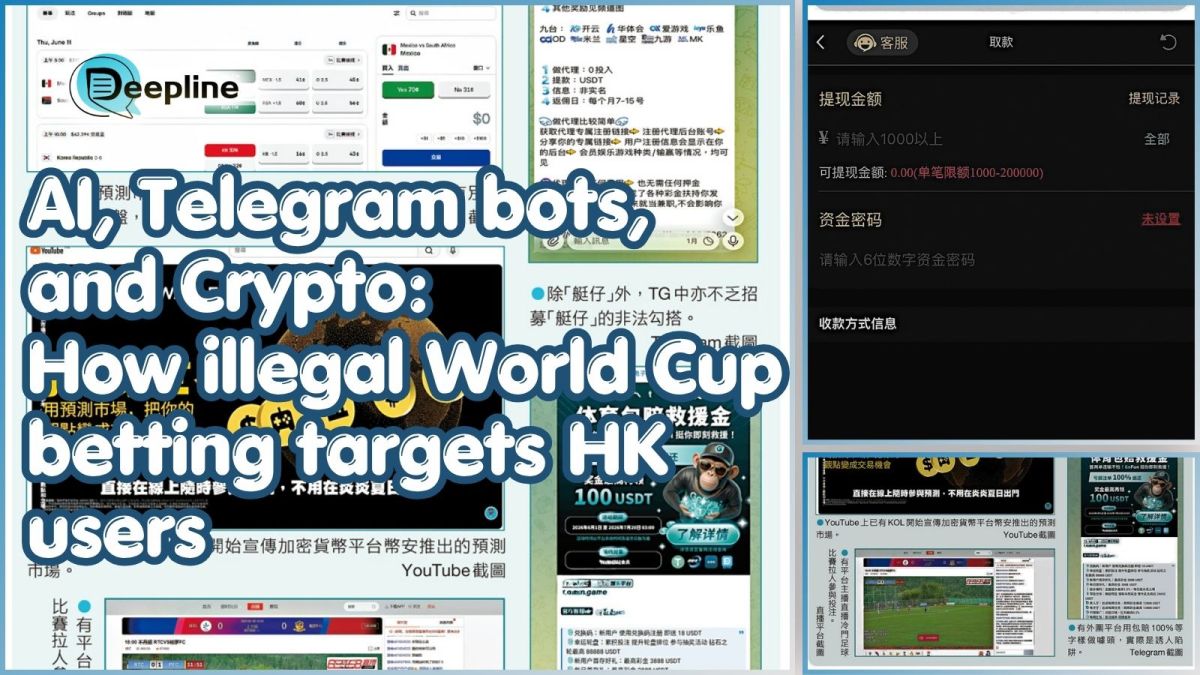
With the FIFA World Cup finals approaching, football fever is rising across the city. But behind the excitement, an illegal online betting war is also quietly escalating.
An undercover investigation by Hong Kong Wen Wei Po found that underground betting networks have upgraded their entire operations this year—using AI automation, social-media big-data targeting, Telegram bot-driven search tactics, and cryptocurrency settlement to build a near-omnipresent "tech flytrap" designed to "harvest" users through algorithms. Some operators even recruit ordinary netizens as agents to attract new bettors by promising aggressive commission rates. "The more your downline loses, the more you earn—up to 55%." For example, they claim that if a recruited bettor loses HKD 10,000, the recruiter can earn HKD 5,500.
In past World Cups, illegal betting often relied on traditional "agents" recruiting in bars or among acquaintances. This time, however, syndicates have pushed into mainstream platforms such as YouTube, Facebook, Instagram, and Google. According to the investigation, simply searching for keywords like "World Cup" or "match livestream" can lead to a flood of betting "tips," links, and promotional content.
KOL + AI "disguised" funneling: accounts promote "free football analysis," publishing videos generated by AI to direct users to seemingly professional "free AI match prediction" sites—then steer them toward placing bets.
New accounts with blunt advertising: low-effort accounts place offshore gambling links directly in bios or posts, baiting users with offers such as "deposit bonuses" or "celebrity endorsements."
Telegram search pollution: without needing cross-platform traffic, operators exploit Telegram's own search ecosystem—where bot-powered search engines cause betting ads and diversion links to dominate results the moment users type in related keywords.
After interacting with Telegram bot links or leaving search traces, the undercover reporter's phone reportedly began receiving dozens of unsolicited private messages from strangers inviting him to become a recruiter: "Just bring people in. As long as they bet, you can earn commission—lying down and collecting."
Many platforms advertise "first deposit matched 1:1" and even claim "100% guaranteed compensation." But when the reporter asked customer service about the terms, the response was blunt: "There's no free lunch." Bonuses are often locked behind requirements to wager at least five times—sometimes dozens of times—the bonus amount before withdrawal is allowed. Some "gift credits" cannot be used for sports betting and can only be spent on other gambling products, pushing users deeper into the ecosystem.
The investigation also notes that newer "prediction market" platforms have joined the competition, with some promoted in the comment sections of certain YouTube videos. Unlike traditional sports betting—where odds are set by a bookmaker—prediction markets use an order-book model similar to that of financial derivatives. Users buy and sell "Yes/No" shares tied to match outcomes, with prices moving in real time.
The report warns that this fintech-style packaging can reduce the stigma of gambling and create the illusion—especially among younger users or the middle class—that they are making "smart investments." Yet the risks remain high, particularly because these markets can trade 24 hours a day. During a match, prices can swing rapidly, encouraging repeated in-game trading—fueling compulsive behavior similar to high-frequency speculation.
These online platforms are described as full of "devil-in-the-details" terms. Registration is straightforward, but deposits may have minimum thresholds (the report cites HKD 1,000 in one example). Some claim users can bet directly in Hong Kong dollars or top up via FPS, but the system is effectively tied to crypto-linked exchange rates.
The greatest obstacles often appear at the withdrawal stage—minimum withdrawal amounts, high fees, and demanding identity verification—creating a "get in easily, get out with difficulty" structure. Even when some gambling sites block access in Hong Kong, operators may provide "global direct links" or VPN instructions to bypass local restrictions.
Beyond offshore betting sites, the investigation also found so-called "online agents" offering proxy purchase services for legal lotteries in the Mainland or Taiwan, using second-hand trading platforms and then funneling users into private chat groups on WeChat or Line. They may claim to be employees of lottery shops, but the report stresses the risk: users can be charged extra service fees, scammed through fake ticket images, or blocked outright—especially if they win.
As the World Cup approaches, counseling organizations report rising demand. Tung Wah Group of Hospitals' Ping Wo Fong told the reporter that in the past two months, football-betting-related cases accounted for about 60% of all gambling help inquiries and are expected to rise further during and after the tournament. In the first five months of this year, illegal football betting help cases rose to about 20.7% of total help seekers—higher than the roughly 15% average over the past three years.
Caritas Family Crisis Support Center senior supervisor Ng Shuk-ping shared a case involving a man in his 30s who ran a business and could borrow easily. After years of escalating football betting, he reportedly lost over HK$10 million, drawing his family into heavy repayment burdens.
Counselors warn that social media and Telegram groups overflowing with "tips" and "winning stories" can lure even first-time gamblers into a downward spiral. Early wins can create dangerous misconceptions—people may believe they are "good at analysis," then increase stakes, chase losses, and accumulate debt.
Even Center data shows that many help-seekers are aged 30–39, followed by 40–49. Consequences often include debt distress, emotional and mental health problems, family conflict and breakdown, and in severe cases, self-harm or suicidal thoughts. The combination of Telegram/WhatsApp distribution, AI-generated "tips," and crypto-based payment methods makes these traps harder to detect—and potentially more addictive.
Counselors urge the public to stay clear-headed while enjoying matches. If people choose to bet, they should do so only through Hong Kong's sole legal channel—the Hong Kong Jockey Club—set strict limits, and treat it as entertainment—not a tool for making money. Parents are also encouraged to speak with teenagers early about values related to football and gambling and to seek professional help promptly if warning signs appear.
(Source: WenWeiPo)
Related News:
OMG | 2026 World Cup street quiz: Fans in HK put to the test




Comment