






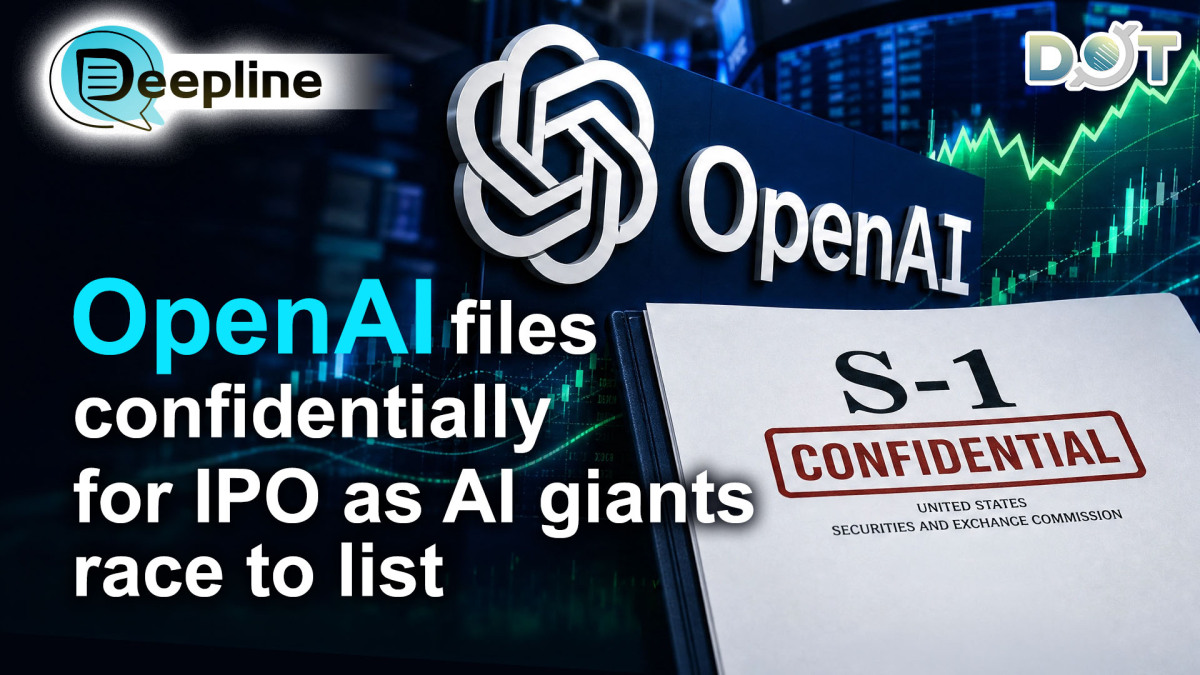
On June 8 local time, OpenAI released a statement on its official website, formally confirming that it has confidentially submitted a Form S-1 registration statement to the US Securities and Exchange Commission. The AI giant, valued at over US$850 billion, has finally taken a substantial step toward the public market.
This not only signals that Wall Street may witness one of the largest tech IPOs in history, but also intensifies the capital race among Sam Altman, his archrival Elon Musk, and the fast-rising Anthropic CEO Dario Amodei.
Typically, confidentially filing a registration statement is an operation conducted under strict secrecy. Sam Altman had no intention of passively waiting for media leaks. OpenAI stated outright in its announcement: "We recently submitted a confidential S-1. We expect it to leak, so we're just announcing it."
However, OpenAI also tempered overly high expectations in its official press release, making it clear that no IPO timing has been decided.
"We have not decided on timing yet; it may be a while because there are things we want to do that are likely easier as a private company. But it's a complicated set of tradeoffs, and this gives us the option to go public sooner if that ends up being best."
This statement demonstrates both a willingness to embrace capital markets and a desire to preserve flexibility between an unfinished mission and immense financial interests.
OpenAI's Chief Financial Officer, Sarah Friar, said in April that for a company of OpenAI's scale, it is "good hygiene" to "look, feel, and act" like a public company, but she declined to comment on a specific timeline at the time.
According to people familiar with the matter, OpenAI also plans to conduct a tender offer, allowing employees to sell shares based on the latest post-money valuation of US$852 billion, in order to ease near-term liquidity pressures.
OpenAI's move essentially mirrors the path taken by its fierce rival, Anthropic.
On June 1, Anthropic had just announced its confidential IPO filing and, with a US$965 billion valuation, overtook OpenAI's US$852 billion valuation from late March in the private market for the first time.
Meanwhile, Elon Musk's SpaceX has already begun IPO roadshows and is scheduled to go public as early as June 12. In its IPO filing, OpenAI, Anthropic, and Google are all listed as key competitors in the AI sector.
The three companies are likely to account for several of the largest IPOs in human history.
Jeff Bernstein, capital markets advisor at the consulting firm Riveron, pointed out that the essence of this race is a battle for capital. He suggested that if one lets a competitor go first, that competitor will take away a large amount of available IPO capital.
However, going public first does not guarantee better returns.
Take Lyft and Uber as examples. Both companies confidentially filed in December 2018. Lyft went public first in March 2019, followed by Uber two months later. But one year after listing, Lyft's stock price had fallen about 66% from its offering price, while Uber had dropped only about 30% over the same period.
According to officially disclosed data, within one year of ChatGPT's release, the company's annual revenue exceeded US$1 billion. By the end of 2024, that figure had become US$1 billion in quarterly revenue.
Currently, OpenAI's monthly revenue has reached US$2 billion. The company even boasts that its revenue growth rate is four times faster than that of internet and mobile-era giants like Alphabet and Meta during their comparable early stages.
On the user front, ChatGPT's weekly active users have surpassed 900 million, and the number of subscribers exceeds 50 million. Its monthly web visits and mobile sessions are six times those of the next closest AI application. Its share of total time spent is four times that of competitors, and it also accounts for four times the total of all other AI applications combined. Search feature usage has nearly tripled in one year, and an advertising pilot program achieved over US$100 million in annual recurring revenue in less than six weeks.
The enterprise market now contributes more than 40% of the company's revenue and is expected to be on par with the consumer business by the end of 2026.
Driven by GPT-5.4, the usage rate of agentic workflows is growing explosively, with API processing exceeding 15 billion tokens per minute. Codex's weekly active users have surpassed 2 million, a fivefold increase over the past three months, with month-over-month growth remaining above 70%.
But behind the impressive revenue lies a cash-burning black hole that would be difficult for any public company to ignore.
OpenAI has raised over US$180 billion, yet its cash burn is staggering as it secures computing power and builds infrastructure to train and run AI models. Projections shared with investors show that, based on committed spending of hundreds of billions of dollars through 2030, its burn rate would outpace any other public company in history.
On the same day the S-1 was submitted, Altman and current OpenAI Chief Scientist Jakub Pachocki co-authored a lengthy article titled "Built to benefit everyone: our plan," systematically laying out the company's vision for entering its "third phase."
The article compares the spread of AI to the arrival of electricity in rural America in the 1920s. Electricity did not transform every home overnight, but as it spread, daily life fundamentally changed: nights were extended by light, appliances eased heavy labor, and radios brought distant voices into living rooms. By the end of the 20th century, average human life expectancy had increased by about 23 years, and inflation-adjusted average income had grown by about 50%—achievements largely attributable to electrification and related technological advances.
"This is happening again with AI," they wrote.
But they quickly added that such a future will not arrive automatically. "Transformative technologies can concentrate power, or they can broaden it. They can make life easier for a few, or they can expand opportunity for many."
The article divides OpenAI's history into three phases.
The first phase was about "doing research toward AGI." The second phase began when research "became relevant to the real world," as the company became a "product company," deploying systems and learning how people use them.
"Now we are entering the third phase. The economy is beginning to reshape around AI. The central question now is how to make advanced AI abundant, affordable, safe, useful, and easy enough for every person and organization to benefit from it."
The article outlines three current main goals: building an automated AI researcher—internally believed to be capable of handling a significant portion of research jointly with human researchers by March 2028; accelerating economic development while ensuring benefits are widely shared; and providing a personal AGI for every person on Earth.
Just as OpenAI filed its IPO paperwork, the company is also preparing product changes.
On June 7, the Financial Times reported that OpenAI is undertaking a major revamp of ChatGPT, planning to fully integrate the coding tool Codex into the chat interface and connect with external partner applications, reshaping it into a super-entry point capable of performing multiple tasks.
But before the product can be fully realized, the more immediate test remains the public market.
OpenAI, SpaceX, and Anthropic are all seeking to go public at enormous valuations. Together, the three companies could raise up to hundreds of billions of dollars from public markets. Bankers have told them that whoever goes public first will define this emerging industry and will be able to tap first into the vast pool of capital eager to invest in AI companies.
With the noise of litigation against Musk just fading, Altman is leading OpenAI toward a future he himself calls a "complex set of trade-offs."
Investor reaction to SpaceX's mega-IPO, the overall health of the global economy, the company's own financial strength, and unpredictable revenue growth alongside soaring computing costs will all affect the final IPO timeline for OpenAI.
The answer may lie in the as-yet-unpublicized prospectus itself.
(Source: 36kr)
Related News:
Deepline | Growth with pain: Can Baidu's AI conviction outrun its legacy?




Comment