






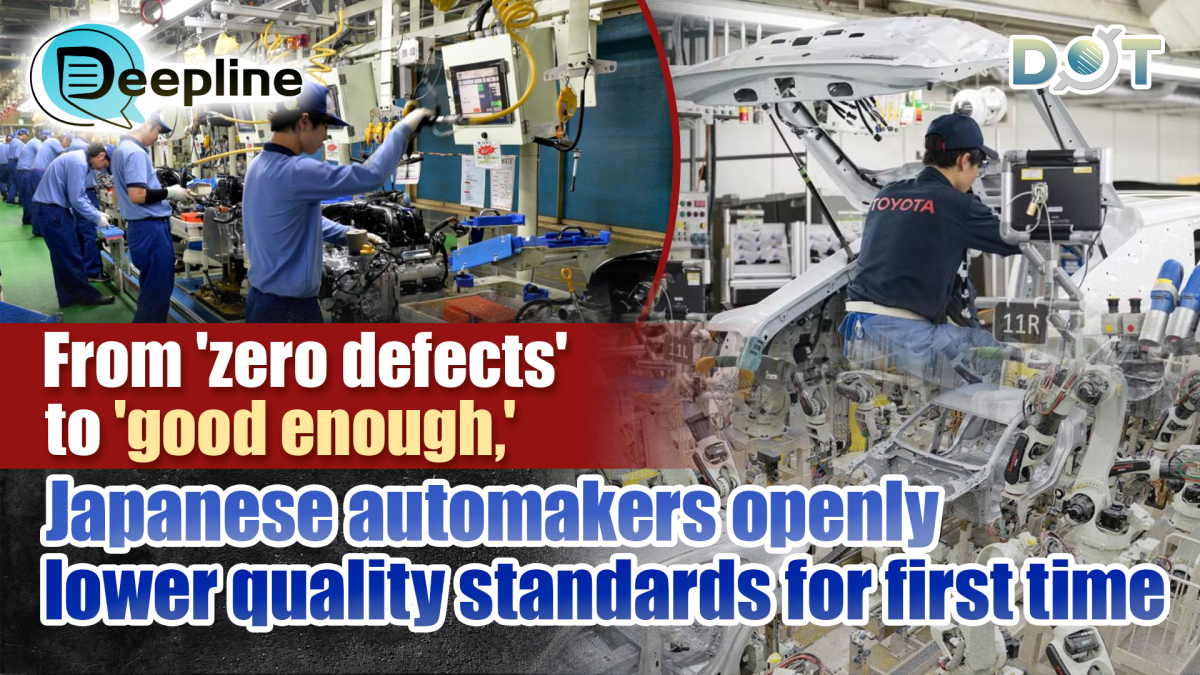
Recently, Japanese automakers (including Toyota) and auto parts suppliers have been working on a unified policy for determining defects in components. In simple terms, they have lowered the previous "quality bottom line" under the new rule; minor flaws that do not affect functionality and are not easily noticeable after assembly will no longer be considered defective. Such parts can be directly used in production, and the new standard is expected to be gradually applied to various components by 2026.
To sum it up in one sentence: it lowered the quality bar.
This new rule was jointly finalized by the Japan Automobile Manufacturers Association (JAMA), which includes eight major passenger carmakers such as Toyota and Honda, as well as commercial vehicle manufacturers, and the Japan Auto Parts Industries Association (JAPIA), which represents over 450 parts suppliers across Japan.
In effect, this means the entire Japanese automotive supply chain is adopting a unified change in quality inspection standards, marking the first time Japan's auto industry has openly and broadly relaxed its criteria for parts defects.
In the past, Japanese automakers built their reputation on "zero defects and stringent quality control," and their demands on parts suppliers were extremely strict. Even a tiny black spot, a fine scratch, or a minor color difference on a part's surface would typically lead suppliers to scrap the part themselves, or have it rejected by the automaker during inspection. Such parts were deemed defective and discarded, even if they functioned perfectly.
A supplier to a Japanese automaker once revealed that for plastic dashboard components, if a black spot larger than 0.3 mm in diameter was detected under strong light, the entire batch would be returned. A tiny burr on a door seal, even if it did not affect sealing performance, would also be rejected.
This extremely rigorous quality control helped Japanese cars build a global reputation for "flawless craftsmanship," which became a major source of brand premium.
Now, however, that iron rule has been broken.
Under the new rule, as long as a part meets national standards and has no substantial issues with function or appearance, minor imperfections are acceptable for direct installation. Parts with harmless burrs or flashes will be approved. Even headlamp components with small bubbles can be used, provided functionality and appearance remain intact.
Parts that previously required rework can now be directly assembled if they have no significant functional impact.
Of course, there will be a clear line: critical functional components related to braking, powertrain, body structure, and safety protection will see no reduction in standards. The relaxation applies only to non-core, non-structural appearance defects that do not affect function and are hidden from view after assembly.
The effects of lowering the standard are immediate. JAMA has calculated that for plastic connectors used in automotive electronics, about 60% of defect rejections are due to black spots. Under the new standard, Japan could reduce the number of scrapped parts by 10,000 per month, significantly cut ineffective inspection labor hours, and save on both labor and material costs.
Toyota has already set up a dedicated department to evaluate parts jointly with suppliers according to the unified standard, and regularly holds joint review meetings with Honda, Nissan, and other Japanese automakers and parts suppliers.
For consumers, the changes under the new standard may not be noticeable; minor flaws do not affect performance and are hard to detect. But frankly speaking, parts that would have been scrapped in the past can now legitimately enter the market. The "Japan precision" gold standard has indeed begun to show cracks.
Why the sudden loosening of quality standards?
The most direct trigger is the intensifying supply chain crisis caused by the Middle East geopolitical conflict.
Currently, about 70% of Japanese automakers' processed aluminum and naphtha are imported from the Middle East. With the ongoing tensions in the Strait of Hormuz, procurement has become difficult. Meanwhile, raw material prices for plastics and interior materials have soared, deliveries have become intermittent, and the risk of supply disruption has increased.
With parts supply already tight, sticking to the old, stringent standards would waste large amounts of materials and could even force factories to halt production due to missing parts. Toyota and Mazda have already been forced to cut production of models destined exclusively for the Middle East.
Koji Sato, who recently stepped down as CEO of Toyota, once said at a supplier conference, "Unless things change, we will not survive."
For decades, much of the brand premium of Japanese cars rested on the reputation of "precision and flawlessness." But that reputation came at a high cost. Now, when the cost becomes so high that companies "cannot survive," the priority is to stay alive. In other words, relaxing standards is a reluctant move to secure supply.
In fact, some Japanese automakers have already done this before due to supply chain crises. As early as 2021, because of the pandemic, Toyota announced that it was "willing to use worn or flawed parts from suppliers, as long as vehicle performance and safety are not affected."
For one automaker to do that might be seen as an isolated corporate decision. But now that the entire Japanese auto industry is lowering standards, the deeper reason may be that Japanese automakers are truly backed into a corner.
On one hand, Chinese parts suppliers, leveraging domestic raw material advantages and low costs, are rapidly eating into the market share of Japanese suppliers. Japanese automakers are also losing ground overseas.
Recently, South Korea's Yonhap News reported that in the April import passenger car market in South Korea, Chinese-made cars outsold Japanese cars for the first time, ranking among the top three. This breakthrough was achieved by BYD alone, with sales surpassing the combined total of Lexus, Toyota, and Honda in South Korea.
On the other hand, according to the latest report from a Japanese database, listed Japanese auto parts companies saw net profit drop 35% in fiscal 2025, while labor costs rose 20% over the past decade, putting them at a significant disadvantage in cost competitiveness. In fiscal 2024, bankruptcies among Japanese auto parts manufacturers reached 32, a 33.3% increase year-on-year — the highest in a decade.
Tight raw material supply is only the surface reason. Under multiple pressures, Japanese automakers are forced to find savings and reduce waste in the quality inspection process, and cutting manufacturing costs is the underlying driver.
Since the 1980s, "Made in Japan" has been a global symbol of high quality and an important source of brand premium.
Previously, Toyota's "lean production" system has become a classic case study in business schools worldwide. But now, Toyota is leading the way in actively "relaxing" quality standards. Even though minor flaws do not affect performance and are hard to notice, in the long run, the once-unshakable perception that "Japanese craftsmanship is flawless" will inevitably be affected. Once the brand's quality bottom line begins to slip, it will rely entirely on automakers' self-discipline to maintain boundaries amid rising raw material costs and profit pressures.
In fact, even without considering this unified relaxation of quality standards, the "Made in Japan" of today is no longer a myth. In recent years, Japanese automakers have been hit by a series of scandals involving falsified crash test, emissions, and quality inspection data. The practice of promoting "high standards" while shipping "low-standard" products is no longer news.
In June 2024, Japan's Ministry of Land, Infrastructure, Transport and Tourism reported that five automakers, including Toyota, Honda, and Mazda, had committed irregularities in vehicle certification, such as tampering with crash test data and cheating on engine power tests, involving 38 models and about 5.18 million vehicles.
That same year, Daihatsu admitted to manipulating side-crash safety tests on 88,000 small cars. Toyota later found around 174 irregularities across more than 60 models.
At the end of 2025, Mitsubishi Electric was exposed for data fabrication spanning 35 years. Kawasaki Heavy Industries admitted to falsifying test data for ship engines. And Japan Steel Works' Hokkaido subsidiary had a 24-year history of quality inspection fraud, with a total of 449 violations.
More recently, Nidec, a major Japanese electric motor manufacturer, admitted to over 200 billion yen in accounting fraud and was also found to have engaged in large-scale quality violations including faking test data, falsely labeling product origins, and using false reports to pass inspections.
After each scandal, executives hold press conferences and bow in apology, but consumer trust is hard to restore.
"Made in Japan," already on a downward slope in consumer trust, is now openly and collectively lowering quality standards. Even if this can be seen as a reasonable optimization to eliminate "redundant quality" and a prudent survival strategy, for an industry that once embedded a "quality myth" into its DNA, once a crack appears, it is very difficult to close.
(Source: Super-EV Lab)
Related News:
Deepline | Trust rally: How Geely conquers Mexico's roads and skeptical consumers
Deepline | Familiar land, unfamiliar race: Tesla's China story shows evolution of local automakers




Comment