






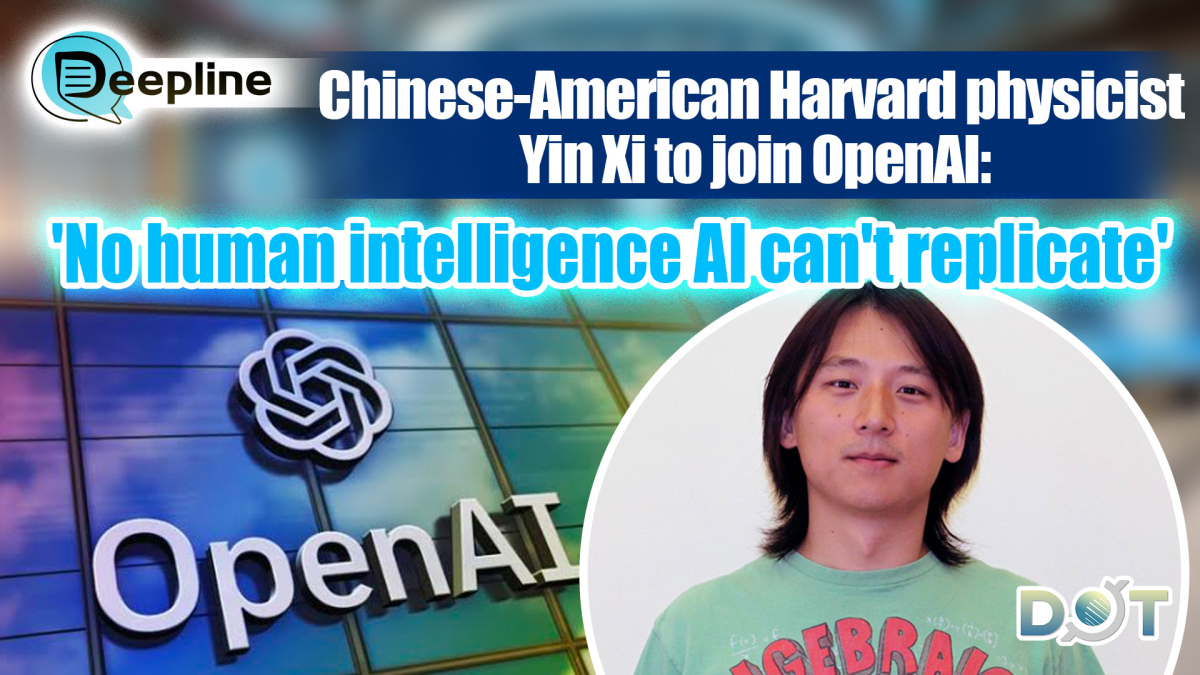
A Harvard professor is going to OpenAI?
According to a whistleblower on social media X, Yin Xi, a Harvard professor of physics, has left academia and crossed over to join OpenAI.
Who is Yin? As a string theorist, he is the youngest tenured Chinese-American professor in Harvard's history and reached the highest rung of academia at just 31. His departure is far more than a simple personal career choice.
It looks more like a historic shift in the center of gravity of scientific research: an era is quietly drawing to a close.
As the whistleblower put it, the center and future of scientific research are rapidly shifting from traditional university laboratories to tech giants armed with top-tier computing power.
Born in 1983, Yin's life story has been marked by the word "genius" from the very beginning. He was born into a highly educated family in Zhuzhou, Hunan Province; both his parents graduated from China University of Geosciences.
Yin's innate intellectual talent showed its edge early. At the age of nine and a half, he was admitted to Beijing No. 8 Middle School's gifted class, the well-known "children's class." What took others six years of middle and high school, he fast‑forwarded through in just four years. In 1996, before turning 13, Yin entered the University of Science and Technology of China's Special Class for the Gifted Young (Class of 1996), becoming the youngest student on campus.
Even more breathtaking than his talent was his extreme self‑discipline. Throughout his five‑year undergraduate program, he scored above 90 in every course and won scholarships effortlessly.
Starting in his sophomore year, he would go to the classroom at 6:30 every morning to save a seat; for three full years, he was nearly always the first person to walk through the door for each class. In 2001, at 18, he graduated with his bachelor's degree. Tsinghua University offered him a spot, but Yin was already holding an acceptance letter from Harvard.
What followed seemed almost superhuman.
At 22, under the legendary physicist Andrew Strominger, he earned his Ph.D. in physics from Harvard. Strominger recalled that a topic which would take an average student two years to tackle, Yin completed in a single semester.
To keep him, Harvard broke a tradition that had stood for over 300 years: that its own Ph.D. graduates could not stay on as postdocs. In 2008, at 25, Yin became an assistant professor in Harvard's Department of Physics, then was promoted to associate professor. In 2015, at 31, he was officially made a tenured full professor at Harvard — the youngest tenured Chinese-American professor in the university's history.
In the realm of academic honors, Yin's name has nearly swept the board.
The 2013 Sloan Research Fellowship, the 2017 Breakthrough Prize in Fundamental Physics (New Horizons in Physics Prize), the NSF CAREER Award, the Simons Investigator award -- all these top‑tier accolades that countless researchers covet have been scooped up by him. He is also the leading principal investigator of the Simons Collaboration on the Nonperturbative Bootstrap, widely recognized as one of the young generation most likely to win a Nobel Prize in theoretical physics.
Yin's deep expertise lies in the toughest bone of fundamental science: string theory.
Academia generally views it as the best hope for describing quantum gravity and moving toward a "Theory of Everything." Simply put, he stands at the very pinnacle of physics, doing the most brain‑intensive, hard‑core research on Earth.
And yet, this is the person now saying: AI can do this, and much faster than humans!
Not long ago, Harvard's student newspaper, The Harvard Crimson, ran an in‑depth feature on how AI is disrupting theoretical physics research.
In that article, Yin said that for him, AI is already far more than just an efficiency tool.
"AI gives me 100x speedup. Weeks of output would take me 10 years."
Ten years' worth of work, done in weeks. That means an entire career of a top physicist condensed into a few winter or summer breaks.
Yin's colleague, Matthew Schwartz, took this to the extreme. In January of this year, Schwartz published a paper in which all calculations, numerical analyses, and writing were done by Claude under human supervision.
On this, Yin made a remark that shook his peers, "I don't believe there's any human intellectual ability AI cannot replicate."
A man standing atop the human intelligence pyramid has personally torn down the sign that says "human intelligence is irreplaceable." In the AI era, there may be a better architecture. Someone who is ready to upend the old system will naturally go where the greatest computing power is available.
If the rumor of Yin's heading for OpenAI is true, what does a string-theory heavyweight mean for an AI company?
First and foremost, the most rigorous theoretical validation. OpenAI is striving for AGI, and AGI cannot avoid a core question: Is there any limit to AI's reasoning ability?
String theory and quantum gravity are among the most mathematically complex and longest‑chain reasoning domains in human knowledge. If AI can genuinely produce new knowledge in this field, that would be a true scientific breakthrough.
Second, training data and evaluation systems. The rarest value that top theoretical physics researchers offer is not the ability to use AI, but the ability to judge whether AI is right. Mistakes in quantum gravity are extremely hard to detect because there are no direct experimental tests. Only an expert like Yin can look at a model's derivation which sounds correct and immediately spot where it has gone wrong.
This high‑quality human supervision is currently the key bottleneck for AI to break through the ceiling of theoretical physics.
Third, the redesign of the scientific research paradigm. Yin has long believed that the paper publication system is a marketplace, not a grand edifice.
If he joins OpenAI, he will likely be directly involved in designing a new generation of AI tools for scientific research, completely re‑engineering how knowledge is produced, validated, and disseminated. This direction is exactly what OpenAI for Science most wants to achieve.
In short, what Yin brings to OpenAI is a key that can unlock the highest‑difficulty dungeon of theoretical physics.
It took humanity three hundred years to go from Newton's apple to string theory's eleven dimensions, and Yin says what AI accomplishes in a few weeks would take him ten years. The real weight of that statement lies not in "speed" but in "direction."
When the person at the very apex of human intelligence admits that no kind of human intellect is beyond AI's reach, and bets the second half of his life on computing power, he is gambling on an entirely new kind of cognitive subject.
In the past, humans used their brains to approach a Theory of Everything. Next, it may be an intelligence far beyond human that, for the first time, finishes writing the deepest equations of the universe on behalf of humanity.
String theory is the longest‑chain, most brain‑intensive dungeon there is. If an ASI (artificial superintelligence) can produce new knowledge that even physicists cannot verify, it will mean that the ceiling on intelligence is no longer set by humans.
(With input from 36kr)
Related News:
Deepline | Apple to overhaul Siri at WWDC 2026, opening iOS to Gemini and Claude




Comment