






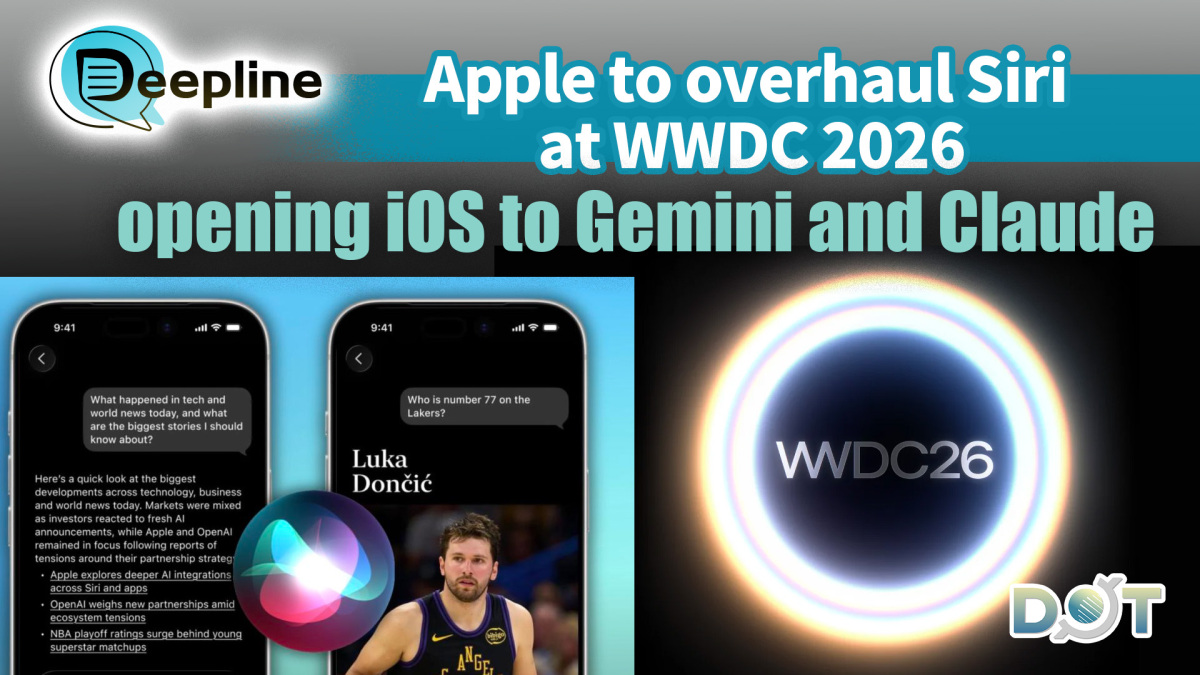
Apple's WWDC is just around the corner. For Apple, what matters most isn't just the farewell speech of Tim Cook, but the need to answer the world's expectations for "Apple AI."
Apple must confront its most embarrassing question from the past three years: Why does the world's most expensive smartphone come with the dumbest AI assistant?
On May 28, local time, ten days before the event, the media leaked the answer.
Reportedly, the upcoming Siri overhaul is the largest since Siri first debuted with the iPhone 4S in 2011. The new interface features a dark color scheme, is rebuilt around a chatbot interaction paradigm, and is deeply integrated with the Dynamic Island.
More crucially, Apple will allow users to "plug" Google Gemini and Anthropic's Claude directly into the Siri experience—turning Siri into a distribution platform for AI models.
Everyone is curious: what will an AI-powered Siri actually look like?
According to Bloomberg, the new Siri has several core changes. Taken together, they reveal Apple's complete strategy.
The most obvious is the complete redesign of the interface. A chatbot-style interface, dark color scheme, and Dynamic Island integration—Siri is evolving from a pop-up layer into a standalone app-like entry point. This isn't just a visual upgrade; it signals that Apple wants users to treat Siri as a tool they actively use, rather than a voice command they occasionally summon.
Next is conversation persistence. For years, one of the biggest pain points of talking to Siri has been its memory deficit—it doesn't remember context. Each wake-up starts from zero, with no memory or continuity. The new Siri, reportedly, will fix this issue.
Still, the most noteworthy change is the "Extensions" framework, allowing third-party AI models to be integrated into Siri.
The deeper meaning here is that Apple is no longer treating "building the best AI model" as its only path forward. Instead, it's repositioning iOS as "the best platform for AI models to compete on." Just as the App Store doesn't require Apple to develop every app itself, the new Siri ecosystem doesn't need Apple to beat everyone on model capability. It simply needs to bring in various models and retain users through system-level integration.
To understand the weight of this overhaul, we first need to grasp how "passive" Apple has been in recent years.
In 2023, ChatGPT burst onto the scene, redefining what "conversational AI" means. In 2024, Google embedded Gemini into Android, and Samsung turned AI features into a selling point.
The entire industry has been sprinting forward, but what has Apple's Siri been doing? Still misinterpreting user commands, still turning "set an alarm for 8 am tomorrow" into "open the alarm app."
Of course, Apple hasn't just sat idly by. At WWDC 2024, Apple Intelligence made a grand entrance, promising a host of deeply integrated AI features. But in reality, many of those features have either been delayed, restricted to specific regions, or delivered an experience far from what was shown on stage.
"This doesn't feel like a completed comeback. It feels like Apple has finally arrived at the AI race, only to realize it's still in mid‑development," one Apple analyst put it bluntly.
With three years of accumulated lag, Apple desperately needs a true turnaround.
Two days ago, Apple quietly launched the subdomain genai.apple.com. This small move caused quite a stir in the tech community—many interpret it as a signal that Apple is laying the final public groundwork for its "AI transformation" at this WWDC.
But there's a paradox that many media outlets are already discussing.
One of Apple's most important long‑standing moats is privacy. "Your data is processed only on your device" is Apple's core promise to users, and the reason behind the Private Cloud Compute architecture. Back in the day, some Apple users had to resort to complicated "jailbreak" methods to install game mods or software from other sources, but most still trusted and agreed with the "barriers" Apple set. After all, in the early days of smartphones, the more permissive Android phones often mysteriously got infected.
Now, to make Siri more powerful, Apple is bringing in Google's infrastructure to handle some AI queries. This isn't a technical problem; it's a trust problem.
When Apple personally breaks the red line of "using only our own computing infrastructure," its privacy promise to users is no longer absolute. Of course, users can choose not to use Google Gemini integration, but "can choose not to use" and "never touch by default" are two completely different things. How Apple explains this shift to users at the keynote will be one of the most noteworthy details on June 8.
Moreover, there's an even more fundamental question. A user on Reddit asked a sharp question: If the Claude inside Siri feels the same as using Claude directly, why would I use the wrapper version?
Apple must provide a compelling answer, and so far, there's only one candidate: system‑level integration. An AI that can access contacts, calendars, photos, and health data offers a completely different experience from an isolated AI. This is Apple's last and most important bargaining chip.
There's been plenty of criticism of Apple's AI pace, but an alternative logic is also circulating—maybe Apple remains slow because it's waiting for others to step on any landmines first.
OpenAI, Google, and Meta have invested hundreds of billions of dollars in data centers, chips, and model training over the past two years, and concerns about an AI bubble have grown. In contrast, Apple's strategy is to "strike after the enemy has struck": not rushing to build the "strongest model," but after confirming the track is stable, using its best‑in‑class system integration capability to catch up from behind.
To some extent, the blueprint for iOS 27 is exactly about executing this logic. Instead of competing on model capability, Apple is bringing in Gemini and Claude, and then leveraging capabilities that Android cannot replicate—Dynamic Island, personal data permissions, and on‑device processing—to build a differentiated moat.
This isn't a desperate laggard's pursuit; it's a calculated bet. The bet is that the endgame of AI isn't about whose model is strongest, but about whose system puts models to the most seamless use.
On June 8, Apple will give its complete answer. Whether Siri can truly win over users already accustomed to ChatGPT and Gemini will be the real test of this high‑stakes gamble.
Fifteen years later, Siri owes users an answer.
(With input from 36kr)
Related News:
Deepline | Samsung faces potentially largest strike in history as labor talks collapse
Deepline | Apple announces new CEO: Post-Cook era begins, but Cook isn't leaving




Comment