






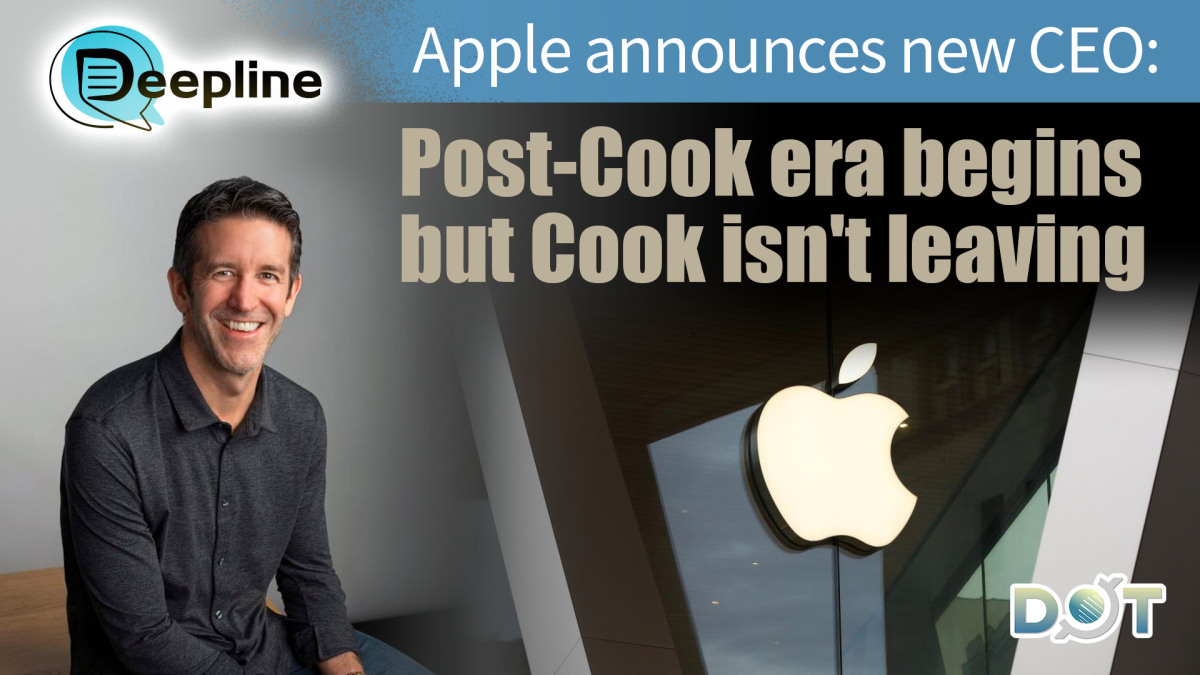
First, let's be clear about one thing: Apple has indeed changed its leadership, but Tim Cook is not saying goodbye.
On April 21, 2026, Apple announced that Cook will transition to the role of Executive Chairman on Sept 1, while John Ternus, Senior Vice President of Hardware Engineering, will take over as CEO.
On the same day, another major development occurred: Johny Srouji, Senior Vice President of Hardware Technologies, was named Apple's Chief Hardware Officer.
Apple is now pivoting the entire company back toward hardware systems. The CEO role goes to the head of hardware engineering, the Chief Hardware Officer role to the head of chips and underlying technologies. Cook steps back to the board, a product engineer steps into the spotlight, and a chip veteran holds down the foundation.
Cook joined Apple in 1998 and succeeded Steve Jobs as CEO in 2011.
At the time, people believed Jobs was the soul of Apple. Cook was neither a hardware engineer nor a software engineer, so Wall Street was largely bearish on Apple.
However, according to official disclosures from Apple, since becoming CEO in 2011, Cook has overseen the launch of numerous products and services, creating new product lines such as the Apple Watch, AirPods, and Apple Vision Pro, and rolling out a range of services from iCloud and Apple Pay to Apple TV and Apple Music.
In terms of specific numbers, the company's market capitalization grew from approximately US$350 billion to US$4 trillion. Annual revenue increased from US$108 billion in fiscal year 2011 to over US$416 billion in fiscal year 2025. The active installed base of devices exceeds 2.5 billion, and the services business has scaled to over US$100 billion.
The Apple of the Steve Jobs era excelled at turning product launches into cultural events. The Apple of the Tim Cook era turned the iPhone into a cash flow machine powered by supply chains, service subscriptions, in-house chip design, retail networks, and regulatory negotiations. Jobs was great at creating a blockbuster new iPhone, while Cook is great at making Apple increasingly difficult to replace.
Once the hardware is sold, Cook keeps users inside iCloud, the App Store, Apple Pay, and Apple's broader suite of services.
We have to admit that the Cook era also had its share of regrets: AI, agents, and where Apple's next growth will come from.
The Vision Pro did not quickly replicate the iPhone's magic. The Apple car project was shelved. Cook has left his share of unfinished business at Apple.
That said, Cook moving to Executive Chairman is not an exit. Apple has stated that it will continue to assist with certain aspects of the company's work, including engaging with policymakers around the world.
This arrangement is very Cook.
He keeps the most external, most political part of the job for himself, while leaving the next big bet on products and technology to his successor.
New CEO Ternus joined Apple's product design team in 2001, worked his way up from a rank-and-file engineer, became Vice President of Hardware Engineering in 2013, and was promoted to Senior Vice President of Hardware Engineering and joined the executive team in 2021.
During his 25 years at Apple, he has been involved in the development of nearly every major product line, from the iPad and AirPods to successive generations of the iPhone, Mac, and Apple Watch. His fingerprints are on all the hardware devices we know so well.
Ternus's contributions go beyond the products themselves. According to official Apple reports, he has introduced new technologies in reliability and durability, making Apple products more robust. In terms of environmental protection and sustainability, he has driven the use of recycled aluminum, the application of 3D-printed titanium in the Apple Watch Ultra 3, and improved repairability to extend product lifespan. The recently launched MacBook Neo, iPhone 17 series, and iPhone Air are also results of his team's work.
Being low‑key and pragmatic, Ternus rarely appears in public, and even when he does at launch events, he typically only briefly discusses technical details.
Interestingly, internal assessments of Ternus at Apple are remarkably consistent. Everyone describes him as even‑tempered, detail‑oriented, and deeply knowledgeable about the supply chain. At age 50, Ternus takes the helm at the same age Cook was when he succeeded Jobs.
Ternus's appointment as CEO is the clear headline, while Srouji's promotion to Chief Hardware Officer is the quieter but equally significant move.
Srouji is also not widely known outside Apple. Inside the company, he represents chips, sensors, displays, cameras, batteries, modems, and all the underlying technologies that turn the "Apple experience" into engineering reality.
In fact, Srouji has built the world's most powerful and innovative team of chip and technology engineers. Under his leadership, Apple has achieved numerous leading breakthroughs in custom silicon and hardware technology, spanning Apple's chips, batteries, cameras, storage controllers, sensors, and displays across the entire product line.
According to Apple's announcement, Srouji will expand his responsibilities in this promotion to lead both Hardware Engineering and Hardware Technologies. In other words, Apple is further integrating product hardware engineering with core technologies.
This is not an ordinary promotion.
Srouji joined Apple in 2008 to lead the development of the A4, Apple's first in‑house system‑on‑a‑chip. Since then, the A‑series chips have powered the performance narrative of the iPhone and iPad, while the M‑series chips have enabled the Mac's transition from Intel to Apple's own architecture. A big part of why Apple can create seamless integration across phones, computers, headphones, and watches that is hard for others to replicate is its sustained effort to bring key technology control back in‑house.
That control will become even more critical in the era of AI.
Over the past decade, Apple's most important battle has been to sell hardware to as many people as possible and keep them inside the ecosystem.
What about the future?
Cook has taken Apple to a US$4 trillion market valuation, but clearly, the cost of maintaining that is high. Users expect Apple to deliver on AI, while also making its products thinner, lighter, and more power‑efficient.
Therefore, the real signal from this leadership change is neither "Cook is leaving" nor "new sheriff in town" but rather that Apple no longer wants to face the future using only Cook‑style steady operations. It is handing the CEO role to hardware engineer Ternus, placing the hardware foundation in the hands of chip veteran Srouji, and keeping Cook on the board to engage with the outside world.
Related News:
Deepline | Crossroads in front of DeepSeek's Liang Wenfeng: Talent, options, and becoming 'normal'
Deepline | The end of 'anonymous AI'? Anthropic enforces real-name verification, hitting VPN users




Comment