






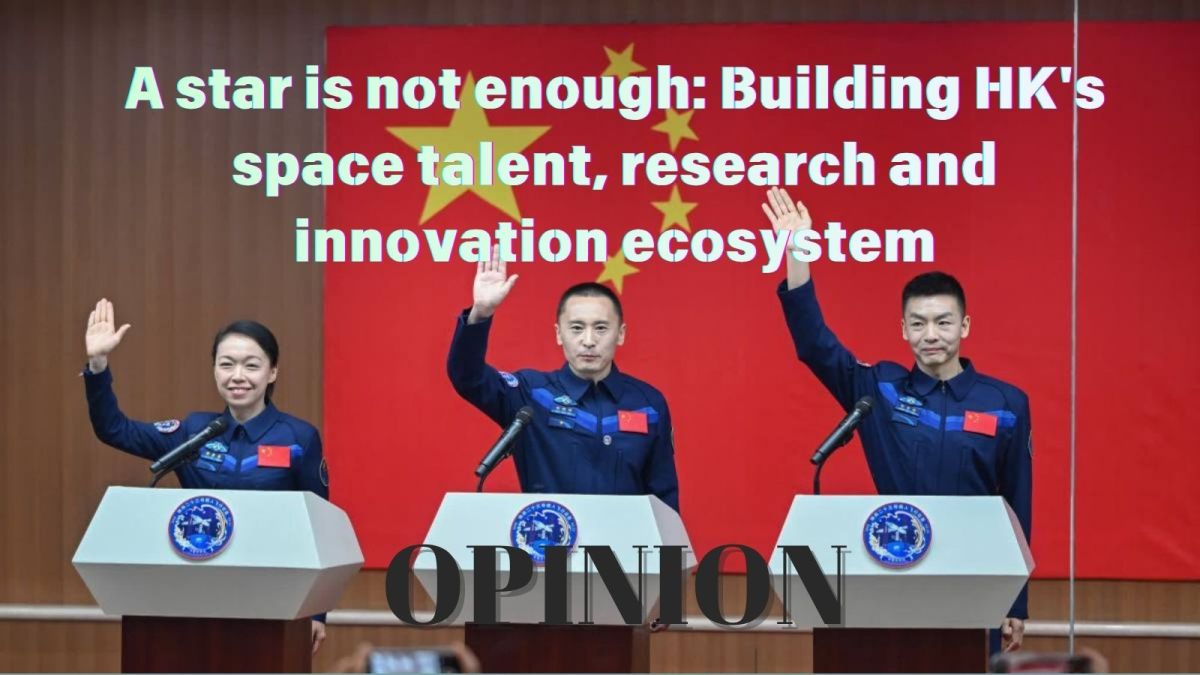
As the Shenzhou-23 crewed mission gets underway, Hong Kong is witnessing a genuinely historic moment: its first astronaut, Lai Ka-ying—widely described as "the first Hong Kong-born astronaut" and also China's first female payload specialist—is set to embark on a six-month journey in space. She will take part in China's space station mission and carry out frontline scientific work in an extreme environment.
This matters for more than symbolic reasons. It marks an important milestone for Hong Kong's innovation and technology ambitions, and it also reflects a clear message: the country is willing to place trust in Hong Kong's scientific talent and its younger generation. But the real question is what Hong Kong does next—because historic moments, if left to applause alone, can quickly become one-off memories.
The most meaningful way to read this moment is not simply as "someone from Hong Kong made it to space," but as evidence that Hong Kong can contribute real value to national missions—through research capacity, engineering capabilities, and institutions that can work with partners across boundaries.
In fact, Hong Kong has not been a bystander to the national space program. In this mission, for example, Lai's space operations include the MUSICO ("Tianyun") camera, led by a team at the Hong Kong University of Science and Technology, designed to support emissions monitoring and carbon‑reduction goals. Lingnan University also contributes a carbon‑emissions source database to help enable targeted greenhouse‑gas monitoring from space. Beyond these, Hong Kong universities have participated in different capacities in major national exploration programs, from deep‑space instrumentation to space‑based experiments and astronaut health and safety support.
The takeaway is straightforward: space is not a distant romance—it is a test of a city's "high‑precision, cutting‑edge" capabilities. Optics, materials, sensors, algorithms, reliability engineering, standards, and complex collaboration all have to work together. If Hong Kong wants this milestone to matter in the long run, it must treat it as a starting point for building repeatable capability, not a finishing line.
Hong Kong's Secretary for Innovation, Technology, and Industry, Sun Dong, has argued that the city must continue to nurture a large cohort of young people who love aerospace and are willing to fight for it—and he has expressed confidence that Hong Kong will see its second and third astronauts in the not-too-distant future. At the same time, China is pushing ahead with its goal of achieving a first crewed lunar landing before 2030, a direction that will demand a large pool of top‑tier talent.
For Hong Kong, this is both an opportunity and a challenge. The city must act on three fronts—basic education, university research policy, and the innovation ecosystem—to build a durable talent reserve and keep high‑end talent in place.
1) Make aerospace education part of mainstream schooling
Talent does not appear at the last minute; it is cultivated over years. Hong Kong should integrate aerospace topics more systematically into STEAM and cross-disciplinary learning so that curiosity becomes competence. Lai's story can be a powerful catalyst, but the city should go further: develop curriculum resources and multimedia learning packages rooted in China's aerospace development, and make them flexible for schools to adopt. The goal is not propaganda or spectacle, but a genuine, sustained pipeline of students who see aerospace as a realistic path—and have the skills to pursue it.
2) Strengthen universities' "mission-driven" research and deep collaboration
If Hong Kong wants to contribute meaningfully to national missions, universities must be enabled—and incentivized—to pursue longer-horizon, mission-driven research that bridges scientific discovery and engineering delivery. This requires policy support, stable resources, and mechanisms that make deeper collaboration with national research teams easier and more productive.
Hong Kong's universities should position themselves as both talent engines and frontier research hubs: leading the development of world‑class space science instruments, supporting deep‑space missions with critical systems and technologies, participating in space‑based experiments that validate research outcomes in real conditions, and making full use of platforms such as InnoHK to take on major national projects.
3) Build an ecosystem that can keep high-end aerospace talent
Training and attracting "high-precision" talent is only part of the story. Retaining that talent depends on whether Hong Kong can offer a vibrant ecosystem—research institutes, engineering roles, startups, procurement pathways, test and validation facilities, and credible career trajectories.
Recent contributions from InnoHK-backed centers working on national lunar exploration missions show that Hong Kong can create institutions aligned with major national tasks. The city should continue to support such centers, expand cross‑disciplinary and cross‑region collaboration, and strengthen Hong Kong's capacity to serve national strategic technology missions in a sustained way.
For many students in Hong Kong, Lai Ka‑ying may once have been an ordinary girl staring at the stars from a classroom window. Now she has shown that Hong Kong people can reach space. But Hong Kong's responsibility is larger than celebrating its first astronaut. The city must build the structures that produce more aerospace talent, deliver more world‑class instruments, and translate participation in space missions into long‑term innovation strength.
A nation's journey is long. Hong Kong's best answer is practical work—turning today's liftoff into tomorrow's system.
Related News:
Launch countdown! Shenzhou-23 crew send-off ceremony to be held at 7:30 pm today




Comment