






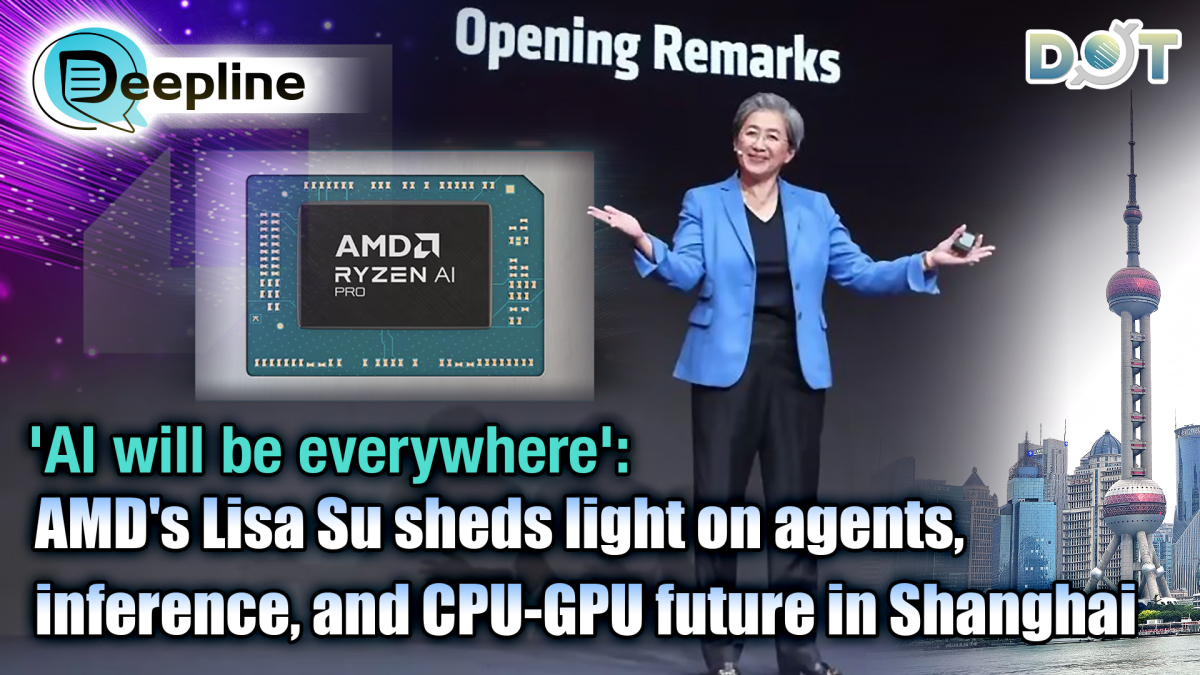
On May 19, Advanced Micro Devices, Inc. (AMD) host its AI Developer Day in Shanghai. During the keynote, AMD Chair and CEO Lisa Su highlighted AI agents and reiterated a point she had emphasized during the company's latest earnings call: CPUs are becoming increasingly critical.
Su noted that the traditional CPU-to-GPU ratio in data centers has been 1:4, but by 2026, it is expected to shift to 1:1.
Throughout the event, the frequency of terms closely tied to AMD's performance, such as CPUs and AI agents, was matched only by the mentions of Chinese tech companies like 01.AI, StepFun, Infinigence, Xiaomi, and Alibaba, whether in presentations or guest speeches.
AMD executives also sought to attract more Chinese customers, pointing out that top developers in China currently spend millions of yuan annually on API calls for complex coding tasks and routine agent tasks. By running a data-center-grade foundational model locally on an AMD workstation, they could significantly cut costs. Industry observers believe that as China's AI industry rapidly expands, the growing computing demands from top-tier enterprises to individual users have turned China into a "major potential customer" for computing power vendors.
In recent years, computing power has become increasingly scarce, elevating the status of companies like Nvidia and AMD. Both Nvidia's GTC conference and AMD's AI Developer Day are now seen as bellwethers of the AI era.
According to Su at the event, the rise of inference and AI agents is driving a shift in computing demand. AI will become ubiquitous, running on every device, with performance requirements that must scale both up and down, and is operating across the entire ecosystem, from large-scale cloud computing to PCs, physical systems, and robotics, she noted.
Su also cited a statistic: over one billion people use AI daily, and predicted that by 2030, this number will rise to five billion.
The arrival of intelligent agents, she added, is fundamentally changing how users interact with AI. The evolution of technology demands not only large language models but also capabilities for reasoning, learning, and data flow—tasks that agents orchestrate and coordinate.
Beyond GPUs, which have been in short supply since the rise of AI, agents also rely heavily on substantial CPU computing power. Su thus believes society is entering a "CPU+GPU" era.
She elaborated on this logic: moving from a "large model-centered" approach to "agent orchestration," the operation of agents depends on reasoning, tool invocation, data processing, and goal management, placing heavy demand on the CPU. While GPUs continue to excel at what they do, the CPU's workload increases significantly in inference scenarios, shifting its role from auxiliary to peer.
This is not the first time AMD has emphasized the growing importance of CPUs. On May 5, AMD reported fiscal Q1 2026 results with revenue of US$10.25 billion and net income of US$1.38 billion, both beating expectations. At that time, AMD revised its long-term market outlook for server CPUs upward, projecting the market to exceed US$120 billion by 2030. Additionally, AMD guided Q2 revenue to a midpoint of US$11.2 billion, with server CPU revenue expected to grow more than 70% year over year.
Notably, AMD competes in CPUs with its EPYC product line and in GPUs with its Instinct series. If the 1:1 prediction holds, AMD stands to be one of the few vendors capable of supplying both product types—and would naturally welcome such a trend.
Moving the AI Developer Day from North America to China naturally involved discussion of the Chinese market.
Su called China home to "the world's most dynamic AI ecosystem." "AMD has been in China for over 30 years. We think of China as the heart driving our roadmap, including silicon, AI software and platform engineering," she said.
She also emphasized that AMD's major R&D hub in Greater China has more than 4,000 engineers, and its Shanghai R&D Center is one of the company's largest globally.
Notably, during a meeting in Beijing on the afternoon of May 18, Su expressed her honor at visiting China, saying that the Chinese market is extremely important. In talks with Ren Hongbin, President of the China Council for the Promotion of International Trade (CCPIT), Su said that computing power has become central to AMD's business and that she is fortunate to maintain strong, stable partnerships with major Chinese collaborators in this field.
The event also featured numerous entrepreneurs, including Kai-Fu Lee, founder and CEO of 01.AI and Chairman of Sinovation Ventures; Zhu Yibo, co-founder and CTO of StepFun; and Wang Yu, founder of Infinigence. Among them, Lee appeared for the longest duration, and AMD's announcement of a joint enterprise agent appliance with 01.AI drew significant media and audience attention.
Beyond the Chinese companies that took the stage, AMD also discreetly acknowledged several domestic tech firms. Jack Huynh, AMD senior vice president and general manager of the computing and graphics group, displayed and quoted Luo Fuli, head of Xiaomi's MiMo LLM team, who said "the age of agents does not belong to those who burn the most computing power, but to those who use it most intelligently." Nick Ni, Senior Director of AI at AMD, also hinted at potential collaboration opportunities.
Ni noted that top Chinese developers currently spend millions of yuan annually on API calls for complex coding and daily agent tasks. Running a data-center-grade foundational model locally on an AMD workstation could drastically reduce those costs.
He also revealed that AMD has optimized its platform for leading Chinese models like Xiaomi MIMO, StepFun, and MiniMax. Using vLLM for local inference speeds exceed human reading rates with no cloud latency, no API bills, and data staying local.
Ni further announced that AMD is launching its first public AI developer cloud specifically for AI developers in China, free of charge. Additionally, through partnerships with ModelScope and Alibaba Cloud, AMD GPUs can now be used directly within the ModelScope Studio environment.
With China's AI industry advancing, the intensifying competition among leading enterprises consumes ever-greater resources, making them "potential major customers" for computing power vendors. According to the latest data from OpenRouter, from April 27 to May 3, global AI LLM total calls reached 23.9 trillion tokens, up 8.6% from the prior week, marking two consecutive weeks of growth.
Among the listed models, Chinese AI models saw weekly calls rise to 7.942 trillion tokens, a 81.7% increase, while US models' weekly calls fell 34.6% to 3.258 trillion tokens. After two weeks, China's AI model weekly call volume once again surpassed that of the United States.
(Source: NBD)
Related News:
Global Lens | Chinese brands going global: Starting with a cup of tea for RMB 7
Deepline | Building rockets on code: How does AI unicorn Cursor catch Musk's attention?




Comment